
Private jet travel offers convenience, privacy, flexibility, and a premium travel experience. Instead of dealing with crowded terminals, long security lines, and rigid commercial airline schedules, private aviation allows travelers to design a journey around their own needs.
However, flying privately does not mean that travel planning can be ignored. Choosing an unsuitable aircraft, overlooking airport logistics, misunderstanding charter costs, or waiting until the last minute can create unnecessary complications.
Whether you are booking your first private jet or regularly use private aviation, understanding the most common planning mistakes can help you enjoy a smoother and more efficient journey.
1. Choosing the Wrong Aircraft for the Trip
One of the most important decisions in private jet travel is selecting an aircraft that fits the requirements of the journey.
Private aircraft come in different sizes and configurations. A light jet may be suitable for a short trip with a small group, while a midsize or heavy jet may be more appropriate for longer flights, larger groups, or travelers carrying substantial luggage.
Before selecting an aircraft, consider:
- Number of passengers
- Flight distance
- Amount and type of luggage
- Cabin space
- Required onboard amenities
- Number of flight hours
- Destination airport requirements
- Need for nonstop travel
Choosing an aircraft based solely on appearance or price can result in an experience that does not meet your expectations.
2. Comparing Only the Advertised Hourly Rate
A common mistake is to compare private jet options solely by their hourly charter rate.
The final cost of a charter can depend on several factors, including aircraft positioning, airport charges, crew expenses, fuel, taxes, overnight requirements, and other operational considerations.
For this reason, travelers should ask for a clear understanding of the overall trip cost rather than assuming that the lowest advertised hourly rate represents the cheapest option.
A transparent quotation should make it easier to understand what is included and whether additional charges may apply.
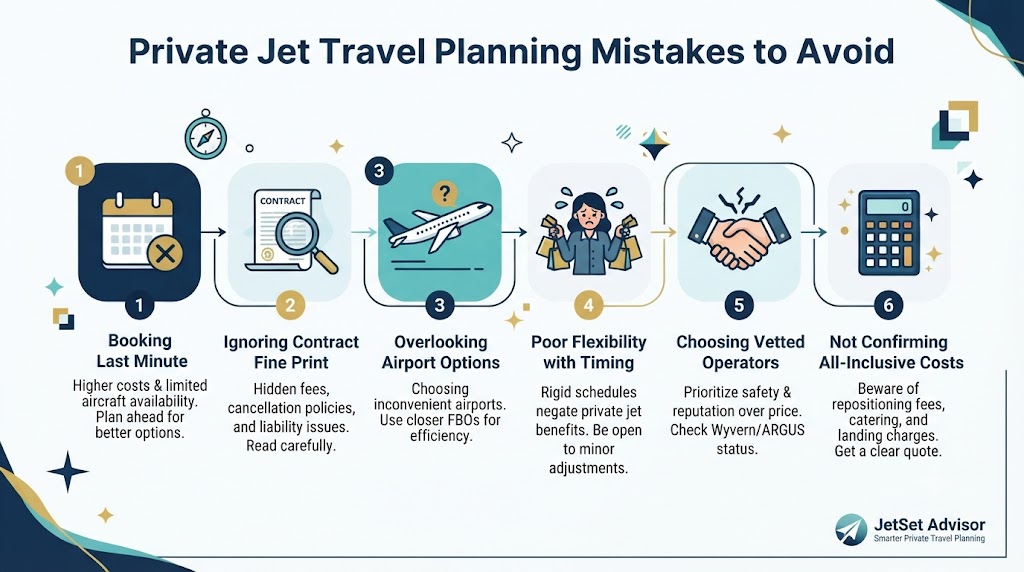
3. Waiting Too Long to Book
Private aviation provides flexibility, but that does not mean every aircraft is immediately available.
Last-minute booking can limit your choices, particularly during busy travel periods, major events, holidays, or popular vacation seasons. You may have fewer aircraft options, less flexibility with departure times, or fewer convenient airports available.
Planning earlier can provide more opportunities to find an aircraft that matches your preferred schedule, passenger requirements, and budget.
For important business trips, family vacations, and international journeys, early planning is especially valuable.
4. Ignoring the Airport Location
Private aircraft can often use airports that are different from the major commercial airport serving a destination.
This can be a major advantage because smaller airports may be closer to the final destination and can provide a more convenient departure experience. However, travelers should still consider the complete ground journey.
Before confirming an airport, evaluate:
- Distance from your home or hotel
- Driving time
- Ground transportation options
- Airport operating restrictions
- Availability for the selected aircraft
- Destination accessibility
The airport that looks closest on a map is not necessarily the most practical choice.
5. Not Providing Accurate Passenger and Luggage Information
Passenger and luggage details are important when arranging a private aircraft.
Travelers should provide accurate information about the number of passengers and the amount and type of luggage they expect to carry. Large suitcases, sporting equipment, musical instruments, specialized equipment, or other oversized items may require additional consideration.
Providing incomplete information can make aircraft selection more difficult and potentially create problems closer to departure.
It is better to discuss luggage requirements during the initial booking process.
6. Overlooking the Importance of Flight Timing
Private jet travel offers greater scheduling flexibility, but the flight still needs to be coordinated with the rest of your itinerary.
For example, a business traveler may need to arrive before an important meeting, while a family may need to coordinate the flight with hotel check-in or a cruise departure.
When planning your trip, consider the complete schedule rather than looking only at the flight itself.
Think about:
- Departure preparation
- Ground transportation
- Meeting times
- Hotel check-in
- Events and appointments
- Return travel
- Destination transportation
A well-planned schedule helps ensure that the advantages of private aviation extend beyond the aircraft itself.
7. Forgetting About Ground Transportation
A private jet can take you closer to your destination, but you still need transportation after landing.
One of the common planning mistakes is arranging the aircraft without considering what happens when you arrive.
Ground transportation should ideally be coordinated with your flight schedule. Depending on the destination, this could involve a private car, chauffeur service, rental vehicle, hotel transfer, or other transportation arrangements.
Planning this in advance reduces waiting time and makes the overall journey more seamless.
8. Not Understanding Charter Terms and Additional Fees
Before confirming a private jet charter, travelers should understand the booking terms.
Depending on the trip and provider, the overall price may be affected by factors such as:
- Aircraft repositioning
- Landing and handling charges
- Crew expenses
- Overnight stays
- De-icing or weather-related operational requirements
- Taxes and applicable fees
- Cancellation conditions
- Schedule changes
Travelers should carefully review the quotation and charter agreement before making a final commitment.
A clear understanding of the terms helps prevent unexpected surprises later.
9. Failing to Communicate Special Requests
One of the advantages of private aviation is the ability to personalize the travel experience. However, special requirements should be communicated early.
These may include:
- Catering preferences
- Dietary requirements
- Pet travel
- Accessibility considerations
- Traveling with children
- Special occasions
- Preferred seating arrangements
- Additional luggage requirements
The earlier these details are communicated, the more effectively the operator or charter provider can prepare for the journey.
10. Choosing a Provider Based Only on Price
Price is an important consideration, but it should not be the only factor when selecting a private aviation provider.
Travelers should also evaluate the provider’s reputation, transparency, aircraft options, operational standards, customer service, and ability to meet specific trip requirements.
A lower initial quote may not always provide the best overall value if the service does not match your expectations.
The goal should be to find the right balance between cost, safety, reliability, aircraft suitability, and service quality.
11. Overlooking International Travel Requirements
International private jet travel requires additional planning.
Depending on the countries involved, travelers may need appropriate passports, visas, customs documentation, immigration clearance, permits, or other travel documentation.
Requirements can vary depending on nationality, destination, aircraft, and itinerary.
Before an international charter, travelers should confirm the documentation and entry requirements that apply to everyone in the traveling party.
Do not assume that private aviation eliminates immigration or customs requirements.
12. Not Planning for Possible Schedule Changes
Private aviation offers considerable flexibility, but flights can still be affected by weather, air traffic, airport restrictions, operational considerations, or other unforeseen circumstances.
Travelers should therefore avoid building an itinerary with no flexibility at all.
If you have an important meeting, event, or connection, allow sufficient time between your flight and the next activity.
Having a contingency plan can make unexpected changes much easier to manage.
13. Assuming Every Private Jet Experience Is the Same
Private jet travel is not a single standardized experience.
Different aircraft offer different cabin configurations, ranges, luggage capacities, seating arrangements, and amenities. Airports and operators can also provide different levels of convenience and service.
For example, a traveler taking a short regional trip may have completely different aircraft requirements from someone planning a long international journey with several passengers.
Understanding these differences helps travelers select an experience that actually matches their needs.
How to Plan a Private Jet Trip the Right Way
Effective private jet planning starts well before the day of departure. A simple step-by-step approach can help travelers avoid many common mistakes.
Step 1: Define Your Trip Requirements
Start by identifying your destination, travel dates, preferred departure time, passenger count, and expected luggage.
Step 2: Determine the Appropriate Aircraft
Consider the flight distance, passenger requirements, cabin preferences, luggage, and desired amenities when evaluating aircraft options.
Step 3: Review Airport Options
Look beyond the main commercial airport. Private aviation may provide access to alternative airports that could be more convenient for your itinerary.
Step 4: Request Transparent Pricing
Ask for a detailed quotation and clarify what is included in the price and what additional charges could apply.
Step 5: Communicate Special Requirements
Tell your charter provider about catering, pets, accessibility requirements, special luggage, or other needs as early as possible.
Step 6: Coordinate Ground Transportation
Arrange transportation to the departure airport and from the destination airport so that your entire journey is connected.
Step 7: Confirm Travel Documentation
For international travel, verify passports, visas, customs, immigration, and other applicable requirements before departure.
Step 8: Review the Final Itinerary
Before traveling, confirm the aircraft, departure airport, departure time, passenger information, destination airport, ground transportation, and other important details.
Private Jet Travel Planning Checklist
Before finalizing your private charter, review the following:
- Destination and travel dates
- Number of passengers
- Preferred departure time
- Appropriate aircraft category
- Luggage requirements
- Departure and arrival airports
- Total charter cost
- Applicable additional fees
- Cancellation and change policies
- Catering requirements
- Pet or accessibility requirements
- Ground transportation
- International travel documents
- Schedule flexibility and contingency plans
This simple checklist can help identify potential problems before they affect your trip.
Why Professional Planning Matters
The value of private aviation goes beyond simply avoiding commercial airline travel. It is about creating a travel experience that fits your schedule, destination, group, and personal preferences.
That experience depends heavily on planning.
When travelers communicate their requirements clearly, select an appropriate aircraft, understand the costs, choose suitable airports, and coordinate transportation and documentation, they are better positioned to take advantage of the flexibility private aviation provides.
For travelers researching private jet charter options, CHARTERKINGS.COM can serve as a resource for understanding private aviation and planning a charter journey around individual travel requirements.
Final Thoughts
Private jet travel can make journeys more convenient, flexible, and personalized, but successful private aviation still requires thoughtful preparation.
The biggest mistakes are often simple ones: choosing an unsuitable aircraft, focusing only on the advertised price, booking too late, ignoring airport accessibility, overlooking luggage requirements, or failing to coordinate ground transportation.
By planning the complete journey—not just the flight—travelers can avoid unnecessary complications and make better decisions.

