
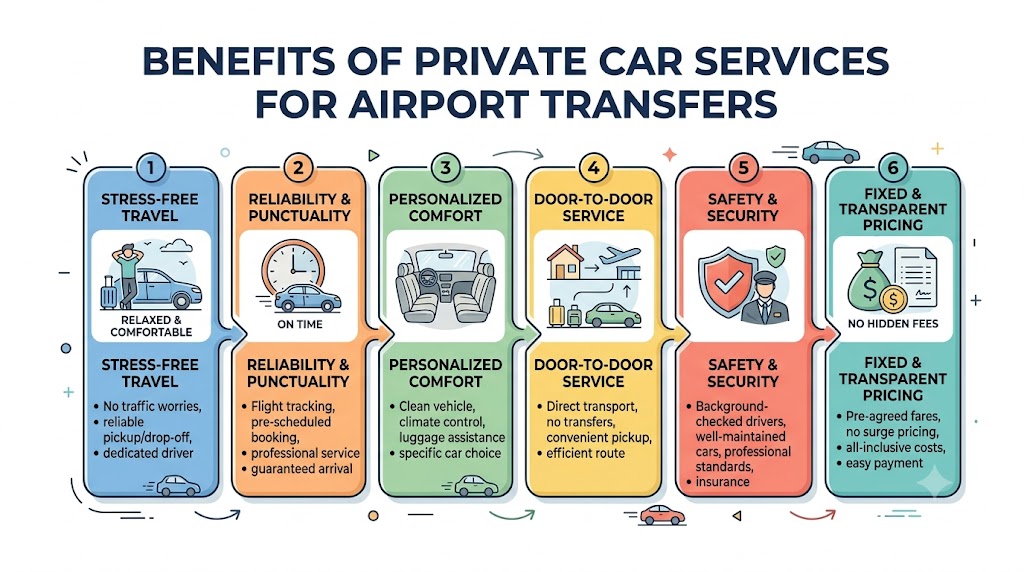
Airport transfers are often treated as a small part of a trip, but they can have a significant effect on the overall travel experience. After a flight, passengers usually want a transfer that is predictable, comfortable, safe, and easy to manage. Private car services provide a structured alternative to taxis, public transportation, rideshare services, or arranging a pickup at the last minute.
A private airport transfer typically involves a pre-arranged vehicle and driver collecting passengers from an agreed pickup location and taking them directly to their destination. Depending on the service, travelers may be able to select the vehicle type, schedule, passenger capacity, luggage requirements, and pickup instructions in advance.
The main value is not simply having a nicer vehicle. It is the predictability and coordination of the entire transfer process.
What Is a Private Airport Car Service?
A private airport car service is a pre-arranged transportation service designed to move passengers between an airport and another destination, such as a hotel, home, office, meeting venue, or another transportation hub.
Unlike shared airport transportation, a private vehicle is generally reserved for one passenger, family, group, or organization.
A typical private airport transfer may include:
- Pre-arranged pickup
- Dedicated vehicle
- Professional driver
- Direct transportation to the destination
- Luggage assistance
- Scheduled pickup time
- Flight information coordination where offered
- Airport pickup instructions
- Vehicle selection
- Customer support
- Corporate or group transportation options
The exact services vary by provider, location, vehicle category, and booking terms.
Why Airport Transfers Require More Planning Than Ordinary Trips
Airport transportation has several characteristics that make reliability particularly important.
Passengers may be dealing with:
- Flight delays
- Baggage collection
- Immigration or customs procedures
- Unfamiliar airports
- Large amounts of luggage
- Children or older travelers
- Tight business schedules
- Late-night or early-morning arrivals
- Unfamiliar roads
- Multiple passengers arriving together
A transportation option that works well for an ordinary city journey may not provide the same level of predictability for an airport transfer.
For this reason, travelers should evaluate an airport car service based on the complete transfer process, rather than judging it only by vehicle appearance or advertised price.
Key Benefits of Private Car Services for Airport Transfers
1. Pre-Arranged Transportation
One of the biggest advantages is knowing that transportation has been organized before reaching the airport.
Instead of leaving the terminal and beginning to search for available transportation, travelers can follow predetermined pickup instructions.
This can be especially useful when:
- Arriving in an unfamiliar city
- Traveling with children
- Carrying several bags
- Arriving late at night
- Traveling for business
- Traveling as part of a group
Pre-arrangement reduces the number of decisions that passengers need to make immediately after a flight.
2. Direct Transportation to the Destination
Private transfers generally take passengers directly from the airport to their specified destination.
This can eliminate unnecessary intermediate stops associated with shared transportation.
For example, a family arriving at an airport may prefer to travel directly to its hotel rather than stopping at several other properties to drop off other passengers.
Direct transportation can be particularly useful when:
- Travelers are tired after a long flight
- The destination is outside the central area
- Passengers have heavy luggage
- A group needs to remain together
- A business traveler has a meeting shortly after arrival
The practical benefit is simple: fewer interruptions between the airport and final destination.
3. Greater Scheduling Predictability
A private transfer can be arranged around a specific flight schedule or requested pickup time.
This does not eliminate the possibility of delays. Airports, airlines, traffic, weather, and baggage handling can all affect travel time.
However, advance scheduling creates a clearer transportation plan.
When booking, travelers should confirm:
- Pickup time
- Pickup location
- Airport terminal
- Flight number, if required
- Driver contact procedure
- Waiting-time policy
- What happens if the flight is delayed
- Cancellation conditions
These details are often more important than the vehicle itself.
4. Convenient Airport Pickup
Navigating an unfamiliar airport while carrying luggage can be frustrating.
A properly organized private transfer should provide clear instructions about where the driver will meet the passenger.
Depending on the provider, pickup may involve:
- Terminal arrivals area
- Designated meeting point
- Curbside pickup
- Parking area
- Meet-and-greet service
- Driver identification procedure
Passengers should not assume that every airport permits vehicles to wait directly outside the baggage claim area. Airport access rules vary.
Clear pickup instructions are therefore an important part of a reliable service.
5. Comfortable Travel After a Flight
Air travel can already be physically demanding. A private vehicle gives passengers an opportunity to continue their journey in a more controlled environment.
Depending on the vehicle category, travelers may have:
- More personal space
- Dedicated seating
- Climate control
- Storage for luggage
- A quieter environment
- Flexible seating arrangements
Comfort becomes particularly relevant on longer airport-to-destination journeys.
For example, someone traveling several hours by air may value the ability to sit comfortably and travel directly to accommodation rather than navigating several transportation changes.
6. Better Luggage Management
Luggage is one of the practical reasons travelers choose private transportation.
Passengers with multiple suitcases, carry-on bags, equipment, or specialized travel items may find public transportation less convenient.
A private vehicle allows travelers to consider luggage capacity before booking.
Before confirming a vehicle, passengers should check:
| Requirement | What to Confirm |
|---|---|
| Number of passengers | Maximum passenger capacity |
| Large suitcases | Available trunk/storage space |
| Carry-on bags | Interior or storage requirements |
| Oversized items | Provider acceptance |
| Special equipment | Vehicle compatibility |
| Child equipment | Availability or customer-supplied equipment |
| Multiple destinations | Whether additional stops are permitted |
The correct vehicle is not necessarily the largest vehicle. It is the vehicle that realistically accommodates the passenger group and its luggage.
7. Useful for Families Traveling Together
Families can face additional transportation challenges at airports.
Parents may need to manage:
- Children
- Strollers
- Car seats
- Multiple suitcases
- Hand luggage
- Different arrival requirements
A private transfer keeps the group together and can reduce the number of transportation changes.
Families should confirm child-seat requirements in advance because availability, legal requirements, and provider policies can differ by location.
The important point is to communicate family requirements during booking rather than assuming they will be available automatically.
8. Practical for Business Travelers
Time management is often a major concern for business travelers.
A private airport transfer can fit into a larger itinerary involving:
- Client meetings
- Conferences
- Office visits
- Hotel check-in
- Business dinners
- Corporate events
A traveler may have limited flexibility after landing. Having transportation arranged in advance can simplify the transition from airport to meeting location.
For corporate travel programs, companies can also establish consistent transportation procedures instead of having every employee arrange airport transportation independently.
9. Helpful for Group Travel
Groups can face difficulties when traveling in multiple vehicles.
Potential problems include:
- Different pickup times
- Different drivers
- Vehicles becoming separated
- Uneven luggage capacity
- Communication problems
- Unclear meeting points
A properly selected private vehicle or coordinated fleet can keep the group transportation plan more organized.
For larger groups, travelers should ask whether the provider offers:
- Multiple coordinated vehicles
- Minivans
- Passenger vans
- Larger group vehicles
- Group dispatch coordination
- Centralized billing
- Dedicated transportation coordinators
The objective should be coordinated movement rather than simply booking several cars independently.
10. Reduced Need to Navigate an Unfamiliar City
After landing in a new city, travelers may not know:
- Which terminal exit to use
- Where taxis queue
- Which transportation areas are legitimate
- How local transit works
- Which roads lead to their accommodation
- How long the journey normally takes
A pre-arranged private transfer can reduce this learning curve.
The traveler can focus on reaching the pickup point and confirming the destination instead of solving the entire transportation problem after landing.
11. Greater Privacy
Private transportation provides a dedicated environment for the passengers who booked the vehicle.
This can matter for:
- Business conversations
- Families
- Individuals who prefer a quieter journey
- Travelers carrying sensitive business materials
- Passengers who simply want personal space
Privacy does not automatically mean complete confidentiality, however. Business travelers should still use appropriate precautions when discussing sensitive information in any transportation environment.
12. Professional Driver Support
A professional airport transfer generally includes a designated driver who is responsible for the journey.
Depending on the service, drivers may assist with:
- Locating the passenger
- Loading luggage
- Navigating the route
- Communicating pickup instructions
- Handling airport access procedures
- Adjusting to reasonable travel disruptions
Driver quality matters significantly. A clean vehicle cannot compensate for poor communication or unreliable service.
When evaluating providers, travelers should therefore consider the driver experience as part of the service, not as a separate issue.
Private Car Service vs. Other Airport Transportation Options
Different transportation methods serve different needs.
| Factor | Private Car | Taxi | Rideshare | Public Transportation | Shared Shuttle |
|---|---|---|---|---|---|
| Pre-arrangement | Usually | Sometimes | Usually through app | Usually not individual | Usually |
| Direct destination | Usually | Usually | Usually | Often requires changes | May include stops |
| Vehicle dedicated to passenger | Yes | Usually | Usually | No | No |
| Luggage convenience | High, depending on vehicle | Variable | Variable | Often lower | Variable |
| Group coordination | Strong | Moderate | Moderate | More difficult | Strong |
| Privacy | High | Moderate | Moderate | Low | Low |
| Pickup predictability | Generally high | Variable | Variable | Route-dependent | Generally scheduled |
| Cost structure | Pre-arranged pricing varies | Metered or fixed depending on location | Dynamic or quoted | Usually lower | Usually moderate |
| Flexibility | High when booked correctly | High | High | Route-dependent | Moderate |
There is no universal transportation option that is appropriate for every traveler.
The right choice depends on factors such as group size, luggage, budget, timing, destination, airport layout, and personal preferences.
How to Choose the Right Private Airport Transfer
Choosing a provider should involve more than comparing advertised prices.
1. Confirm the Complete Price
Ask what the quoted price includes.
Potential additional charges may involve:
- Airport fees
- Waiting time
- Parking
- Additional stops
- Extra passengers
- Oversized luggage
- Late-night service
- Tolls
- Cancellation
- Changes to the itinerary
A lower initial quote may not represent a lower final cost if important services are excluded.
2. Check Vehicle Capacity
Do not choose a vehicle based only on passenger count.
A vehicle that technically seats six passengers may not have enough practical luggage capacity for six people with large suitcases.
Consider both:
Passenger capacity + luggage capacity
This is one of the most common planning mistakes in airport transportation.
3. Understand the Pickup Procedure
Before travel, make sure you know:
- Which terminal
- Which exit
- Which meeting point
- How to identify the driver
- Whether the driver carries a name board
- What phone number to contact
- What to do if the driver cannot be located
Clear instructions reduce unnecessary confusion.
4. Understand Flight Delay Procedures
Flight schedules can change.
Ask the provider:
- Do they track the flight?
- Is the booking connected to the flight number?
- What happens after a delay?
- How much waiting time is included?
- Are additional waiting fees possible?
- What happens after a missed flight?
These questions are particularly important for international arrivals.
5. Review Cancellation and Change Policies
Travel plans can change because of:
- Flight cancellations
- Schedule changes
- Hotel changes
- Weather disruptions
- Medical emergencies
- Business itinerary changes
Understand the cancellation deadline and modification rules before booking.
Operational Considerations for a Smooth Transfer
A good airport transfer starts before the vehicle arrives.
Before the Flight
Confirm:
- Booking details
- Passenger names
- Flight information
- Terminal
- Destination address
- Number of passengers
- Luggage requirements
- Pickup instructions
- Driver contact information
- Payment method
- Cancellation terms
At the Airport
After landing:
- Complete immigration or arrival procedures where applicable.
- Collect luggage.
- Check the designated meeting point.
- Contact the provider if instructions are unclear.
- Confirm the vehicle and driver.
- Verify the destination before departure.
During the Journey
Passengers should:
- Keep important belongings with them.
- Confirm the destination if there are multiple stops.
- Communicate schedule changes promptly.
- Follow local safety requirements.
- Use appropriate child-restraint equipment when required.
Common Mistakes to Avoid
Booking Only Based on Price
Price matters, but it should not be the only consideration.
A transportation service with unclear pickup procedures, restrictive luggage policies, or limited support may create more problems than the savings justify.
Providing Incomplete Flight Information
If the provider uses flight information to coordinate pickup, an incorrect flight number can create confusion.
Double-check the details before submitting the booking.
Underestimating Luggage
A group can have fewer passengers but still require a larger vehicle because of luggage.
Always consider the actual bags being transported.
Ignoring Airport Pickup Rules
Airport pickup locations can differ considerably.
Read the provider’s pickup instructions rather than assuming the driver can meet you anywhere outside the terminal.
Not Checking Waiting-Time Policies
A delayed flight can change the timing of an airport transfer.
Understand what waiting period is included and what happens afterward.
Assuming Every Vehicle Has the Same Features
Vehicle availability varies.
If a specific requirement matters, confirm it before booking instead of assuming it will be provided.
Safety and Reliability Considerations
Private transportation should also be evaluated from a safety perspective.
Travelers can ask whether the provider maintains:
- Properly maintained vehicles
- Appropriate insurance
- Qualified drivers
- Driver identification procedures
- Customer support
- Clear booking records
- Secure payment processes
- Emergency contact procedures
Passengers should also verify that the vehicle selected is appropriate for the number of travelers and luggage being carried.
For families, child-restraint requirements should be confirmed in advance.
For corporate travelers, organizations may additionally want to establish approved transportation providers and standardized booking procedures.
When Private Airport Transfers Make the Most Sense
Private car services can be particularly useful when:
You Are Traveling With a Family
Children, luggage, and multiple passengers can make transportation changes inconvenient.
You Have a Tight Schedule
A pre-arranged transfer can simplify the transition between the airport and your next appointment.
You Are Carrying Significant Luggage
A dedicated vehicle may provide more practical storage than some public transportation options.
You Are Traveling as a Group
Keeping passengers together can simplify logistics.
You Are Visiting an Unfamiliar Destination
Pre-arranged transportation reduces the amount of transportation planning required after arrival.
You Arrive at an Inconvenient Time
Early-morning or late-night arrivals may make transportation planning more important.
You Want a More Controlled Travel Experience
A private vehicle provides greater control over the immediate airport-to-destination journey.
When a Private Car May Not Be Necessary
Private transfers are not automatically the best fit for every journey.
Public transportation may make more sense when:
- The airport has convenient rail or bus connections.
- The traveler has minimal luggage.
- The destination is close to a major transit route.
- Budget is the primary consideration.
- The traveler is comfortable navigating public transit.
A taxi or rideshare may also be appropriate when:
- The journey is spontaneous.
- The passenger does not need advance coordination.
- The airport has an efficient regulated taxi system.
- The traveler is comfortable managing pickup through an app or taxi queue.
The decision should reflect the traveler’s actual requirements rather than the perceived status of the transportation option.
Decision Framework for Choosing Airport Transportation
A simple decision process can help.
| Requirement | Private Car | Public Transit | Taxi/Rideshare | Shared Shuttle |
|---|---|---|---|---|
| Advance planning is important | Strong fit | Moderate | Moderate | Strong fit |
| Large luggage load | Often suitable | May be inconvenient | Variable | Variable |
| Family travel | Often suitable | Depends on route | Suitable | Suitable |
| Large group | Suitable with correct vehicle | More coordination required | Multiple vehicles may be needed | Often suitable |
| Maximum budget sensitivity | May not be ideal | Often suitable | Variable | Often suitable |
| Direct destination required | Strong fit | Route-dependent | Strong fit | May involve stops |
| Privacy required | Strong fit | Low | Moderate | Low |
| Unfamiliar destination | Convenient | Requires navigation | Moderate | Convenient |
This framework should be treated as a planning aid rather than a universal rule.
A Practical Airport Transfer Checklist
Before booking:
- Confirm the airport and terminal.
- Confirm arrival or departure time.
- Provide accurate flight information where requested.
- Count passengers.
- Count and assess luggage.
- Select an appropriate vehicle.
- Confirm the pickup location.
- Check waiting-time policies.
- Check cancellation and modification rules.
- Confirm the complete price.
- Verify payment arrangements.
- Save the driver’s contact information.
- Review airport-specific pickup instructions.
- Confirm special requirements in advance.
Before leaving the airport:
- Collect all luggage.
- Check the designated meeting point.
- Confirm the driver and vehicle.
- Keep essential personal items with you.
- Verify the destination.
- Communicate significant changes promptly.
Final Recommendation
The main benefit of a private car service for an airport transfer is predictable, coordinated transportation from the airport to the intended destination. It can reduce the practical difficulties associated with luggage, unfamiliar locations, group travel, tight schedules, and airport navigation. The value is greatest when travelers prioritize convenience, direct transportation, privacy, and advance planning. However, the right service depends on the trip, so passengers should compare total cost, vehicle capacity, pickup procedures, waiting policies, cancellation terms, and provider reliability rather than focusing only on price. A well-planned airport transfer should make the journey simpler without introducing unnecessary complexity.
FAQs
Q1. What are the main benefits of using a private car for an airport transfer?
The main benefits include pre-arranged transportation, direct travel, easier luggage handling, greater privacy, convenient pickup, and better coordination for families, groups, and business travelers.
Q2. Is a private airport transfer suitable for families?
Yes. Private transfers can be convenient for families because everyone can travel together with their luggage. Families should confirm vehicle capacity and any child-seat requirements before booking.
Q3. Can private airport services accommodate large amounts of luggage?
Many services offer vehicles with different luggage capacities, but this varies by vehicle. Travelers should provide accurate information about the number and size of their bags before confirming the booking.
Q4. Are private airport transfers more expensive than public transportation?
They can be, particularly when compared with buses or trains. However, the comparison should consider the total cost and convenience, including the number of travelers, luggage, additional transfers, and time involved.
Q5. What should travelers ask about flight delays?
Travelers should ask whether the provider monitors flight information, how much waiting time is included, whether delay-related charges apply, and what happens if the flight is cancelled or significantly rescheduled.
Q6. How early should a private airport transfer be booked?
Booking requirements vary by provider and destination. Advance booking is generally useful when travelers have specific vehicle requirements, large groups, significant luggage, or an important schedule to maintain.
Q7. What information is normally required when booking?
Common information includes the airport, terminal, flight details, pickup time, destination, passenger count, luggage requirements, contact information, and any special transportation requirements.
Q8. What is the most important thing to check before booking?
Do not focus only on the vehicle. Confirm the complete service arrangement, including pickup location, vehicle capacity, pricing, waiting policy, cancellation terms, driver contact procedure, and any special requirements.
Q9. Are private airport transfers useful for business travelers?
They can be useful when a traveler has meetings, appointments, conferences, or other time-sensitive activities after landing. Advance coordination can reduce transportation-related uncertainty.
Q10. What makes a private airport transfer reliable?
Reliability depends on several factors, including accurate booking information, clear pickup instructions, appropriate vehicle selection, driver communication, reasonable contingency procedures, transparent policies, and proper coordination with the passenger’s itinerary.
Q11. Should travelers choose the largest available vehicle?
Not necessarily. The appropriate vehicle should comfortably accommodate the passengers and their luggage while matching the actual requirements of the trip.
Q12. What should travelers do if they cannot find their driver?
They should follow the provider’s designated meeting-point instructions and use the official contact procedure supplied with the booking. They should avoid making assumptions about where the driver is waiting.
Conclusion
Private car services can make airport transfers easier by combining advance planning, direct transportation, luggage convenience, and dedicated service. They are particularly useful for families, groups, business travelers, and passengers visiting unfamiliar destinations. The strongest benefit is not simply comfort but reduced transportation uncertainty. Before booking, travelers should verify the vehicle, total cost, pickup process, waiting policy, cancellation terms, and special requirements. With those details confirmed, a private airport transfer can become a straightforward and well-coordinated part of the overall journey.

