
Introduction
Helicopter charter travel can make short regional journeys, remote destinations, business transfers, sightseeing trips, and time-sensitive travel considerably more practical. However, planning a helicopter flight involves different considerations from booking a conventional airline journey. Aircraft size, passenger weight, baggage, weather, landing-site restrictions, operating limitations, and local procedures can all affect the final plan.
For passengers, the most important principle is simple: good charter planning is not only about choosing a convenient departure time and destination. It is about giving the operator accurate information early enough to build a safe and workable flight plan.
A passenger should understand the operator, aircraft, baggage limitations, meeting arrangements, weather flexibility, passenger briefing, and emergency procedures before arriving at the departure point.
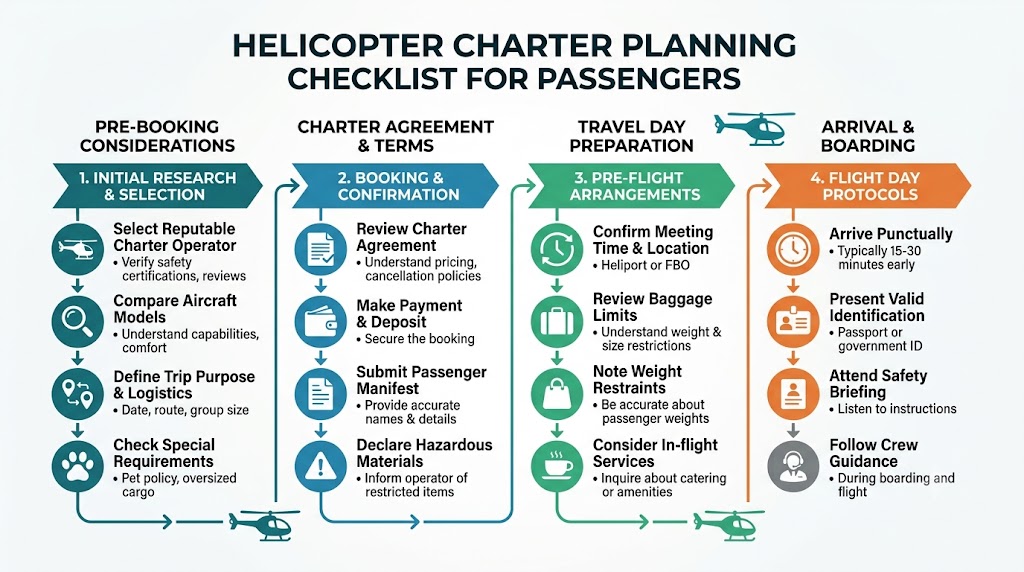
This checklist provides a practical framework for planning a helicopter charter from the initial inquiry through arrival.
1. Start With the Actual Travel Requirement
Before contacting a helicopter charter operator, define exactly what you need.
Record:
- Departure location
- Destination
- Preferred departure time
- Required arrival time
- Number of passengers
- Approximate passenger weights
- Baggage requirements
- One-way or return travel
- Desired waiting time, if applicable
- Intermediate stops
- Special mobility requirements
- Children or elderly passengers
- Pets, if applicable
- Any unusual equipment or luggage
- Whether the flight involves an offshore, mountainous, remote, or otherwise specialized destination
Do not assume that a helicopter can simply operate between any two convenient points.
The actual routing may depend on:
- Available landing facilities
- Local permissions
- Weather
- Terrain
- Aircraft performance
- Fuel requirements
- Airspace restrictions
- Operating limitations
- Day/night requirements
- Landing-site suitability
A good initial inquiry gives the operator enough information to determine whether the requested journey is operationally practical.
2. Choose a Legitimate Charter Operator
One of the most important passenger responsibilities is confirming that the company you are booking with is actually authorized to conduct the proposed charter operation.
In the United States, the FAA specifically advises passengers to verify an operator’s authorization and warns about illegal charter operations. It also identifies lack of proper safety information and evasiveness about operational questions as warning signs.
For international travel, the relevant aviation authority and applicable national regulations will differ.
Passenger verification checklist
Before paying a deposit, ask:
- Who is the actual operating company?
- Who will operate the helicopter?
- Is the operator authorized to conduct commercial charter flights?
- What type of aircraft will be used?
- Is the aircraft suitable for the requested passenger and baggage load?
- Who is responsible for operational control?
- What happens if the advertised aircraft becomes unavailable?
- What safety briefing will passengers receive?
- What documentation will be provided before departure?
Be cautious when:
- The company cannot clearly identify the actual operator.
- The contract is vague about who is conducting the flight.
- The price appears unusually low without a clear explanation.
- The operator avoids reasonable safety questions.
- The company asks passengers to describe the flight inaccurately to officials.
- There is no clear passenger briefing process.
A legitimate charter provider should be able to explain its operating arrangements clearly.
3. Confirm the Helicopter Type
The phrase “helicopter charter” does not describe a single type of aircraft.
Different helicopters have different:
- Passenger capacities
- Cabin dimensions
- Baggage compartments
- Performance characteristics
- Range
- Noise levels
- Weather limitations
- Landing requirements
- Payload capabilities
The aircraft selected for a short executive transfer may be very different from one required for a remote-area operation.
Ask the operator
- What helicopter type is planned?
- How many passenger seats are available?
- How much baggage can realistically be carried?
- Is the cabin suitable for all passengers?
- Is the aircraft configured for the intended mission?
- Could the aircraft type change before departure?
- What happens if the replacement aircraft has different baggage or seating limitations?
Do not select an aircraft solely because its advertised passenger capacity appears sufficient.
4. Provide Accurate Passenger Information
Passenger information affects flight planning.
Give the operator accurate information about:
- Number of passengers
- Approximate weight of each passenger
- Baggage weight
- Number of bags
- Special equipment
- Mobility devices
- Child passengers
- Any other significant payload
This information is operationally relevant because helicopter performance depends on the combination of aircraft weight, environmental conditions, fuel requirements, and other factors.
Do not underestimate your baggage
A common planning mistake is saying:
“We only have a few bags.”
The number of bags is not enough information.
A few large cases may create a greater payload problem than several small bags.
For each passenger, consider:
| Item | Information to provide |
|---|---|
| Passenger | Approximate body weight |
| Carry-on | Number and approximate weight |
| Checked baggage | Number and approximate weight |
| Special equipment | Type and dimensions |
| Mobility equipment | Type, weight, folding requirements |
| Other items | Camera equipment, sports equipment, business equipment, etc. |
The operator can then determine what can actually be carried.
5. Understand Weight and Balance
Weight and balance are not administrative details.
They directly affect aircraft performance and handling.
The operator must consider factors such as:
- Passenger weight
- Baggage
- Fuel
- Aircraft configuration
- Center of gravity
- Temperature
- Elevation
- Wind
- Route requirements
- Landing-site conditions
A helicopter may have enough seats for a group while still having payload limitations that affect how much baggage or fuel can be carried.
Passenger planning rule
Never assume that a full cabin automatically means a full baggage allowance.
If the operator asks for passenger weights or baggage details, provide them accurately rather than treating the request as optional paperwork.
6. Confirm Baggage Restrictions Before Travel
Helicopter baggage arrangements can differ substantially from airline travel.
Before departure, ask:
- What is the maximum baggage allowance?
- Is there a weight limit per passenger?
- Is there a total baggage limit?
- Are hard-shell cases permitted?
- Are large suitcases permitted?
- Are backpacks easier to accommodate?
- Is there a separate baggage compartment?
- Are fragile items accepted?
- Are oversized items permitted?
- Are there restrictions on loose equipment?
Some helicopters have compact baggage areas, while others may have very limited cabin storage.
Pack for the aircraft, not for an airline
Avoid arriving with:
- Oversized luggage
- Heavy hard cases
- Unsecured loose equipment
- Bulky sports equipment
- Items the operator has not approved
Ask about baggage dimensions as well as weight.
7. Check Special-Item Requirements
Tell the operator about anything unusual before the day of travel.
Examples include:
- Professional camera equipment
- Musical instruments
- Sports equipment
- Large backpacks
- Medical equipment
- Mobility devices
- Child equipment
- Work equipment
- Fragile equipment
- Specialized cases
Some items may require additional planning or may not be permitted in a particular aircraft configuration.
If an item is important to the trip, get confirmation before packing it.
8. Confirm the Departure Location
“Airport” is not always an adequate description for a helicopter departure.
The flight may operate from:
- Heliport
- Airport
- Private landing facility
- Hotel helipad
- Business facility
- Remote landing area
- Approved temporary landing site
The meeting point may also be different from the location shown in a general map application.
Confirm:
- Exact meeting location
- Passenger check-in point
- Required arrival time
- Parking arrangements
- Security requirements
- Identification requirements
- Access restrictions
- Ground transportation
- Contact number for the day of travel
For busy facilities, ask whether a specific terminal, gate, office, or reception area should be used.
9. Allow Extra Time at the Departure Point
Helicopter travel is often marketed around time savings, but that does not mean passengers should arrive immediately before departure.
Allow time for:
- Check-in
- Identification or security procedures
- Baggage handling
- Passenger briefing
- Aircraft preparation
- Weather or operational updates
- Boarding instructions
The operator may specify a particular arrival time. Follow that instruction rather than assuming the normal airline check-in process applies.
10. Understand Weather Flexibility
Weather is one of the most important variables in helicopter operations.
Conditions that may affect the flight include:
- Visibility
- Cloud ceiling
- Rain
- Thunderstorms
- Wind
- Gusts
- Fog
- Icing conditions
- Temperature
- Terrain-related weather
- Weather along the route
- Weather at the destination
Weather decisions belong to the flight crew and operator, not the passenger.
A passenger’s schedule may be fixed, but the aircraft still has to operate within applicable safety and operational limits.
Ask before booking
- What happens if weather prevents departure?
- How early will weather decisions normally be communicated?
- Can the departure time be moved?
- Is rescheduling available?
- What happens if the destination becomes unsuitable?
- Are refunds or credits available?
- Who makes the final operational decision?
The exact answer depends on the operator’s contract and operating procedures.
11. Do Not Pressure the Crew to Fly
This is one of the most important practical rules for passengers.
If the pilot determines that conditions are unsuitable, the correct response is not to ask the pilot to “just try.”
Commercial helicopter operations involve professional judgment regarding weather, aircraft performance, route conditions, landing areas, and other operational factors.
A passenger’s appointment, event, meeting, or connection does not override those considerations.
A good passenger attitude is:
“If the conditions are not suitable, we will follow the operator’s safety decision.”
This makes the relationship with the operator much clearer.
12. Confirm the Landing Site
The destination needs to be operationally suitable, not merely geographically convenient.
Ask whether the proposed landing location is:
- Approved or authorized where required
- Suitable for the helicopter type
- Available at the planned time
- Accessible to passengers
- Subject to local restrictions
- Weather dependent
- Restricted by operating hours
For private properties, hotels, resorts, construction sites, remote areas, or event venues, the operator may need additional information or permissions.
Consider the final ground journey
A helicopter can reduce airborne travel time while still leaving a complicated ground transfer.
Check:
- Distance from landing site to final destination
- Ground transportation
- Pickup arrangements
- Access restrictions
- Waiting arrangements
- Luggage transfer
The best landing point is the one that works for the entire journey, not simply the one closest to the destination on a map.
13. Confirm Passenger Eligibility and Special Needs
Tell the operator about passengers who may require additional assistance.
Examples include:
- Young children
- Elderly passengers
- Mobility limitations
- Hearing difficulties
- Visual limitations
- Language barriers
- Passengers unfamiliar with aircraft
- Passengers who may have difficulty climbing into the aircraft
Do this during booking, not at the aircraft.
The operator can then determine what assistance and procedures are appropriate.
14. Children Require Additional Planning
Children should not be treated as miniature adults during helicopter planning.
Ask the operator about:
- Minimum passenger age
- Seating arrangements
- Restraint requirements
- Child safety equipment
- Boarding procedures
- Supervision requirements
- Cabin behavior expectations
Never assume that an airline’s child-travel procedures automatically apply to a helicopter.
Follow the specific operator’s instructions.
15. Understand Seating Arrangements
Helicopter seating may differ considerably from airline seating.
Ask:
- Are seats assigned?
- Can passengers choose seats?
- Does everyone have a window?
- Are certain seats restricted?
- Can passengers sit next to children?
- Are seat changes permitted after boarding?
Do not change seats without following the crew’s instructions.
Passenger positioning can be relevant to weight distribution, visibility, access, and operational considerations.
16. Prepare for Noise
Helicopters are generally much louder inside the cabin than conventional passenger aircraft.
A headset or other approved communication system may be provided.
Passengers should:
- Wear the provided headset correctly.
- Keep conversations appropriate.
- Follow crew instructions.
- Avoid touching unfamiliar controls.
- Understand how to communicate with the pilot or crew.
FAA passenger briefing guidance emphasizes passenger understanding of headset use and flight-relevant communication procedures.
17. Understand the Passenger Briefing
A professional operator should provide safety instructions before flight.
The briefing should cover the procedures relevant to that aircraft and operation.
Important topics can include:
- Seatbelts
- Doors
- Emergency exits
- Emergency equipment
- Passenger conduct
- Rotor hazards
- Boarding procedures
- Disembarkation procedures
- Communication with the pilot
- Emergency procedures
FAA helicopter safety guidance emphasizes the importance of briefing passengers before they approach the aircraft and ensuring they understand safe boarding, disembarkation, rotor hazards, restraints, and emergency procedures.
Do not treat the briefing as optional
Even if you have flown in helicopters before, aircraft layouts and procedures can differ.
Listen to the briefing for that particular aircraft and flight.
18. Learn How to Approach the Helicopter
This is one of the most important helicopter-specific passenger safety issues.
Passengers should never decide independently how to approach or leave a running helicopter.
Follow the pilot’s or ground marshaller’s instructions.
FAA guidance specifically advises passengers to remain where the pilot can see them, avoid approaching the tail boom, and enter the helicopter only as instructed.
Before boarding
- Wait for permission.
- Stay with the designated escort or marshaller.
- Remain visible to the pilot.
- Follow the instructed route.
- Keep clothing and loose items controlled.
- Do not approach the rear of the helicopter.
- Do not walk toward the helicopter independently.
Never assume
“I’ve done this before” does not make it safe to improvise.
Rotorcraft layouts and operating procedures vary.
19. Secure Loose Items
Loose objects can become a distraction or create hazards around an aircraft.
Secure:
- Hats
- Scarves
- Phones
- Bags
- Documents
- Clothing
- Camera accessories
- Other loose objects
FAA passenger briefing guidance specifically emphasizes securing loose items before boarding and ensuring baggage does not interfere with flight controls or critical equipment.
A passenger should never place an object somewhere merely because it is convenient.
20. Follow Seatbelt Instructions
Keep the restraint secured as instructed by the crew.
Before departure, make sure you understand:
- How the belt operates
- How to tighten it
- How to release it
- When it must remain fastened
- Whether shoulder restraints are required
Do not unfasten the restraint simply because the helicopter appears to be flying smoothly.
FAA passenger guidance recommends remaining properly restrained while seated.
21. Understand Emergency Exits
Before takeoff, identify the applicable emergency exits and understand how they operate.
Do not assume the exit nearest you works exactly like an airline aircraft door.
The briefing should explain the relevant procedures for the helicopter being used.
Remember
In an emergency, passengers should follow crew instructions unless immediate circumstances require otherwise.
FAA helicopter passenger guidance also emphasizes understanding emergency egress procedures and waiting for the rotors to stop before leaving except in circumstances such as fire or smoke where immediate evacuation may be necessary.
22. Know Where Emergency Equipment Is Located
Depending on the aircraft and operation, equipment may include:
- Fire extinguisher
- First-aid equipment
- Life preservers
- Emergency exits
- Emergency locator equipment
- Other required safety equipment
You do not need to memorize an aircraft manual.
You do need to pay attention to the operator’s passenger briefing.
23. Understand Water Operations
If the helicopter will operate over or near water, ask about the applicable safety equipment and procedures.
Depending on the operation, passengers may need information about:
- Life preservers
- Emergency exits
- Water evacuation
- Emergency communications
- Passenger restraints
- Post-landing procedures
Do not assume that normal land-operation procedures automatically apply.
24. Check Communication Procedures
Passengers should know how to communicate with the crew.
Ask:
- How do I speak to the pilot?
- Is there an intercom button?
- Should passengers remain quiet during certain phases?
- How do I report a problem?
- What should I do if I cannot hear the instructions?
The concept commonly known as a sterile cockpit means that unnecessary conversation should be avoided during phases of flight when crew concentration is particularly important.
FAA helicopter passenger guidance specifically recommends explaining headset use and flight-relevant communication expectations.
25. Understand Electronic Device Rules
Do not assume that a smartphone or camera can be used without restriction.
Ask the operator about:
- Phone use
- Camera use
- Video recording
- Headphones
- Bluetooth devices
- Portable electronics
- Flash photography
- Device charging
The operator may have restrictions based on the aircraft, equipment, operating environment, or company procedures.
Follow the operator’s instructions rather than relying on general airline assumptions.
26. Photography Requires Extra Awareness
Helicopter flights are attractive photography opportunities, but passengers should not allow photography to interfere with safety.
Avoid:
- Removing restraints to take photographs
- Moving between seats without permission
- Holding large objects where they could obstruct another passenger
- Dropping anything
- Distracting the pilot
- Opening doors or windows without authorization
- Using equipment in a way that conflicts with crew instructions
FAA passenger guidance specifically warns passengers not to drop objects from helicopters.
27. Plan Clothing Carefully
Helicopter travel is not the place for clothing that can easily become loose or difficult to manage.
Consider:
- Secure clothing
- Comfortable footwear
- Minimal loose accessories
- Clothing appropriate for the weather
- Protection from sun or cold where relevant
Avoid carrying unnecessary loose items.
Your clothing should allow you to follow boarding and disembarkation instructions comfortably.
28. Consider Motion and Passenger Comfort
Helicopter flights can involve different sensations from airline travel.
Passengers may experience:
- Vibration
- Noise
- Turns
- Changes in altitude
- Turbulence
- Visual motion
- Cabin temperature changes
If someone in the group is uncomfortable with motion or flying, tell the operator in advance and ask what passenger-comfort measures are appropriate.
Do not assume that the passenger experience will be identical to an airline flight.
29. Review the Commercial Terms
Safety planning should be accompanied by careful contract planning.
Before payment, confirm:
- Total price
- Taxes and fees
- Deposit
- Cancellation policy
- Weather cancellation policy
- Rescheduling terms
- Waiting charges
- Ground transportation charges
- Landing fees
- Additional stops
- Additional flight time
- Baggage limitations
- Aircraft substitution terms
Pay particular attention to weather clauses
A charter may be cancelled or delayed for operational reasons even when the weather looks acceptable from the passenger’s location.
Ask:
Who determines whether the flight can safely operate?
The answer should be clear.
30. Confirm the Cancellation Policy
Helicopter charters can involve aircraft, crew, landing permissions, and other resources arranged specifically for the passenger.
Understand:
- How far in advance you can cancel.
- What happens if you cancel.
- What happens if the operator cancels.
- What happens if weather prevents the flight.
- Whether a deposit is refundable.
- Whether the flight can be rescheduled.
- Whether an alternative aircraft can be offered.
Do not wait until the day of travel to read these conditions.
31. Prepare a Backup Plan
A good helicopter itinerary has a Plan B.
Possible alternatives include:
- Later departure
- Earlier departure
- Different landing location
- Ground transportation
- Commercial airline connection
- Overnight accommodation
- Rescheduled charter
The backup plan becomes particularly important when the helicopter flight is connected to:
- Business meetings
- Events
- Cruises
- Remote accommodation
- Medical appointments
- International connections
- Time-sensitive transfers
Do not build a schedule where a small helicopter delay causes the entire trip to fail.
32. Understand the Difference Between Passenger Preference and Operational Authority
Passengers can specify:
- Preferred time
- Preferred route where practical
- Destination
- Number of passengers
- Baggage requirements
- Service preferences
But passengers should not dictate:
- Unsafe weather decisions
- Aircraft operating decisions
- Minimum safety margins
- Emergency procedures
- Pilot operational judgment
The pilot in command has operational responsibilities that cannot be replaced by passenger preferences.
33. Confirm the Actual Flight Details Before Departure
A final confirmation should verify:
| Item | Confirm |
|---|---|
| Date | Correct |
| Departure time | Correct |
| Departure location | Exact |
| Destination | Correct |
| Passenger count | Correct |
| Passenger information | Updated |
| Baggage | Approved |
| Aircraft | Confirmed where possible |
| Meeting point | Confirmed |
| Weather status | Operator’s latest assessment |
| Ground transport | Arranged |
| Emergency contact | Available |
| Payment | Completed as required |
If any material detail has changed, notify the operator.
34. Day-of-Flight Checklist
Before Leaving for the Departure Point
- Confirm the flight is still scheduled.
- Check the operator’s latest instructions.
- Confirm meeting location.
- Confirm required arrival time.
- Bring required identification.
- Pack only approved baggage.
- Remove unnecessary loose items.
- Keep the operator’s contact details accessible.
- Have a backup plan for significant delays.
At the Departure Location
- Check in as instructed.
- Identify yourself to the appropriate staff.
- Follow security procedures.
- Keep baggage under control.
- Attend the safety briefing.
- Ask questions if something is unclear.
- Wait for boarding instructions.
- Do not approach the helicopter independently.
During Boarding
- Wait for permission to approach.
- Stay within the pilot’s or marshaller’s view.
- Follow the designated route.
- Keep loose items secured.
- Do not approach the rear of the helicopter.
- Enter only as instructed.
- Sit in the assigned position.
- Secure your restraint.
- Put baggage where instructed.
During Flight
- Keep restraints secured as instructed.
- Follow crew instructions.
- Use the headset correctly.
- Keep unnecessary conversation to a minimum when requested.
- Keep loose items secured.
- Do not interfere with aircraft controls.
- Follow electronic-device restrictions.
- Report safety concerns to the crew.
Before Landing
- Remain seated as instructed.
- Keep restraints secured.
- Prepare belongings only when permitted.
- Listen to arrival instructions.
- Do not open doors independently.
After Landing
- Wait for instructions before unfastening restraints.
- Wait for the pilot or marshaller to authorize exit.
- Follow the designated exit route.
- Stay clear of rotor hazards.
- Collect baggage only when instructed.
- Follow ground transportation instructions.
FAA guidance emphasizes that passengers should not independently exit a helicopter and should follow marshalling or crew instructions, particularly around operating rotors.
35. Common Helicopter Charter Planning Mistakes
Mistake 1: Booking Based Only on Price
The cheapest quote may not represent the same aircraft, service, operating arrangement, baggage allowance, or cancellation terms.
Better approach
Compare the complete proposal rather than the headline price.
Mistake 2: Giving an Inaccurate Passenger Count
Adding another passenger later may affect aircraft selection or payload planning.
Better approach
Provide the most accurate passenger count possible when requesting the quotation.
Mistake 3: Underestimating Baggage
Passengers often think about the number of bags rather than their total weight and dimensions.
Better approach
Describe both baggage quantity and approximate weight.
Mistake 4: Assuming Airline Procedures Apply
Helicopter operations have different boarding, seating, baggage, and safety procedures.
Better approach
Treat the helicopter operator’s briefing as the controlling passenger guidance.
Mistake 5: Ignoring Weather Flexibility
A tightly scheduled itinerary can become difficult if there is no contingency.
Better approach
Build reasonable flexibility into important journeys.
Mistake 6: Arriving With Oversized Equipment
Large cases or specialized equipment can create problems after the aircraft has already been selected.
Better approach
Declare unusual equipment before booking.
Mistake 7: Approaching the Aircraft Without Permission
This is one of the most serious passenger behavior errors.
Better approach
Wait for the pilot, crew member, or marshaller to provide instructions.
Mistake 8: Treating the Safety Briefing as Routine
Familiarity with helicopters does not eliminate the need to understand the specific aircraft’s procedures.
Better approach
Listen to every briefing.
Mistake 9: Pressuring the Pilot About Weather
Passengers sometimes focus on the appointment waiting at the destination.
Better approach
Allow the flight crew to make operational decisions based on the conditions and applicable procedures.
Mistake 10: Forgetting the Ground Journey
The helicopter may save significant airborne time while leaving passengers far from their final destination.
Better approach
Plan the complete door-to-door journey.
36. A Practical Charter Decision Framework
When evaluating a helicopter charter, consider five areas.
| Area | Questions to Ask |
|---|---|
| Operator | Who actually operates the aircraft? |
| Aircraft | Is the helicopter suitable for the passengers, baggage, and route? |
| Operation | Are weather, landing site, timing, and permissions workable? |
| Passenger | Can everyone safely follow the boarding and flight procedures? |
| Commercial | Are price, cancellation, delay, and rescheduling terms clear? |
A charter should be considered as a complete operating package, not simply as a seat from Point A to Point B.
37. Passenger Risk Review
Before confirming the booking, ask:
Operational
- Is the route practical?
- Is the destination suitable?
- Is the requested schedule realistic?
- Is weather flexibility available?
Aircraft
- Is the aircraft type appropriate?
- Is the passenger load confirmed?
- Is the baggage load acceptable?
Safety
- Is the operator properly authorized?
- Will passengers receive a safety briefing?
- Are boarding and disembarkation procedures clear?
- Are emergency procedures explained?
Commercial
- Is the full price understood?
- Are cancellation terms clear?
- Are weather-related changes addressed?
- Are additional charges identified?
Logistics
- Is the meeting point clear?
- Is ground transportation arranged?
- Is there enough schedule flexibility?
38. What a Well-Planned Charter Looks Like
A properly planned passenger charter typically has:
- A clearly identified operator.
- A confirmed aircraft arrangement.
- Accurate passenger and baggage information.
- A realistic itinerary.
- An appropriate departure and landing location.
- Clear weather and cancellation procedures.
- A documented commercial agreement.
- A passenger safety briefing.
- Clear boarding and disembarkation instructions.
- A contingency plan for delays or cancellation.
The passenger does not need to manage the pilot’s technical flight planning. The passenger’s role is to provide accurate information, understand the operator’s instructions, and avoid creating preventable operational problems.
39. The Complete Helicopter Charter Passenger Checklist
Booking
- Define the complete journey.
- Confirm passenger count.
- Provide accurate passenger information.
- Estimate baggage weight and dimensions.
- Identify special equipment.
- Confirm destination and landing requirements.
- Verify the operator.
- Confirm aircraft type or aircraft category.
- Review the quotation.
- Review cancellation and weather terms.
Before Travel
- Confirm departure location.
- Confirm arrival time at the facility.
- Confirm identification requirements.
- Confirm baggage restrictions.
- Confirm special assistance.
- Confirm child requirements.
- Check the latest operator instructions.
- Prepare a contingency plan.
At the Heliport
- Follow check-in procedures.
- Keep baggage controlled.
- Attend the passenger briefing.
- Ask questions.
- Wait for boarding authorization.
- Follow the marshaller or crew.
Boarding
- Remain visible to the pilot or marshaller.
- Follow the approved approach route.
- Avoid the rear of the helicopter.
- Secure loose items.
- Enter only when instructed.
- Take the assigned seat.
- Secure the restraint.
- Put baggage where directed.
In Flight
- Keep restraints secured.
- Follow crew instructions.
- Use the headset correctly.
- Observe communication procedures.
- Follow electronic-device rules.
- Do not interfere with aircraft controls.
- Keep loose items secured.
Arrival
- Remain seated until instructed.
- Wait for permission to exit.
- Follow the designated route.
- Stay clear of rotor hazards.
- Retrieve baggage when instructed.
- Proceed to ground transportation safely.
40. Final Pre-Booking Questions
Before paying for the charter, a passenger should be able to answer these questions clearly:
- Who is actually operating the flight?
- What helicopter is planned?
- How many passengers can it carry with our baggage?
- What baggage restrictions apply?
- Where exactly do we meet?
- How early should we arrive?
- What happens if weather prevents the flight?
- What happens if the aircraft becomes unavailable?
- What are the cancellation and rescheduling terms?
- What passenger safety briefing will be provided?
- What special requirements have we already disclosed?
- What is our backup plan if the flight cannot operate?
If these questions have clear answers, much of the avoidable uncertainty has already been removed.
Frequently Asked Questions
Q1. What should I confirm before booking a helicopter charter?
Confirm the operator, aircraft arrangement, passenger count, baggage limitations, departure and landing locations, schedule, pricing, cancellation terms, weather procedures, and any special passenger requirements.
Q2. How much baggage can I take on a helicopter?
It depends on the aircraft, passenger load, baggage dimensions, fuel requirements, and operational limitations. Always confirm the actual baggage allowance with the operator rather than assuming airline-style allowances.
Q3. Do I need to provide passenger weights?
The operator may request passenger weights because aircraft performance and loading depend on the total payload. Provide accurate information when requested.
Q4. Can I choose any landing location?
No. The proposed landing location must be operationally suitable and may require permissions, approvals, or other arrangements depending on the location and jurisdiction.
Q5. What happens if the weather becomes unsuitable?
The operator may delay, reschedule, modify, or cancel the flight depending on the conditions and applicable operating requirements. The flight crew’s operational decision takes priority over the passenger’s preferred schedule.
Q6. Should I arrive early for a helicopter charter?
Yes. Follow the operator’s specified arrival time and allow enough time for check-in, baggage handling, security, passenger briefing, and boarding instructions.
Q7. Can I approach a helicopter by myself?
No. Wait for the pilot, crew member, or authorized marshaller to tell you when and how to approach. Never improvise your route around a helicopter.
Q8. Can I use my phone during the flight?
Ask the operator. Electronic-device policies can vary according to the aircraft and operation.
Q9. Can I take photographs during the flight?
Photography may be permitted, but passengers must follow the operator’s instructions and must not allow photography to interfere with restraints, equipment, communication, or crew duties.
Q10. What should I do if I do not understand the safety briefing?
Ask the crew to explain it before departure. Passengers should understand the relevant procedures rather than pretending they are clear.
Q11. Do helicopter passengers need a safety briefing?
Passengers should receive and follow the applicable safety briefing for the aircraft and operation. FAA guidance places significant emphasis on passenger briefings covering restraints, boarding, rotor hazards, emergency procedures, and passenger conduct.
Q12. What is the most important thing passengers can do?
Provide accurate information, listen carefully to the crew, follow boarding and disembarkation instructions, keep restraints secured as directed, and never pressure the crew to operate outside safe or applicable limits.
Conclusion
A successful helicopter charter begins well before passengers reach the heliport.
Accurate passenger and baggage information helps the operator plan the flight properly.
Clear communication about weather, landing locations, timing, and special requirements prevents avoidable problems.
Passengers should also take rotor hazards, safety briefings, restraints, and emergency procedures seriously.
The safest planning approach is to treat the charter as a complete operational journey rather than simply a fast form of transportation.
Good preparation gives both passengers and the flight crew a clearer, more predictable travel experience.

