
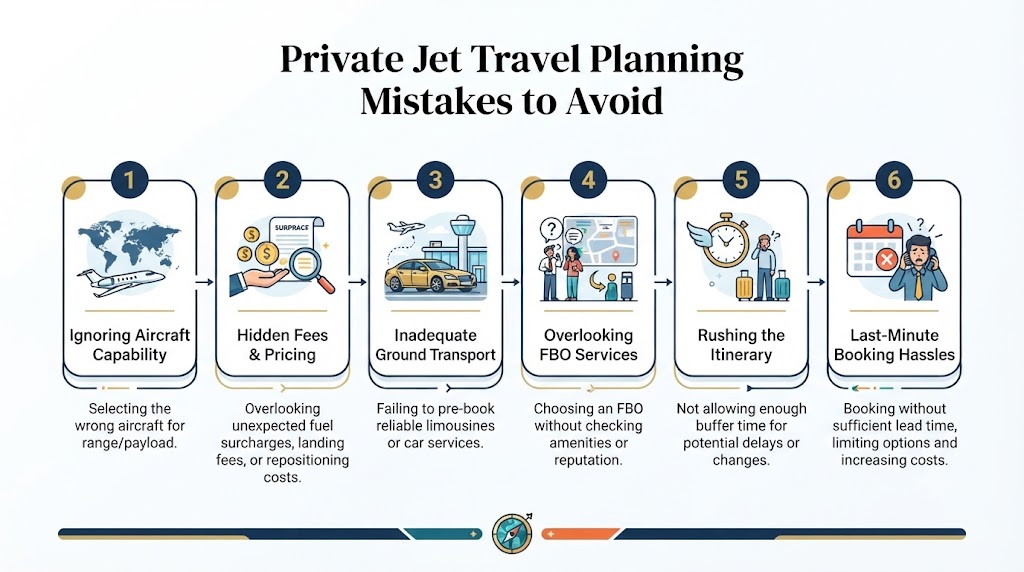
Private jet travel can make a journey more flexible, comfortable, and convenient, but a successful charter experience depends on more than simply booking an aircraft. From choosing the right jet to confirming luggage requirements and airport details, several planning decisions can affect the overall experience.
Understanding common private jet travel planning mistakes can help travelers prepare more effectively, communicate their needs clearly, and enjoy a smoother journey from departure to arrival.
Why Careful Planning Matters for Private Jet Travel
Private aviation gives travelers greater control over their schedules and travel arrangements. However, that flexibility works best when important details are discussed and confirmed before departure.
A well-planned private jet trip should consider:
- Number of passengers
- Destination and route
- Aircraft type
- Luggage requirements
- Departure and arrival airports
- Travel documentation
- Ground transportation
- Special requests
- Schedule requirements
Overlooking even one of these areas can create unnecessary complications. Good preparation helps ensure that the selected charter solution matches the actual requirements of the trip.
1. Choosing a Jet Without Considering Your Actual Needs
One of the most common mistakes is selecting an aircraft based only on appearance, size, or general reputation.
Different aircraft are designed for different travel requirements. Passenger capacity, cabin configuration, luggage space, range, and airport compatibility can all influence whether a particular aircraft is appropriate.
Before selecting an aircraft, consider:
- How many people will travel?
- How much luggage will everyone bring?
- How long is the flight?
- Is the trip nonstop?
- Are there particular airport requirements?
- Does the cabin provide the space and facilities you need?
The best aircraft is not necessarily the largest one. It is the aircraft that fits the specific requirements of the journey.
2. Waiting Until the Last Minute to Plan
Private aviation offers flexibility, but that does not mean every trip should be arranged at the last possible moment.
Last-minute planning can make it more difficult to coordinate aircraft availability, passenger requirements, airport preferences, and ground transportation.
Planning ahead allows travelers to:
- Clearly define their itinerary
- Communicate passenger information
- Discuss aircraft options
- Confirm luggage requirements
- Organize transportation
- Address documentation requirements
- Prepare for possible schedule changes
Early communication generally creates a more organized travel experience.
3. Focusing Only on the Price
Another mistake is treating the quoted charter price as the only factor when evaluating a private jet option.
The overall value of a charter involves much more than the initial figure. Travelers should understand what is included and whether the proposed arrangement actually meets their requirements.
When reviewing a private jet charter option, consider:
- Aircraft suitability
- Passenger capacity
- Luggage capacity
- Departure airport
- Arrival airport
- Scheduling flexibility
- Ground transportation arrangements
- Additional travel requirements
- Terms and conditions
A lower quoted amount may not provide the most suitable solution if important requirements are overlooked.
4. Ignoring Airport and Route Options
Private aviation can provide access to a broader selection of airports, but travelers should still discuss airport preferences and route details in advance.
The most convenient airport is not always the same airport used by commercial airlines. Travelers may have several options depending on their destination and aircraft.
Airport planning should consider:
- Distance from the traveler’s home or hotel
- Distance from the final destination
- Aircraft requirements
- Airport operating considerations
- Ground transportation
- Departure and arrival timing
Discussing these details before booking can help create a more efficient itinerary.
5. Underestimating Luggage Requirements
Luggage is another detail that travelers sometimes overlook when arranging a private aircraft.
While private aviation can offer greater flexibility, available baggage space still varies between aircraft. Large suitcases, sports equipment, musical instruments, and other bulky items may require additional consideration.
Before the trip, provide accurate information about:
- Number of bags
- Approximate luggage size
- Special equipment
- Oversized items
- Fragile belongings
- Any unusual baggage requirements
Being specific about luggage helps ensure that the aircraft arrangement is suitable for everyone traveling.
6. Not Checking the Aircraft Details
Travelers should understand the aircraft being proposed rather than assuming that every private jet provides the same experience.
Aircraft can differ considerably in terms of:
- Cabin size
- Seating configuration
- Passenger capacity
- Baggage capacity
- Range
- Onboard facilities
- Accessibility considerations
If certain cabin features are important to you, ask about them before confirming the booking.
Understanding the aircraft details helps prevent a mismatch between expectations and the actual travel arrangement.
7. Forgetting About Ground Transportation
A private flight is only one part of the overall journey.
Travelers can sometimes spend considerable time planning the flight while overlooking how they will reach the airport or continue their journey after landing.
Ground transportation should be considered as part of the itinerary.
For example, travelers may need to arrange:
- Transportation from home to the departure airport
- Hotel transfers
- Transportation for business meetings
- Airport-to-resort transfers
- Transportation from the arrival airport to the final destination
Coordinating these details in advance can make the entire journey feel more seamless.
8. Failing to Account for Schedule Changes
Private aviation provides scheduling flexibility, but travel plans can still change.
Meetings may move, weather conditions may affect travel, or passengers may need to adjust their departure times. Travelers should understand how schedule changes are handled before finalizing their arrangements.
Ask about:
- Flexibility around departure times
- Procedures for itinerary changes
- Communication during schedule adjustments
- Possible additional charges
- Airport operating considerations
Knowing the process in advance makes unexpected changes easier to manage.
9. Not Communicating Special Requirements
Travelers should not assume that important preferences or requirements will automatically be known.
If someone in the group has a specific travel requirement, communicate it during the planning process.
Depending on the journey, relevant details may include:
- Dietary preferences
- Accessibility requirements
- Seating preferences
- Special luggage
- Pets, where permitted
- Family travel requirements
- Other reasonable onboard requests
Clear communication gives the charter provider an opportunity to determine what can be accommodated before the trip.
10. Overlooking Travel Documentation
Documentation is an essential part of travel planning, particularly when an itinerary involves international destinations.
Travelers should understand which documents are required for their specific journey and make sure passenger information is accurate.
Depending on the destination, requirements may involve:
- Identification documents
- Passports
- Visas
- Immigration information
- Other destination-specific documentation
Documentation requirements can vary according to the itinerary, so travelers should confirm the necessary requirements well before departure.
11. Assuming Every Airport Works for Every Aircraft
Another planning mistake is assuming that any private aircraft can use any airport.
Aircraft capabilities, airport facilities, operating conditions, and other factors can influence airport suitability.
This is why the airport and aircraft should be considered together rather than separately.
A good planning process evaluates:
- Aircraft characteristics
- Airport facilities
- Runway considerations
- Location
- Operating requirements
- Passenger convenience
This approach helps create a practical itinerary instead of simply selecting airports based on location alone.
12. Not Asking Questions Before Booking
Travelers sometimes hesitate to ask detailed questions because they assume the booking process should be straightforward.
However, asking questions early can prevent confusion later.
Before confirming a private jet booking, consider asking:
- Which aircraft is being proposed?
- How many passengers can it accommodate?
- How much luggage can it carry?
- Which airports are being considered?
- What is included in the arrangement?
- How are schedule changes handled?
- Are there special requirements that need advance notice?
- What documentation is required?
Clear answers make it easier to understand the complete travel arrangement.
How to Plan a Private Jet Trip More Effectively
Avoiding mistakes becomes easier when travelers follow a structured planning process.
Step 1: Define Your Trip
Start with the basics:
- Destination
- Departure location
- Preferred travel date
- Number of passengers
- Expected departure time
- Return requirements, if applicable
Step 2: Identify Your Aircraft Requirements
Think about passenger numbers, luggage, flight duration, cabin preferences, and other important requirements.
Step 3: Discuss Airport Options
Consider airports that provide practical access to both the departure point and final destination.
Step 4: Communicate Special Requirements
Share dietary preferences, accessibility needs, unusual luggage, and other important information early.
Step 5: Review the Charter Arrangement
Understand the aircraft, itinerary, included services, scheduling considerations, and relevant terms before confirming.
Step 6: Coordinate Ground Transportation
Plan transportation on both ends of the journey so that the complete itinerary works together.
Step 7: Confirm Everything Before Departure
Review passenger information, timing, airport details, luggage, documentation, and other important arrangements.
Private Jet Travel Planning Checklist
Before your trip, make sure you have considered:
- Passenger count
- Destination
- Departure location
- Preferred schedule
- Aircraft requirements
- Luggage quantity and size
- Airport options
- Ground transportation
- Special requests
- Travel documentation
- Schedule-change procedures
- Booking terms and conditions
This simple checklist can help travelers identify potential problems before they become last-minute concerns.
What Makes Private Jet Planning Successful?
Successful private jet travel is largely about matching the journey with the right arrangements.
The most important elements are clear communication, realistic expectations, accurate passenger information, and careful itinerary planning.
Rather than focusing on one factor, travelers should look at the entire journey. The aircraft, airports, schedule, luggage, documentation, and ground transportation should work together.
A thoughtful planning process also gives travelers the opportunity to address questions before departure rather than trying to solve them during the trip.
Frequently Asked Questions
Q1. What is the biggest mistake to avoid when planning private jet travel?
One of the biggest mistakes is failing to communicate complete travel requirements. Passenger numbers, luggage, schedule, airport preferences, and special requests should be discussed before the booking is finalized.
Q2. How early should I plan a private jet trip?
The ideal planning time depends on the itinerary and specific requirements. Planning earlier generally provides more opportunity to coordinate aircraft options, airports, schedules, and additional services.
Q3. Should I choose a private jet based only on price?
No. Price is only one consideration. Travelers should also evaluate aircraft suitability, passenger capacity, luggage space, itinerary requirements, airport options, and included arrangements.
Q4. Why is luggage information important?
Aircraft have different cabin and baggage capacities. Providing accurate luggage information helps determine whether the selected aircraft is appropriate for the trip.
Q5. Should I plan ground transportation separately?
Ground transportation should be considered as part of the complete itinerary. Coordinating transportation before and after the flight can make the overall journey more convenient.
Q6. What should I confirm before departure?
Confirm the passenger details, aircraft information, departure and arrival airports, schedule, luggage arrangements, documentation requirements, special requests, and any applicable booking conditions.
Conclusion
Private jet travel can offer an efficient and flexible way to reach your destination, but the experience depends heavily on thoughtful preparation. Choosing an unsuitable aircraft, overlooking luggage requirements, ignoring airport options, or waiting too long to organize important details can create avoidable complications.
By communicating your requirements clearly, reviewing the complete charter arrangement, planning transportation, and confirming essential details before departure, you can approach your private jet journey with greater confidence. Good planning turns private aviation from simply a flight into a well-coordinated travel experience.

