
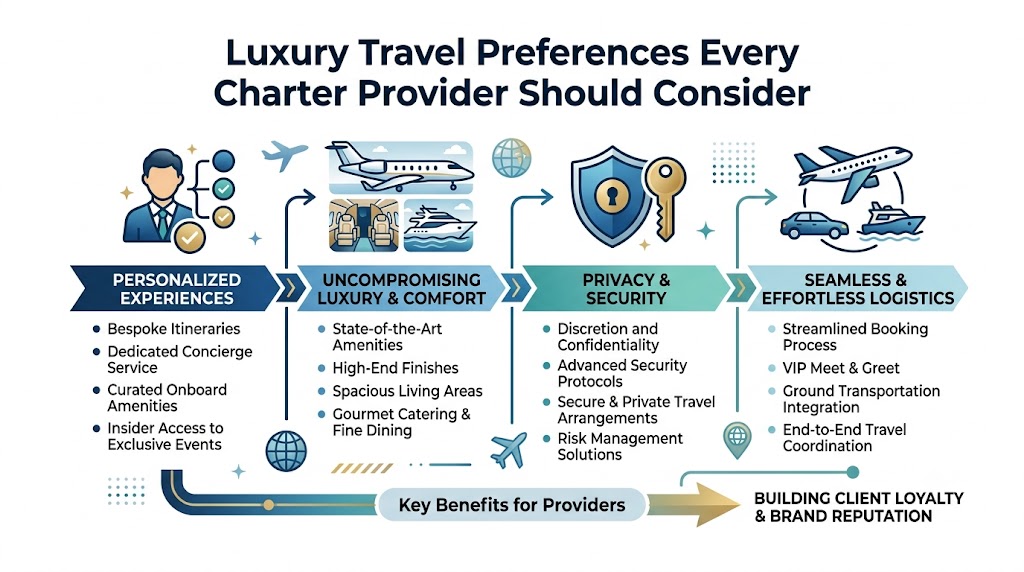
Luxury charter travel involves much more than arranging an aircraft and confirming a departure time. Travelers who choose premium charter services often look for a journey that feels private, flexible, comfortable, personalized, and well coordinated from the initial inquiry through arrival.
At the same time, luxury travelers do not all want the same experience. One passenger may prioritize privacy, while another may care most about scheduling flexibility, family convenience, catering, business connectivity, or ground transportation.
For charter providers, understanding these differences can create a more thoughtful customer experience. The key is to ask the right questions, communicate clearly, understand individual preferences, and avoid promising services that depend on aircraft, route, airport, or operational availability.
What Defines a Luxury Charter Travel Experience?
Luxury means different things to different travelers.
For some passengers, luxury may mean:
- Privacy
- Schedule flexibility
- Comfortable seating
- Personalized service
- Convenient airport arrangements
- Quiet travel
- Customized catering
- Efficient ground transportation
For others, the most important benefit may simply be reducing the complexity associated with a conventional commercial journey.
A charter provider should therefore avoid assuming that every premium traveler expects the same amenities.
Instead, the provider should understand the purpose of the trip, passenger requirements, schedule, preferences, and practical constraints before finalizing the travel arrangement.
1. Personalization Is a Major Luxury Travel Preference
Personalization can make a charter experience feel more relevant to the individual traveler.
Useful preferences may include:
- Preferred communication method
- Departure-time preferences
- Seating preferences
- Food requirements
- Beverage preferences
- Cabin environment
- Ground transportation
- Family requirements
- Business needs
- Special occasions
The objective should not be to collect as much information as possible.
Instead, providers should collect relevant information that helps deliver the requested service.
For example, knowing about a dietary restriction can directly improve catering coordination. Knowing a traveler’s preferred communication method can make itinerary updates easier.
Good personalization should improve convenience without becoming intrusive.
2. Privacy and Discretion
Privacy can be an important consideration for passengers choosing private charter travel.
Travelers may value:
- Discreet communication
- Professional staff behavior
- Limited unnecessary exposure
- Private travel arrangements
- Careful handling of personal information
- Respect for individual preferences
Charter providers should establish appropriate processes for handling customer information and communicating with passengers.
Discretion also extends beyond data handling. Staff should understand that professional conduct, respectful communication, and appropriate boundaries contribute to the overall passenger experience.
3. Flexible Scheduling
Schedule flexibility is one of the reasons travelers may consider charter aviation.
Passengers may have:
- Business meetings
- Personal commitments
- Events
- Multiple destinations
- Connecting transportation
- Time-sensitive appointments
A traveler may therefore prefer a schedule designed around the trip rather than a fixed commercial timetable.
However, flexibility still has operational boundaries.
Aircraft availability, airport restrictions, weather, crew considerations, and other operational factors can affect the final itinerary.
A good charter provider should clearly explain what flexibility is available rather than promising unlimited changes.
4. Comfort and Cabin Experience
Cabin comfort remains an important part of the premium travel experience.
Depending on the aircraft, travelers may consider:
- Seating configuration
- Personal space
- Cabin environment
- Temperature preferences
- Noise
- Work areas
- Resting arrangements
- Entertainment
- Cabin cleanliness
Not every aircraft offers the same cabin layout or amenities.
For this reason, providers should match the traveler’s expectations with the actual aircraft capabilities.
Clear communication before booking can prevent misunderstandings later.
5. Food and Beverage Preferences
Catering can become an important part of a personalized charter experience.
Travelers may have preferences involving:
- Cuisine
- Dietary restrictions
- Food allergies
- Meal timing
- Beverage preferences
- Children’s meals
- Special occasions
Providers should ask about these requirements early enough to coordinate appropriate arrangements.
A simple question about dietary restrictions can be especially valuable because a passenger’s needs may not be obvious from the booking information.
At the same time, providers should confirm what catering options are actually available for the aircraft, airport, route, and itinerary.
6. Seamless Ground Transportation
The luxury travel experience does not necessarily begin or end at the aircraft.
Ground transportation can connect:
- Home to airport
- Hotel to airport
- Airport to meeting
- Airport to resort
- Airport to event venue
Passengers may prefer:
- Private car services
- Chauffeur arrangements
- Direct airport transfers
- Coordinated luggage assistance
- Transportation timed around the flight
When ground transportation and charter arrangements work together, travelers can experience fewer gaps between different parts of their journey.
Providers should confirm ground-service availability instead of assuming that every airport or destination offers identical options.
7. Luggage Preferences
Luggage planning is particularly important when travelers have more than standard personal bags.
Passengers may travel with:
- Business equipment
- Sporting equipment
- Oversized luggage
- Family belongings
- Special items
- Multiple bags
Aircraft baggage capacity varies, so providers should discuss luggage requirements before finalizing arrangements.
A simple question such as “Will you be traveling with any oversized or special equipment?” can identify potential issues early.
This is especially useful for trips involving recreational equipment, family travel, or specialized business equipment.
8. Technology and Connectivity
Some luxury travelers expect technology that supports productivity and communication.
Depending on the aircraft and route, travelers may value:
- Internet connectivity
- Communication capabilities
- Charging options
- Digital travel information
- Entertainment
- Work-friendly cabin arrangements
However, connectivity and onboard technology vary significantly between aircraft and operating environments.
Providers should explain actual capabilities rather than making assumptions.
Business travelers should know what technology is available before relying on it for important meetings or work activities.
9. Business Traveler Preferences
Business travelers can have particularly specific requirements.
Their priorities may include:
- Schedule coordination
- Privacy
- Quiet surroundings
- Productivity
- Connectivity
- Flexible routing
- Ground transportation
- Efficient communication
For a business traveler, a change in departure time can affect an entire meeting schedule.
That makes communication particularly important.
Providers should clearly communicate itinerary details, possible changes, ground arrangements, and any operational limitations that could affect the journey.
10. Family and Group Travel Preferences
Family travel introduces another set of considerations.
Providers may need to understand:
- Number of adults
- Number of children
- Seating preferences
- Luggage volume
- Food requirements
- Ground transportation
- Special assistance
- Schedule preferences
Families may also value a simpler travel experience because coordinating several passengers can become complicated.
A provider who understands the group’s composition can prepare more effectively.
11. Special Occasion Travel
Private charter travel may also form part of a special occasion.
Examples can include:
- Birthdays
- Anniversaries
- Weddings
- Family celebrations
- Corporate events
- Leisure trips
- Milestone journeys
Passengers may request special catering, transportation, timing, or other arrangements.
Providers should clarify which requests can actually be accommodated before confirming them.
Thoughtful service does not require excessive promises. Often, simply understanding the occasion and coordinating realistic details can improve the experience.
12. Accessibility and Individual Requirements
Travelers may have individual requirements that should be discussed before the trip.
These can include:
- Mobility considerations
- Assistance requirements
- Medical equipment considerations
- Dietary restrictions
- Seating needs
- Family support requirements
Aircraft configurations and airport facilities vary, so providers should confirm feasibility before making commitments.
A professional approach starts with respectful questions and clear communication.
13. Communication Preferences
Communication can significantly influence how travelers perceive the overall charter experience.
Important communication stages include:
Initial Inquiry
The provider should understand the trip’s purpose and basic requirements.
Booking
Passengers should receive clear information about the itinerary and services.
Pre-Trip
Relevant travel details and changes should be communicated in a timely manner.
Travel Day
Passengers should know whom to contact if an issue arises.
Post-Trip
Feedback can help identify areas for improvement.
Some travelers prefer frequent updates, while others prefer fewer messages.
Understanding the passenger’s preferred communication method can make the process more efficient.
14. Transparency in Pricing and Services
Luxury service does not eliminate the need for clear pricing.
Passengers should understand what is included and what may generate additional charges.
Depending on the arrangement, relevant cost areas may include:
- Charter service
- Ground transportation
- Catering
- Airport-related charges
- Special requests
- Additional services
- Changes to the itinerary
Actual pricing varies by aircraft, itinerary, airport, service requirements, and provider.
Clear explanations help travelers make informed decisions and reduce the possibility of unexpected misunderstandings.
15. Service Consistency
A premium travel experience depends on more than one interaction.
The customer journey can involve:
- Sales or booking staff
- Travel coordinators
- Airport personnel
- Ground transportation providers
- Flight crew
- Catering providers
- Customer support teams
If one part of the process does not communicate effectively with another, the passenger may experience unnecessary friction.
Providers should therefore aim for consistency across the entire journey.
16. Discretion and Professional Staff
Professional behavior is an important part of luxury service.
Staff should demonstrate:
- Respectful communication
- Appropriate conduct
- Attention to detail
- Cultural awareness
- Professional presentation
- Respect for passenger boundaries
- Responsible information handling
Luxury service does not require intrusive attention.
For many passengers, the best service may be efficient, respectful, and largely unobtrusive.
17. Personalization Without Overstepping
Personalization can become counterproductive when providers collect unnecessary information or make assumptions about a customer.
A better approach involves:
- Asking relevant questions
- Remembering useful preferences
- Respecting privacy
- Allowing customers to update preferences
- Avoiding unnecessary personal details
- Using information responsibly
For example, remembering a dietary restriction can be helpful.
Assuming unrelated personal preferences without asking can create an uncomfortable experience.
The goal should be thoughtful service rather than intrusive service.
18. Sustainability and Responsible Travel Preferences
Some travelers may consider environmental factors when evaluating premium travel options.
Their interests may include:
- Aircraft efficiency
- Operational efficiency
- Route considerations
- Responsible travel practices
- Environmental information
Providers should communicate environmental information carefully and avoid unsupported claims.
Sustainability expectations can differ significantly between travelers, so this should be treated as an individual preference rather than a universal requirement.
19. Common Mistakes Charter Providers Should Avoid
1. Assuming Every Luxury Traveler Wants the Same Experience
Luxury travelers have different priorities.
Better approach: Ask targeted questions before planning the trip.
2. Overpromising Personalization
Not every request can be accommodated.
Better approach: Confirm what is operationally feasible before making commitments.
3. Ignoring Dietary Preferences
Food requirements can become a major issue when discovered too late.
Better approach: Ask about dietary restrictions and allergies during trip planning.
4. Failing to Confirm Luggage Requirements
Unexpected oversized or specialized luggage can create complications.
Better approach: Ask passengers about special luggage before finalizing arrangements.
5. Providing Unclear Pricing
Unexpected charges can negatively affect the customer experience.
Better approach: Explain included services and potential additional costs clearly.
6. Poor Communication About Schedule Changes
Passengers may have meetings or transportation arrangements connected to their flight.
Better approach: Communicate relevant changes promptly and clearly.
7. Ignoring Ground Transportation
The aircraft may be only one part of the journey.
Better approach: Ask whether airport or destination transportation is required.
8. Forgetting Family Requirements
Children, luggage, meals, and seating can affect trip planning.
Better approach: Understand the complete passenger group.
9. Ignoring Accessibility Needs
Individual requirements should be identified before travel.
Better approach: Discuss requirements respectfully and confirm what can be accommodated.
10. Overlooking Business Travel Requirements
Business travelers may need privacy, connectivity, and precise scheduling.
Better approach: Understand the purpose of the trip before arranging services.
11. Collecting Unnecessary Personal Information
More information does not automatically mean better personalization.
Better approach: Collect only relevant information needed to provide the requested service.
12. Failing to Document Customer Preferences
Important preferences can be lost when information does not move between teams.
Better approach: Maintain appropriate service notes and communicate relevant requirements internally.
20. How Charter Providers Can Build a Luxury Traveler Preference Profile
A simple preference framework can help organize relevant information.
Trip Details
Record:
- Destination
- Dates
- Schedule
- Passenger count
- Trip purpose
Comfort
Understand:
- Seating preferences
- Cabin environment
- Privacy preferences
Catering
Record:
- Dietary restrictions
- Food preferences
- Beverage requirements
Luggage
Identify:
- Standard luggage
- Oversized items
- Special equipment
Ground Services
Determine whether the passenger needs:
- Airport transfers
- Hotel transportation
- Chauffeur services
- Destination transportation
Communication
Confirm:
- Preferred communication method
- Important contact information
- Update preferences
Special Requirements
Discuss:
- Family needs
- Accessibility
- Special occasions
- Business requirements
Providers should keep customer information relevant, secure, and appropriately limited.
21. Creating a Better Luxury Charter Customer Journey
A thoughtful customer journey can be divided into several stages.
1. Initial Inquiry
Understand:
- Destination
- Dates
- Passenger count
- Purpose of travel
- Major preferences
2. Preference Discovery
Ask about:
- Comfort
- Catering
- Luggage
- Ground transportation
- Communication
- Special requirements
3. Aircraft and Itinerary Planning
Match the proposed arrangements with the customer’s practical requirements.
4. Quote and Service Explanation
Explain:
- Included services
- Potential additional charges
- Relevant limitations
- Change policies
5. Booking Confirmation
Confirm the important details in a clear format.
6. Pre-Trip Preparation
Coordinate:
- Transportation
- Catering
- Passenger information
- Schedule details
7. Airport Coordination
Ensure relevant parties understand the itinerary and passenger requirements.
8. Flight Experience
Deliver the agreed service while maintaining professional communication.
9. Ground Transportation
Coordinate onward transportation when included or requested.
10. Post-Trip Follow-Up
Collect useful feedback and address outstanding concerns.
22. Luxury Travel Preference Comparison
| Traveler Preference | Why It Matters | Provider Consideration |
|---|---|---|
| Privacy | Supports a discreet travel experience | Use appropriate communication and information-handling practices |
| Flexible scheduling | Helps coordinate personal or business commitments | Explain available flexibility and operational limitations |
| Personalized service | Makes arrangements more relevant | Ask targeted preference questions |
| Comfort | Influences overall passenger satisfaction | Match expectations with actual aircraft capabilities |
| Catering | Addresses personal and dietary needs | Confirm requirements in advance |
| Ground transportation | Connects the complete journey | Coordinate transfers when requested |
| Connectivity | Supports communication and productivity | Confirm actual aircraft capabilities |
| Luggage support | Helps avoid travel-day complications | Discuss baggage requirements beforehand |
| Family needs | Supports group comfort and coordination | Understand passenger composition |
| Business needs | Supports time-sensitive travel | Discuss privacy, scheduling, and productivity requirements |
| Accessibility | Helps accommodate individual needs | Confirm feasibility before booking |
| Transparent pricing | Reduces uncertainty | Explain included and additional services |
| Discretion | Supports professional service | Train staff to respect passenger boundaries |
| Communication | Keeps passengers informed | Use the passenger’s preferred communication approach |
No single preference should automatically receive priority because luxury travel is highly individual.
23. Decision Guide for Charter Providers
If the Customer Prioritizes Privacy
Focus on discreet communication, professional conduct, and responsible information handling.
If the Customer Prioritizes Flexibility
Clarify scheduling options and operational limitations before confirming the itinerary.
If the Customer Is Traveling for Business
Discuss schedule coordination, privacy, connectivity, and ground transportation.
If the Customer Is Traveling With Family
Ask about children, luggage, meals, seating, and transportation requirements.
If the Customer Has Special Requirements
Confirm feasibility with the appropriate operational teams before making commitments.
If the Customer Wants a Personalized Experience
Ask specific questions instead of assuming what luxury means to that individual.
24. Questions Charter Providers Should Ask Luxury Travelers
Before confirming a charter arrangement, providers can consider asking:
- What is the primary purpose of the trip?
- How many passengers will be traveling?
- Are there preferred departure or arrival times?
- Are there specific cabin preferences?
- Are there dietary restrictions or allergies?
- Will you be traveling with oversized or special equipment?
- Is ground transportation required?
- Are there accessibility considerations?
- Is business-related connectivity important?
- Is the trip connected to a special occasion?
- What is your preferred communication method?
- Is there anything else that would make the journey more convenient?
The questions should remain relevant, respectful, and focused on delivering the requested service.
25. Luxury Charter Service Checklist
Before Booking
- Trip purpose identified
- Passenger count confirmed
- Schedule preferences documented
- Aircraft suitability reviewed
- Luggage requirements discussed
Personalization
- Seating preferences discussed
- Catering requirements documented
- Special requests reviewed
- Accessibility requirements considered
Ground Services
- Airport transfer discussed
- Hotel transportation discussed
- Destination transportation confirmed if needed
- Special ground requirements reviewed
Communication
- Preferred contact method confirmed
- Booking details communicated
- Schedule-update process explained
- Important contacts documented
Pricing
- Included services explained
- Additional charges explained
- Change policies explained
- Cancellation terms explained
Post-Trip
- Customer feedback requested
- Useful preferences recorded responsibly
- Outstanding issues addressed
Frequently Asked Questions
Q1. What do luxury travelers usually expect from charter services?
Preferences vary, but many travelers may value privacy, convenience, flexibility, comfort, personalized service, clear communication, and coordinated ground transportation.
Q2. Why is personalization important in private charter travel?
Personalization helps providers adapt the journey to the passenger’s actual requirements instead of assuming that every traveler wants the same experience.
Q3. How can charter providers improve passenger privacy?
They can use discreet communication, professional staff practices, appropriate information-handling processes, and respectful passenger interactions.
Q4. Do all luxury travelers have the same preferences?
No. Preferences can differ according to trip purpose, passenger group, destination, schedule, personal priorities, and individual requirements.
Q5. What catering preferences should charter providers ask about?
Providers can ask about dietary restrictions, allergies, preferred cuisine, meal timing, beverages, and children’s meals when relevant.
Q6. Why is ground transportation important to luxury travelers?
Ground transportation connects the aircraft journey with the passenger’s final destination and can reduce unnecessary coordination between separate travel arrangements.
Q7. How should providers handle special requests?
Providers should understand the request, determine whether it is feasible, and clearly confirm what can actually be provided before making a commitment.
Q8. What should charter providers know about business travelers?
Business travelers may place particular importance on scheduling, privacy, connectivity, quiet environments, and coordinated ground transportation.
Q9. How can charter services support families and groups?
Providers can ask about passenger numbers, children, luggage, seating, catering, accessibility, and transportation requirements before finalizing arrangements.
Q10. Why is transparent pricing important in luxury charter travel?
Clear pricing helps passengers understand what the quoted service includes and what additional charges may apply.
Q11. How should providers handle accessibility requirements?
They should ask about relevant needs early, confirm what the aircraft and airports can accommodate, and avoid making commitments before feasibility is established.
Q12. What role does communication play in premium charter service?
Clear and timely communication helps passengers understand schedules, services, changes, and travel-day arrangements.
Q13. How can charter providers personalize service without being intrusive?
They should ask relevant questions, use only necessary customer information, respect privacy, and avoid making assumptions about personal preferences.
Q14. What should providers ask before confirming a luxury charter trip?
They should understand the trip purpose, passenger count, schedule, luggage, catering, ground transportation, accessibility, communication preferences, and any special requirements.
Conclusion
Luxury charter travel is not defined by one universal set of preferences.
Passengers may prioritize privacy, flexibility, comfort, personalization, convenience, or seamless coordination depending on their individual needs.
Charter providers can improve the experience by asking relevant questions and confirming realistic service options.
Ground transportation, catering, communication, luggage planning, and accessibility can all influence the journey.
Transparent pricing and professional discretion also help establish clear expectations.
Ultimately, successful luxury charter service comes from understanding the traveler first and tailoring the experience within genuine operational capabilities.

