
Introduction
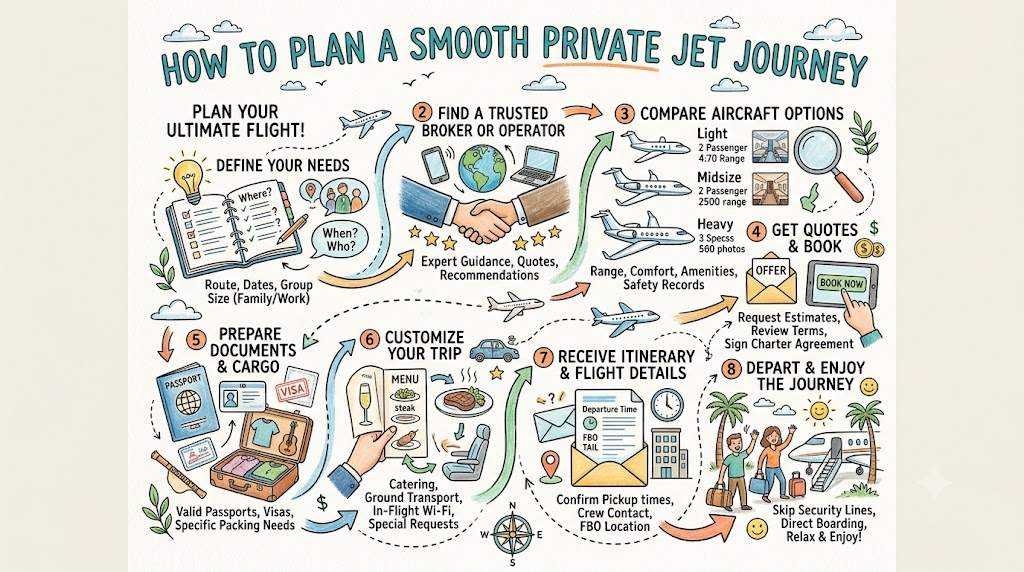
Planning a private jet journey is very different from booking a commercial flight. While private aviation offers unmatched flexibility, speed, and comfort, it still requires thoughtful preparation to ensure a seamless experience. Many first-time travelers assume private jet travel is completely effortless, but proper planning plays a key role in making the journey smooth, efficient, and enjoyable.
From selecting the right aircraft to coordinating airports, timing, baggage, and onboard services, every detail contributes to the overall experience. A well-planned private jet journey eliminates stress, avoids delays, and allows passengers to fully enjoy the benefits of luxury aviation.
This guide explains the essential steps and considerations for planning a smooth private jet journey from start to finish.
Real-world Use Cases
A business executive planning a same-day return trip needs precise timing, efficient routing, and flexible scheduling to attend multiple meetings in different cities.
A family organizing a luxury vacation flight focuses on comfort, baggage arrangements, and in-flight services for a relaxing travel experience.
A VIP traveler requiring privacy and discretion ensures aircraft selection and airport handling meet confidentiality expectations.
A corporate team coordinating multi-city travel needs careful planning of aircraft size, scheduling, and ground logistics.
A first-time flyer experiencing private aviation for the first time requires guidance on documentation, boarding, and flight expectations.
A medical or urgent traveler depends on rapid coordination, immediate departure readiness, and minimal delays.
A frequent flyer optimizing travel efficiency focuses on cost, aircraft availability, and time-saving routes.
Evaluation Criteria for Planning a Private Jet Journey
Before planning a private jet trip, travelers should evaluate:
- Aircraft type suitability
- Budget and pricing structure
- Departure and arrival flexibility
- Airport and FBO accessibility
- Passenger requirements
- Travel distance and route efficiency
- Weather conditions and risks
- Baggage capacity needs
- Onboard service expectations
- Ground transportation coordination
- Operator reliability
- International travel requirements
These factors help ensure a smooth and well-organized journey.
Choosing the Right Aircraft Type
Selecting the correct aircraft is one of the most important steps in planning.
For example, a light jet is ideal for short regional trips, while a heavy jet is better suited for long international travel.
Understanding Charter Pricing Structure
Private jet pricing depends on aircraft type, flight time, fuel, and airport fees.
For example, longer flights or larger aircraft increase overall cost significantly.
Booking and Scheduling Confirmation
Confirming your booking early ensures aircraft availability and better scheduling flexibility.
For example, last-minute bookings may limit aircraft options or increase cost.
Selecting Airports and FBOs
Private jets use Fixed Base Operators (FBOs) instead of commercial terminals.
For example, passengers can arrive at private lounges and board quickly without crowds.
Passenger Documentation and Identification
Even private flights require valid identification and travel documents.
For example, international flights require passports and necessary visas.
Baggage Planning and Restrictions
Private aviation allows more flexible baggage handling, but limits still depend on aircraft size.
For example, small jets may restrict oversized luggage.
Flight Time and Route Planning
Proper route planning helps optimize fuel use and travel time.
For example, direct routes reduce travel duration and improve efficiency.
Weather Considerations and Flexibility
Weather can influence flight timing and routing decisions.
For example, pilots may adjust routes to avoid turbulence or storms.
Onboard Catering and Service Customization
Private flights allow personalized meals and services.
For example, passengers can request specific dietary meals before departure.
Ground Transportation Coordination
Coordinating ground transport ensures smooth arrival and departure transitions.
For example, luxury cars can be arranged to meet passengers at the aircraft.
Crew Communication and Special Requests
Clear communication ensures all passenger needs are met.
For example, operators can arrange seating preferences or onboard entertainment.
Safety Briefing and Expectations
Passengers receive a safety briefing before takeoff.
For example, crew members explain seatbelt usage and emergency procedures.
International Travel Requirements
International flights may require customs clearance and additional documentation.
For example, passport validity and entry permissions must be verified.
Emergency Backup Planning
Good planning includes backup options in case of delays or changes.
For example, alternate aircraft or timing adjustments may be arranged if needed.
Last-minute Schedule Changes
Private aviation offers flexibility, but changes should be coordinated properly.
For example, departure time adjustments depend on aircraft availability.
Empty Leg Flight Opportunities
Empty leg flights offer discounted travel options when aircraft return empty.
For example, travelers can save costs if timing matches availability.
Aircraft Availability and Repositioning
Aircraft may need to reposition before pickup, affecting timing and cost.
For example, a jet flying from another city may require additional coordination time.
Well-Planned vs Poorly Planned Private Jet Journey
| Factor | Well-Planned Journey | Poorly Planned Journey |
|---|---|---|
| Time Efficiency | High | Low |
| Stress Level | Minimal | High |
| Cost Control | Optimized | Unpredictable |
| Comfort | Smooth | Disrupted |
| Flexibility | Managed | Limited |
Light Jet vs Heavy Jet Travel Experience
| Factor | Light Jet | Heavy Jet |
| Range | Short-medium | Long-haul |
| Comfort | Moderate | Premium |
| Cost | Lower | Higher |
| Space | Limited | Spacious |
On-demand Booking vs Advance Booking
| Factor | On-demand | Advance Booking |
| Flexibility | High | Moderate |
| Price | Higher | Better deals |
| Availability | Limited | Guaranteed |
Domestic vs International Private Jet Travel
| Factor | Domestic | International |
| Documentation | Simple | Complex |
| Cost | Lower | Higher |
| Planning Needs | Moderate | High |
Benefits of Proper Private Jet Journey Planning
Proper planning helps travelers:
- Reduce stress and uncertainty
- Improve time efficiency
- Avoid last-minute issues
- Ensure smooth boarding process
- Optimize travel costs
- Enhance onboard experience
- Improve communication with operators
- Increase travel reliability
- Ensure safety compliance
- Deliver premium travel experience
Practical Tips for Travelers
- Choose aircraft based on trip distance
- Confirm all booking details early
- Understand total pricing structure
- Communicate preferences clearly
- Prepare travel documents in advance
- Plan ground transport in advance
- Stay flexible for weather changes
Common Mistakes to Avoid
- Booking without confirming aircraft type
- Ignoring baggage limitations
- Not checking weather conditions
- Overlooking documentation requirements
- Assuming fixed departure times
- Forgetting ground coordination planning
FAQs
1. How do I plan a private jet journey?
Start by selecting aircraft type, confirming schedule, preparing documents, and coordinating airport and ground services.
2. What aircraft should I choose?
Light jets are best for short trips, while heavy jets suit long international travel.
3. How does pricing work?
Pricing depends on aircraft type, distance, fuel, airport fees, and service requirements.
4. What is an FBO?
An FBO is a private terminal used for boarding and handling private jet passengers.
5. Do I need documents for private flights?
Yes, identification and travel documents are required, especially for international trips.
6. Can private jet schedules change?
Yes, schedules are flexible but depend on aircraft and crew availability.
7. How much baggage can I carry?
Baggage depends on aircraft size and type.
8. Are private jets weather dependent?
Yes, but routing adjustments are made for safety and comfort.
9. Can I request special services?
Yes, catering and onboard services can be customized.
10. Are empty leg flights available?
Yes, they offer discounted options based on aircraft positioning.
Conclusion
Planning a private jet journey carefully ensures a smooth, efficient, and stress-free travel experience. While private aviation offers unmatched flexibility and comfort, proper preparation is essential to maximize its benefits. From choosing the right aircraft and coordinating airports to managing baggage, timing, and onboard services, each step plays a key role in travel success. With the right planning, travelers can enjoy a seamless private aviation experience that combines luxury, efficiency, and complete convenience.

