
Introduction
In today’s competitive business environment, time is one of the most valuable assets an executive possesses. Every delayed flight, missed connection, long security line, and airport layover represents lost productivity, delayed decisions, and missed business opportunities. For corporate leaders, entrepreneurs, investors, and high-level professionals, efficient travel is no longer simply a convenience—it is a strategic business advantage.
Commercial airlines serve millions of travelers every day, but their schedules, airport procedures, and operational limitations often create challenges for business travelers with demanding schedules. Flight delays, airport congestion, lengthy check-in procedures, and inflexible departure times can significantly impact important meetings, client engagements, and business operations.
This is one of the primary reasons why private jet charter services have become increasingly popular among executives and corporate teams. Private aviation offers greater flexibility, faster travel experiences, improved productivity, and access to thousands of airports that commercial airlines cannot efficiently serve.
This guide explores how private jet charters save time for business travelers, improve operational efficiency, and help executives maximize every hour of their travel schedules.
Real-world use cases include:
- Same-day business meetings
- Multi-city executive travel
- International corporate travel
- Emergency business trips
- Investor presentations
- Leadership team transportation
- Client relationship management
- High-priority negotiations
Evaluation Criteria for Buyers
When selecting a private jet charter provider, business travelers should evaluate:
- Safety standards
- Aircraft availability
- Scheduling flexibility
- Fleet quality
- International capabilities
- Concierge services
- Airport access
- Pricing transparency
- Customer support
- Corporate travel expertise
Best for: CEOs, executives, entrepreneurs, corporate teams, investors, and time-sensitive professionals.
Not ideal for: Budget-focused leisure travel or large-scale commercial group transportation.
Why Time Matters in Business Travel
Executive Productivity
Executives often manage multiple meetings, projects, clients, and strategic decisions every day. Efficient travel allows leaders to maximize their productivity and focus on business priorities.
Faster Decision-Making
Business opportunities frequently require immediate action. Reducing travel delays enables executives to respond faster to critical situations.
Reduced Travel Fatigue
Less time spent in airports means more energy available for meetings, presentations, and negotiations.
Better Client Relationships
Arriving on time and maintaining schedule reliability helps strengthen professional relationships.
Improved Scheduling Efficiency
Flexible travel options allow businesses to plan meetings around operational needs rather than airline schedules.
Competitive Business Advantage
Organizations that move faster often gain advantages over competitors that depend on slower travel methods.
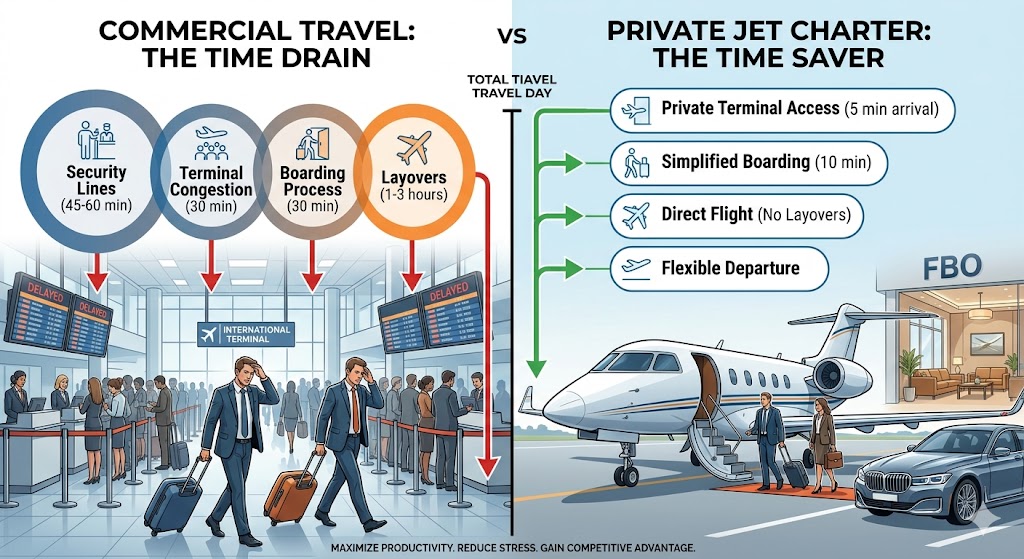
The Biggest Time-Wasting Problems in Commercial Air Travel
Long Security Lines
Business travelers often spend significant time waiting for airport security screening.
Common delays include:
- Passenger volume
- Seasonal congestion
- Security checkpoints
- Additional screening procedures
Airport Congestion
Major airports frequently experience:
- Traffic congestion
- Crowded terminals
- Delayed boarding processes
Flight Delays
Weather conditions, air traffic congestion, and operational issues can significantly impact schedules.
Layovers and Connections
Connecting flights increase:
- Travel time
- Missed connection risks
- Operational complexity
Boarding Delays
Boarding hundreds of passengers can create additional delays.
Lost Productivity
Airports are often not ideal environments for productive work.
Limited Scheduling Flexibility
Commercial airlines operate fixed schedules that may not align with business requirements.
How Private Jet Charters Save Time
Private Terminal Access
One of the biggest advantages of private aviation is access to private terminals.
Benefits Include
- Faster arrival procedures
- Reduced waiting times
- Simplified boarding
- Less congestion
Passengers often arrive shortly before departure rather than hours in advance.
Flexible Scheduling
Private jet charters operate according to the traveler’s schedule.
Advantages include:
- Customized departure times
- Schedule changes
- Last-minute travel planning
- Same-day returns
Direct Flights
Private aircraft frequently operate direct routes that eliminate unnecessary connections.
Benefits
- Reduced travel time
- Fewer disruptions
- Simplified logistics
Access to Smaller Airports
Private aircraft can use thousands of regional airports unavailable to many commercial airlines.
Advantages
- Reduced ground transportation
- Faster arrival
- Improved destination access
Faster Ground Transportation
Private terminals often offer quicker vehicle access and transfers.
Reduced Travel Stress
Simplified procedures help executives remain focused and productive.
Improved In-Flight Productivity
Private cabins create environments optimized for business activities.
Commercial First Class vs Private Jet Charter
| Feature | Commercial First Class | Private Jet Charter |
|---|---|---|
| Airport Wait Time | Long | Minimal |
| Security Procedures | Standard Airport Security | Simplified |
| Boarding Speed | Moderate | Very Fast |
| Scheduling Flexibility | Fixed | Fully Flexible |
| Privacy | Limited | Complete |
| Productivity | Moderate | Excellent |
| Ground Transportation Efficiency | Moderate | High |
| Multi-City Travel | Limited | Excellent |
| Meeting Readiness | Moderate | High |
Same-Day Business Travel Advantages
Morning Meetings and Evening Returns
Private aviation makes same-day travel significantly more practical.
Benefits include:
- Reduced hotel requirements
- Better time utilization
- Increased productivity
Multi-City Business Trips
Executives can visit multiple locations in a single day.
Example itinerary:
- Morning meeting in City A
- Afternoon presentation in City B
- Evening negotiation in City C
Last-Minute Travel Flexibility
Urgent business opportunities often require immediate mobility.
Emergency Corporate Travel
Private aviation supports rapid response to:
- Operational issues
- Client emergencies
- Strategic opportunities
How Private Aviation Improves Business Productivity
In-Flight Meetings
Private cabins allow teams to conduct meetings during travel.
Confidential Conversations
Executives can discuss sensitive business matters without concerns about public exposure.
Wi-Fi and Connectivity
Modern aircraft often provide:
- Internet access
- Email communication
- Video conferencing support
Team Collaboration
Travel time becomes productive work time.
Quiet Working Environment
Private cabins provide fewer distractions than commercial flights.
Reduced Fatigue
More comfortable travel environments improve executive performance.
Private Jet Charter Booking Process
Initial Travel Request
Travelers provide:
- Departure location
- Destination
- Passenger count
- Schedule requirements
Aircraft Selection
Providers recommend suitable aircraft based on mission requirements.
Flight Planning
Flight operations teams coordinate routing and logistics.
Passenger Coordination
Documentation and travel requirements are confirmed.
Concierge Services
Additional services may include:
- Ground transportation
- Hotel arrangements
- Event coordination
Departure Procedures
Passengers typically arrive shortly before departure.
Arrival Experience
Private aviation often provides faster arrivals and reduced airport delays.
Types of Aircraft Used for Business Travel
Light Jets
Passenger Capacity
4–7 passengers
Best For
Short business trips and regional travel.
Midsize Jets
Passenger Capacity
6–9 passengers
Best For
Domestic business travel.
Super Midsize Jets
Passenger Capacity
8–10 passengers
Best For
Longer executive missions.
Heavy Jets
Passenger Capacity
10–16 passengers
Best For
International business travel.
Ultra Long Range Jets
Passenger Capacity
12–18 passengers
Best For
Global executive operations.
Turboprop Aircraft
Passenger Capacity
4–8 passengers
Best For
Short regional routes and smaller airports.
Private Jet Charter Pricing Explained
Several factors influence charter pricing.
Aircraft Type
Larger aircraft generally cost more to operate.
Flight Distance
Longer routes require additional fuel and operational resources.
Airport Fees
Airport handling costs vary by location.
Fuel Costs
Fuel pricing impacts operational expenses.
International Permits
Cross-border travel may require additional approvals.
Crew Expenses
Crew scheduling and accommodations influence pricing.
Peak Travel Demand
High-demand periods may affect availability and pricing.
Concierge Services
Luxury services can increase overall costs.
Empty Leg Flights
Empty leg flights occur when aircraft reposition without passengers.
Benefits
- Lower pricing opportunities
- Luxury travel access
Limitations
- Limited flexibility
- Fixed schedules
Jet Card Programs
Jet cards provide pre-purchased flight hours for frequent travelers.
Membership Models
Membership programs offer preferred access and priority services.
Fractional Ownership
Fractional ownership allows shared aircraft ownership among multiple users.
Pricing Model Comparison Table
| Model | Best For |
|---|---|
| On-Demand Charter | Occasional Travelers |
| Jet Card | Frequent Travelers |
| Membership Program | Regular Executive Travel |
| Fractional Ownership | Heavy Utilization |
Safety Considerations in Private Aviation
FAA Regulations
Private aviation operators must comply with aviation regulations and operational standards.
Aircraft Maintenance Standards
Regular inspections help maintain airworthiness.
Pilot Qualifications
Professional pilots complete extensive training and recurrent evaluations.
Operational Safety Audits
Many operators participate in additional safety programs.
Certified Charter Operators
Travelers should prioritize reputable, certified providers.
Common Mistakes Business Travelers Make When Booking Private Jets
- Booking too late
- Choosing the wrong aircraft size
- Ignoring airport access advantages
- Focusing only on hourly pricing
- Overlooking international permit requirements
- Ignoring operator certifications
- Poor schedule planning
- Underestimating ground transportation needs
How to Choose the Right Private Jet Charter Provider
Fleet Diversity
A larger fleet improves flexibility and availability.
Safety Reputation
Safety should always be the primary consideration.
Business Travel Experience
Corporate travel expertise improves service quality.
Customer Support
Responsive support teams improve travel coordination.
International Operations
Important for global business travelers.
Concierge Services
Premium concierge support enhances travel efficiency.
Pricing Transparency
Clear pricing helps avoid unexpected expenses.
Aircraft Availability
Availability is essential for urgent travel requirements.
Questions Executives Should Ask Before Booking
- Is the operator certified?
- What aircraft are available?
- What airports can be accessed?
- What services are included?
- Is international travel supported?
- Are onboard Wi-Fi and meeting facilities available?
- What are the cancellation policies?
- What ground transportation options exist?
- How flexible are schedule changes?
- What safety standards are followed?
The Role of Technology in Modern Private Aviation
AI-Powered Scheduling
Artificial intelligence improves flight planning and scheduling efficiency.
Digital Charter Platforms
Online booking systems simplify charter coordination.
Real-Time Flight Tracking
Executives can monitor travel progress in real time.
Smart Cabin Systems
Modern cabins provide enhanced connectivity and comfort.
Personalized Travel Apps
Mobile applications improve traveler convenience.
Digital Concierge Services
Technology enhances travel coordination and service delivery.
Future Trends in Corporate Aviation
Sustainable Aviation Fuel
Environmental sustainability is becoming increasingly important.
Electric Business Aircraft
Future technologies may transform short-range executive travel.
AI-Based Charter Planning
Advanced algorithms continue improving operational efficiency.
Smart Luxury Cabins
Future aircraft cabins will offer increasingly personalized experiences.
Eco-Friendly Aviation
Sustainability initiatives continue expanding throughout the industry.
Hyper-Personalized Business Travel
Travel experiences are becoming increasingly customized.
Frequently Asked Questions
1. How much time can private jet travel save?
Time savings vary by route but can be substantial due to reduced airport procedures, direct flights, and flexible scheduling.
2. Are private jet charters suitable for same-day travel?
Yes. Many executives use private aviation specifically for same-day business trips.
3. How early should passengers arrive?
Many travelers arrive approximately 15–30 minutes before departure.
4. Are private jets safer than commercial flights?
Safety depends on operator standards, maintenance programs, and pilot qualifications.
5. What is an empty leg flight?
An empty leg flight is a repositioning flight that may be available at reduced pricing.
6. Can executives hold meetings onboard?
Yes. Private cabins often support productive business discussions.
7. Are private terminals faster?
Private terminals generally provide significantly faster processing.
8. Can private jets access smaller airports?
Yes. This is one of the major advantages of private aviation.
9. How flexible are charter schedules?
Private charter schedules are highly customizable.
10. What aircraft are best for executive travel?
The ideal aircraft depends on passenger count, route distance, and operational requirements.
Conclusion
Private jet charters provide a powerful solution for business travelers who value time, flexibility, productivity, and operational efficiency. By eliminating many of the delays associated with commercial aviation—including long security lines, airport congestion, boarding delays, and inflexible schedules—private aviation allows executives to focus on what matters most: conducting business and creating value. Whether supporting same-day meetings, multi-city travel, international business operations, or urgent corporate missions, private jet charter services offer unmatched convenience and control. For organizations and professionals operating in fast-paced environments, the ability to travel efficiently can become a significant competitive advantage. As business travel continues evolving, private aviation remains one of the most effective tools for maximizing productivity, reducing travel-related stress, and ensuring that valuable executive time is used as efficiently as possible.

