
Introduction
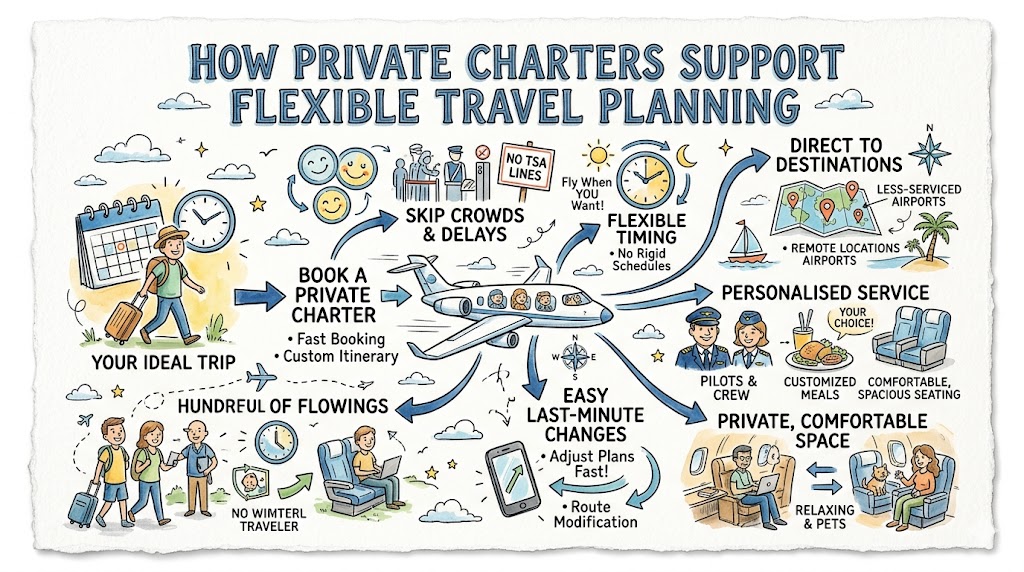
Flexible travel planning has become increasingly important for business executives, families, VIP passengers, event travelers, and groups with changing schedules. Commercial airline travel often requires passengers to follow fixed departure times, limited routes, crowded terminals, and strict booking rules. These restrictions can create stress when meetings change, events run late, weather affects connections, or travelers need to reach smaller destinations.
Private charter travel gives passengers more control over the journey. Travelers can often choose departure times, select convenient airports, plan direct routes, coordinate multiple destinations, and adjust arrangements based on changing needs. Private aviation is not only about luxury. It is also about efficient time management, privacy, convenience, and customized travel planning. Whether someone is arranging a same-day business trip, family vacation, destination wedding, urgent journey, or multi-city itinerary, a private charter can make the schedule more adaptable. With careful planning and a reliable charter provider, passengers can create a travel experience that fits their priorities instead of adjusting everything around a commercial airline timetable.
Real-world Use Cases
A business executive may have a meeting moved from the afternoon to the morning and need to adjust the departure time quickly. A private charter can provide more scheduling flexibility than a commercial flight with fixed departure options.
A corporate team may need to visit several cities within one day. Direct charter routing can help the group avoid connections and spend more time at business locations. A family traveling with children may prefer a departure time that matches school, sleep, or meal schedules.
Wedding guests may need to reach a remote resort that is far from a major commercial airport. VIP passengers may require privacy when discussing sensitive business matters. Friends planning a luxury weekend may want to leave after work and return at a convenient time. An urgent traveler may also need a same-day flight when commercial options are unavailable or impractical.
Evaluation Criteria for Flexible Private Charter Travel
Before booking a private charter for flexible travel planning, evaluate:
- Preferred departure and return times
- Passenger count
- Travel route and destination airports
- Aircraft range and cabin size
- Luggage and special-item requirements
- Multi-city travel needs
- Schedule-change policies
- Cancellation and rescheduling terms
- Ground transportation requirements
- Catering and onboard preferences
- Pet travel needs
- Weather and alternate airport planning
- Total charter pricing
- Operator safety and service standards
Clear communication helps the charter provider design a journey that matches the traveler’s schedule and priorities.
1- Customized Departure Times
One of the biggest advantages of a private jet charter is the ability to request a departure time that fits the passenger’s schedule. Commercial travelers usually select from available airline timetables, while private charter clients can plan around meetings, events, and personal commitments.
For example, an executive whose meeting ends late in the evening may schedule a private flight shortly afterward instead of waiting until the next morning. This flexibility helps travelers use their time more efficiently.
2- Flexible Return Schedules
Return travel can be difficult to predict, especially when meetings, celebrations, or family events do not end at a fixed time. Private charters can provide more adaptable return planning.
For example, a business team may finish negotiations earlier than expected and request an earlier departure. A family attending a wedding may choose a later return so they do not have to leave the celebration before it ends.
3- Last-Minute Booking Options
Private aviation can support urgent or last-minute trips when suitable aircraft and crew are available. This is especially valuable for business emergencies, family situations, time-sensitive events, or unexpected travel needs.
For example, an executive may need to visit a client the same day after an urgent issue develops. An on-demand private charter can provide an option when commercial flight schedules do not fit.
4- Easier Schedule Changes
Travel plans often change. Meetings are delayed, events are extended, and personal situations develop unexpectedly. Private charter providers may offer more direct support for schedule adjustments than standard airline systems.
For example, if a traveler needs to move the departure time by several hours, the provider can review aircraft, crew, airport, and operational availability and explain the available options.
5- Direct Routes Without Unnecessary Connections
Commercial airline travel may involve one or more connections, especially when flying between smaller cities. Private charter travel can often provide a more direct route.
For example, a traveler going from a regional city to a business destination may avoid a connection through a major hub. This saves time and reduces the risk of missed connections or baggage delays.
6- Access to Smaller Regional Airports
Private aircraft can often use smaller airports that are not served by major commercial airlines. This gives passengers more choices when selecting departure and arrival locations.
For example, wedding guests traveling to a remote venue may land at a regional airport closer to the resort. This can reduce several hours of ground travel after arrival.
7- Multi-City Itinerary Planning
Private charters are useful for travelers who need to visit multiple destinations in one trip. The route can be planned around the passenger’s priorities instead of commercial airline networks.
For example, a corporate team may visit factories, offices, or clients in three cities over two days. A customized charter itinerary can reduce waiting time and improve coordination.
8- Same-Day Business Travel
Same-day business travel becomes easier when passengers can control departure and return times. Private aviation helps executives attend meetings and return home without overnight stays in some situations.
For example, a business leader may depart early in the morning, attend meetings during the day, and return that evening. This can reduce hotel needs and keep work schedules more productive.
9- Better Coordination for Group Travel
Coordinating a group on commercial airlines can be difficult. Passengers may be placed on different flights, seated separately, or delayed by individual check-in issues.
A private charter allows the group to travel together on the same aircraft. For example, a corporate team, wedding party, or family reunion group can depart together and arrive at the same time.
10- Personalized Passenger Arrangements
Private charter services can often plan around passenger preferences and needs. These may include seating arrangements, mobility assistance, child-friendly planning, privacy requests, or cabin comfort expectations.
For example, a family traveling with elderly relatives may request easier boarding support and comfortable seating. A VIP passenger may prefer a quiet cabin and discreet terminal arrangements.
11- Flexible Luggage Planning
Luggage needs vary depending on the trip. Business travelers may carry equipment, families may travel with strollers, and event guests may have formal clothing or gifts.
Private charter providers can recommend an aircraft based on luggage volume and item size. For example, travelers carrying golf clubs or event equipment should share those details before booking so the aircraft has suitable storage capacity.
12- Pet-Friendly Travel Options
Private aviation can make pet travel more comfortable because pets may be allowed to remain in the cabin with their owners, depending on operator policies and destination requirements.
For example, a family traveling for an extended vacation may prefer to keep a pet nearby instead of using a commercial cargo process. Pet documentation and cleaning policies should be discussed in advance.
13- Onboard Catering Customization
Private charters allow travelers to request catering based on flight length, dietary needs, passenger age, and travel purpose.
For example, a business team may request simple meals that are easy to eat while working. A family may request child-friendly snacks, while a couple traveling for a celebration may prefer a more premium menu.
14- Ground Transportation Coordination
Flexible travel planning includes the journey before takeoff and after landing. Charter providers may help coordinate vehicles between homes, hotels, airports, offices, resorts, or event venues.
For example, a corporate team may need cars waiting at the destination airport to reach a meeting immediately. Coordinated ground transportation reduces delays and improves the overall experience.
15- Support for Urgent or Time-Sensitive Trips
Some journeys cannot be delayed. These may include critical business travel, family emergencies, legal matters, event appearances, or important project visits.
A private charter can help travelers depart closer to the required time and use airports that provide more direct access to the destination. This is especially useful when every hour matters.
16- Better Planning for Special Events
Private charters can support weddings, anniversaries, birthdays, sporting events, concerts, and private celebrations. Event schedules often require specific arrival and departure times.
For example, a group attending a destination wedding may schedule travel around the ceremony and reception. This can help everyone arrive together and avoid missing important moments.
17- More Privacy During Changing Travel Plans
Schedule changes may involve confidential business discussions, personal matters, or VIP security needs. Private terminals and cabins offer more privacy than crowded commercial travel environments.
For example, executives can discuss meeting changes or business strategy while traveling without sitting near unrelated passengers.
18- Weather and Alternate Airport Planning
Weather can affect every form of aviation. Private charter planning can include alternate airports, adjusted departure windows, or route changes when conditions require it.
For example, if the planned arrival airport becomes unsuitable, the operator may recommend another nearby airport. Discussing backup options in advance helps travelers respond calmly to changing conditions.
Benefits of Flexible Private Charter Travel
Private charter flexibility helps travelers:
- Save valuable time
- Reduce airport stress
- Avoid unnecessary connections
- Reach destinations more directly
- Keep groups together
- Respond to changing schedules
- Improve business productivity
- Plan family travel comfortably
- Protect privacy
- Customize passenger arrangements
- Coordinate ground transportation
- Create a more personalized journey
The main value is control. Travelers can organize the trip around their needs rather than building the entire schedule around airline availability.
Private Charter vs Commercial Airline Travel
| Factor | Private Charter | Commercial Airline |
|---|---|---|
| Departure Schedule | Customized around passenger needs | Fixed airline timetable |
| Route Options | Direct and flexible routing | Based on airline network |
| Airport Access | Smaller airports may be available | Mainly major commercial airports |
| Multi-City Travel | Customized itinerary | Separate bookings and connections |
| Schedule Changes | More direct coordination | Often limited by fare and availability |
| Group Coordination | Entire group travels together | Passengers may be separated |
| Privacy | Private cabin and terminal options | Shared public environment |
| Overall Control | High level of customization | Standardized travel process |
Planned Private Charter vs Last-Minute Charter
| Factor | Planned Charter | Last-Minute Charter |
| Aircraft Choice | More aircraft options | Availability may be limited |
| Pricing Review | More time to compare quotes | Less time for comparison |
| Catering | Easier to customize | Options may be limited |
| Ground Transport | Easier to coordinate | May require quick arrangements |
| Best For | Vacations, events, planned business | Urgent or unexpected travel |
| Schedule Flexibility | Strong | Depends on aircraft and crew availability |
One-Way vs Round-Trip Charter Planning
| Factor | One-Way Charter | Round-Trip Charter |
| Best Use | Travelers unsure of return timing | Travelers with a fixed return plan |
| Schedule Planning | Focused on one departure | Both travel segments coordinated |
| Cost Structure | May include positioning factors | Depends on waiting time and aircraft use |
| Flexibility | Useful for open-ended trips | Better for known itineraries |
| Ground Planning | Needed at destination | Needed for both directions |
Practical Tips for Flexible Charter Planning
Define Your Ideal Itinerary
Share preferred departure times, return options, route, passenger count, and any possible changes. The more information the provider receives, the better the trip can be planned.
Choose the Right Aircraft
Select an aircraft based on distance, passengers, luggage, airport requirements, and cabin needs. The largest aircraft is not always the most practical choice.
Share Passenger and Luggage Requirements
Provide accurate passenger names, baggage details, special equipment, mobility needs, pet information, and catering requests before the flight.
Understand Schedule-Change Policies
Ask how departure-time changes, delays, rescheduling, or cancellations are handled. Policies may vary depending on the operator and booking terms.
Compare Charter Providers Carefully
Review safety standards, communication, aircraft availability, pricing transparency, customer support, and ability to manage schedule changes.
Avoid Unexpected Costs
Ask about landing fees, parking, waiting time, crew expenses, catering, de-icing, ground transportation, and repositioning charges.
Coordinate Private Terminals and Ground Travel
Confirm where passengers should arrive, how early they should be there, where vehicles can park, and what transportation will be available after landing.
Prepare Weather Backup Plans
Ask whether alternate airports or different departure windows may be required in poor weather. Flexible planning should always remain safety-focused.
Book Efficiently for Time-Sensitive Travel
Provide complete trip details as early as possible, even for urgent travel. Fast decisions become easier when passenger, route, and payment information are ready.
Common Mistakes to Avoid
Travelers should avoid:
- Choosing a charter only by price
- Providing an incorrect passenger count
- Forgetting to discuss luggage
- Assuming every schedule change is free
- Ignoring airport operating limitations
- Waiting too long during peak travel periods
- Not reviewing cancellation policies
- Forgetting ground transportation
- Skipping international document preparation
- Expecting weather flexibility to override safety
Avoiding these mistakes helps create a smoother and more predictable charter experience.
FAQs
1- How flexible are private charter schedules?
Private charter schedules can often be planned around passenger preferences, aircraft availability, crew rules, airport hours, and operational conditions. The final schedule must always remain safe and practical.
2- Can I book a private charter at the last minute?
Last-minute booking may be possible when an appropriate aircraft, crew, and airport slot are available. Providing complete travel details quickly improves the booking process.
3- Can I change the departure time after booking?
A departure-time change may be possible, but it depends on aircraft availability, crew scheduling, airport restrictions, and booking terms. Ask about change policies before confirming.
4- Can a private charter visit multiple cities?
Yes. Multi-city itineraries are one of the strongest benefits of private aviation. Travelers can plan routes around meetings, events, or personal priorities.
5- Can I choose which airport to use?
Travelers can request preferred airports, but aircraft performance, runway length, operating hours, weather, and local restrictions determine whether an airport is suitable.
6- Is private charter good for group travel?
Yes. Private charters help families, business teams, wedding parties, and friends travel together. The aircraft must have enough seating and luggage capacity for the group.
7- Are luggage rules more flexible?
Luggage planning is more personalized, but every aircraft still has weight, size, and storage limits. Share exact luggage details before selecting the aircraft.
8- What happens if weather changes the trip?
The operator may adjust the departure time, route, or arrival airport. Safety decisions are made by qualified flight and operational teams, not only by passenger preference.
9- Can I cancel or reschedule a private charter?
Cancellation and rescheduling may be allowed under the booking agreement, but fees can apply. Review all terms carefully before payment.
10- Can ground transportation be coordinated?
Yes, many charter providers can help arrange vehicles to and from private terminals, hotels, offices, resorts, or event locations. Confirm whether this is included or separately charged.
Conclusion
Private charters support flexible travel planning by giving passengers more control over schedules, routes, airport choices, group arrangements, and onboard needs. They can reduce unnecessary connections, improve access to regional destinations, simplify multi-city travel, and help travelers respond to changing plans more efficiently. Business executives, families, VIP passengers, event travelers, and urgent travelers can all benefit from a journey designed around their priorities. However, flexibility still depends on aircraft availability, crew requirements, airport rules, weather, and safety standards. By communicating clearly, reviewing policies, selecting the right aircraft, and preparing backup options, travelers can use private aviation to create a smoother, more adaptable, and more personalized travel experience.

