
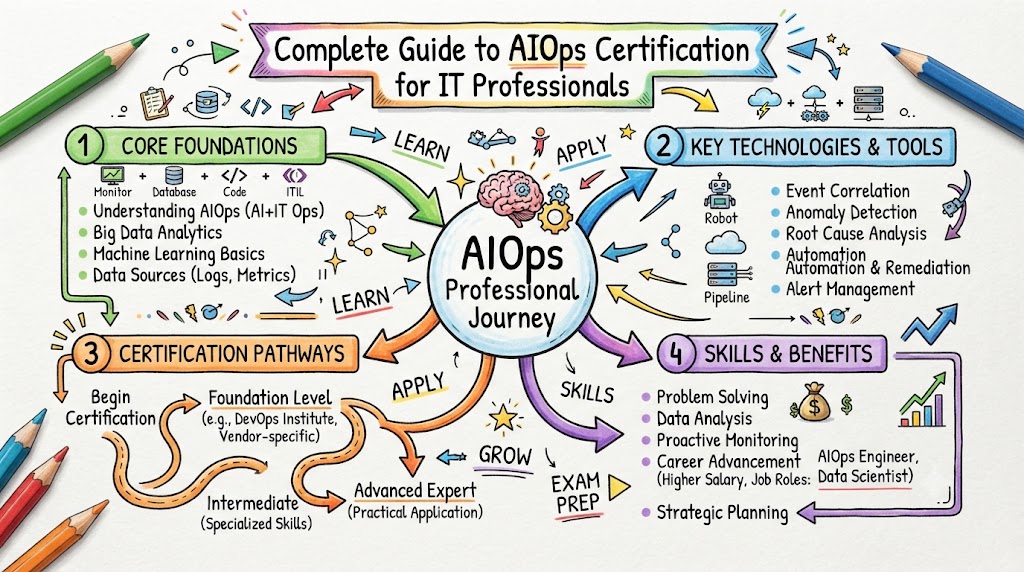
Introduction
IT operations have become increasingly complex due to cloud computing, microservices, Kubernetes, distributed architectures, and hybrid infrastructures. Traditional monitoring and manual incident management approaches are no longer enough to maintain reliability and performance at scale.
AIOps (Artificial Intelligence for IT Operations) is emerging as a critical discipline that combines machine learning, automation, and observability to transform how IT systems are monitored and managed. For IT professionals, AIOps certification has become a valuable pathway to build future-ready skills and advance careers in DevOps, SRE, cloud engineering, and IT operations.
This guide explains what AIOps certification is, why it matters, what you learn, and how it can shape your career in modern IT environments.
What is AIOps Certification?
AIOps certification is a professional credential that validates an individual’s knowledge and skills in applying artificial intelligence to IT operations.
It focuses on how AI and machine learning can improve monitoring, incident management, anomaly detection, and system reliability.
A certified AIOps professional is expected to understand:
- How IT operational data is collected and analyzed
- How machine learning models detect anomalies
- How alerts are correlated and prioritized
- How root cause analysis is automated
- How incidents are predicted and prevented
This certification bridges the gap between traditional IT operations and intelligent, automated systems.
Why AIOps Certification Matters
The demand for AIOps skills is increasing rapidly because modern IT environments generate massive volumes of data every second. Without automation and intelligence, managing this data becomes inefficient and error-prone.
AIOps certification helps professionals:
- Reduce manual effort in incident management
- Improve system uptime and reliability
- Minimize alert fatigue and noise
- Enable faster root cause analysis
- Support proactive and predictive operations
For organizations, certified professionals bring structured approaches to implementing intelligent IT operations strategies.
Who Should Pursue AIOps Certification?
AIOps certification is suitable for a wide range of IT professionals, including:
- DevOps Engineers
- Site Reliability Engineers (SREs)
- Cloud Engineers
- System Administrators
- IT Operations Managers
- Monitoring and Observability Engineers
- Technical Architects
It is especially valuable for professionals working in cloud-native, large-scale, or distributed system environments.
Core Concepts Covered in AIOps Certification
A well-structured AIOps certification program covers several foundational and advanced concepts:
1. AIOps Fundamentals
Understanding the core principles of AI in IT operations, including data ingestion, processing, and analysis.
2. Observability
Learning how logs, metrics, and traces provide visibility into system behavior.
3. Machine Learning for IT Operations
Understanding how algorithms detect anomalies, classify events, and predict failures.
4. Event Correlation
Combining related alerts to reduce noise and identify meaningful incidents.
5. Root Cause Analysis Automation
Using AI models to identify the origin of system issues faster.
6. Predictive Analytics
Forecasting potential system failures before they occur.
7. Incident Lifecycle Automation
Automating detection, response, and resolution workflows.
Key Skills You Gain
After completing an AIOps certification, professionals typically develop skills such as:
- AI-driven monitoring and alerting
- Cloud observability and telemetry analysis
- Automation of IT incident workflows
- Performance optimization of distributed systems
- Designing intelligent IT operations pipelines
- Using data-driven decision-making in operations
These skills are highly relevant in modern enterprise IT environments.
Career Benefits of AIOps Certification
AIOps certification can significantly enhance career opportunities in the IT industry.
1. Better Job Opportunities
Organizations are actively hiring professionals with AIOps expertise for DevOps, SRE, and cloud roles.
2. Higher Salary Potential
Certified professionals often command higher salaries due to specialized skills in AI-driven operations.
3. Career Advancement
AIOps knowledge helps professionals move into senior engineering, architecture, and leadership roles.
4. Industry Relevance
As enterprises adopt automation and observability, AIOps skills are becoming essential rather than optional.
AIOps in Modern IT Operations
AIOps plays a key role in transforming traditional IT operations into intelligent systems.
It helps organizations:
- Detect anomalies in real time
- Reduce alert noise through correlation
- Automate incident response workflows
- Improve system reliability and uptime
- Enable proactive infrastructure management
By integrating AI into IT operations, organizations can shift from reactive problem-solving to predictive and preventive strategies.
How to Prepare for AIOps Certification
To succeed in an AIOps certification program, IT professionals should focus on:
- Understanding basic machine learning concepts
- Learning observability tools and frameworks
- Practicing log and metrics analysis
- Studying cloud and distributed system architectures
- Exploring automation and DevOps pipelines
Hands-on experience with real-world IT environments is highly beneficial.
AIOps Certification vs Traditional IT Certifications
Unlike traditional IT certifications that focus on infrastructure or networking alone, AIOps certification emphasizes intelligence and automation.
| Aspect | Traditional IT Cert | AIOps Certification |
|---|---|---|
| Focus | Infrastructure & systems | AI-driven operations |
| Approach | Reactive | Proactive & predictive |
| Tools | Monitoring tools | AI + observability platforms |
| Outcome | System management | Intelligent automation |
This makes AIOps certification more aligned with future IT trends.
Future of AIOps Careers
The future of IT operations is moving toward fully autonomous systems. AIOps is a key enabler of this transformation.
In the coming years, we will see:
- Increased adoption of AI-driven monitoring systems
- Growth of self-healing infrastructure
- Expansion of predictive IT operations
- Strong demand for AIOps engineers and architects
Professionals with AIOps certification will be well-positioned to lead this transformation.
Conclusion
AIOps certification is becoming one of the most important credentials for IT professionals working in modern infrastructure environments. It equips learners with the skills needed to manage complex systems using artificial intelligence, automation, and observability. As organizations continue to adopt cloud-native technologies and distributed architectures, the need for AIOps expertise will only grow stronger. For IT professionals aiming to stay relevant and advance their careers, AIOps certification offers a powerful pathway into the future of intelligent IT operations.

