
Introduction
Modern IT environments generate massive amounts of data from applications, infrastructure, cloud platforms, networks, logs, metrics, and monitoring systems. As organizations adopt cloud-native architectures, microservices, containers, and distributed systems, traditional IT operations methods struggle to keep pace with the volume and complexity of operational data.
This is where AIOps (Artificial Intelligence for IT Operations) becomes essential. AIOps combines artificial intelligence, machine learning, big data analytics, automation, and observability to help IT teams detect anomalies, correlate events, identify root causes, predict incidents, and automate operational tasks.
Whether you are an IT professional, DevOps engineer, Site Reliability Engineer (SRE), cloud engineer, operations specialist, or a beginner exploring the future of IT operations, understanding AIOps can significantly enhance your career opportunities.
This comprehensive guide explains everything you need to know about AIOps training, certification, tools, use cases, career opportunities, and the learning path from beginner to expert.
What is AIOps?
AIOps stands for Artificial Intelligence for IT Operations. The term refers to the application of AI and machine learning technologies to automate and improve IT operations processes.
AIOps platforms collect data from multiple IT systems, analyze patterns, detect anomalies, correlate events, identify root causes, and recommend or automate corrective actions.
Instead of relying solely on manual monitoring and troubleshooting, organizations use AIOps to improve efficiency, reduce downtime, and accelerate incident resolution.
Key Components of AIOps
- Machine Learning
- Artificial Intelligence
- Big Data Analytics
- Event Correlation
- Observability
- Automation
- Root Cause Analysis
- Predictive Analytics
- Incident Management
- Performance Monitoring
Why AIOps Matters in Modern IT Operations
Today’s enterprises operate highly distributed environments that generate millions of events daily.
Challenges include:
- Alert fatigue
- Complex cloud infrastructures
- Multi-cloud environments
- Microservices architectures
- Large-scale application monitoring
- Increasing operational costs
- Faster incident response requirements
AIOps helps organizations overcome these challenges by automating analysis and decision-making processes.
Benefits of AIOps
Faster Incident Detection
AI algorithms identify unusual patterns before users experience problems.
Improved Root Cause Analysis
AIOps correlates data from multiple systems to quickly identify underlying causes.
Reduced Alert Noise
Event correlation eliminates duplicate and irrelevant alerts.
Predictive Operations
Machine learning models forecast potential issues before they become outages.
Increased Automation
Routine operational tasks can be automated to reduce manual effort.
Better Service Reliability
Organizations improve uptime and service quality through proactive operations.
Understanding the AIOps Ecosystem
AIOps is not a single technology. It is a combination of multiple disciplines.
Data Collection Layer
Collects information from:
- Logs
- Metrics
- Traces
- Events
- Monitoring tools
- Infrastructure components
- Applications
- Cloud services
Analytics Layer
Processes collected data using:
- Machine Learning
- Pattern Recognition
- Statistical Analysis
- Predictive Models
Intelligence Layer
Provides:
- Event Correlation
- Anomaly Detection
- Root Cause Analysis
- Recommendations
Automation Layer
Performs:
- Automated Remediation
- Workflow Automation
- Incident Response
- Resource Optimization
Who Should Learn AIOps?
AIOps is valuable for a wide range of professionals.
DevOps Engineers
Improve automation, monitoring, and operational efficiency.
Site Reliability Engineers (SREs)
Enhance service reliability and incident management.
Cloud Engineers
Manage large-scale cloud environments more effectively.
IT Operations Teams
Reduce operational complexity and improve performance.
System Administrators
Automate repetitive tasks and troubleshooting activities.
Network Engineers
Monitor and optimize network performance using AI insights.
IT Managers
Improve service quality while reducing operational costs.
Students and Beginners
Prepare for emerging careers in AI-driven operations.
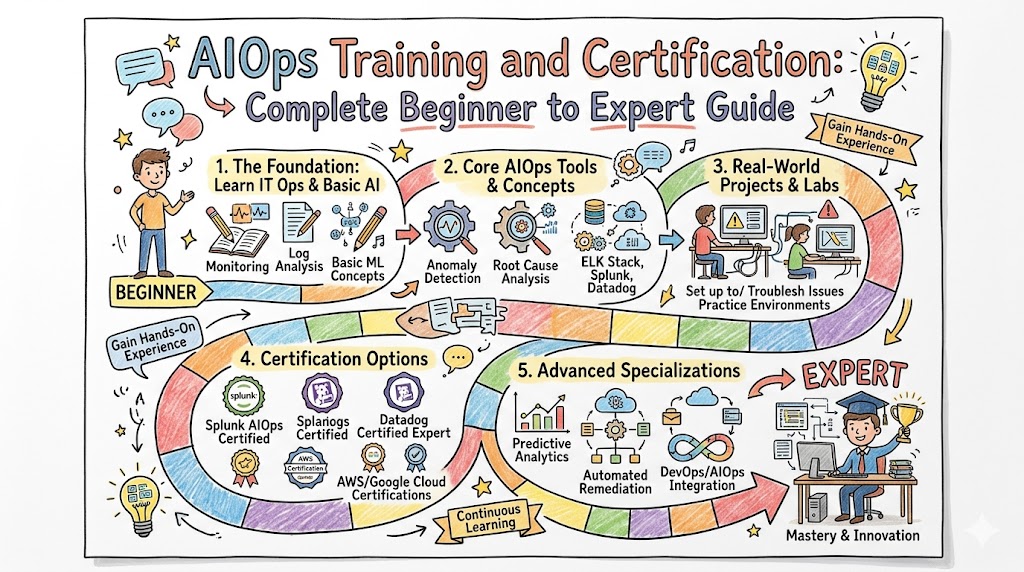
AIOps Training Roadmap for Beginners
Learning AIOps requires understanding several foundational technologies.
Stage 1: Learn IT Operations Fundamentals
Focus on:
- Operating Systems
- Linux Administration
- Networking Concepts
- Server Management
- Monitoring Basics
Stage 2: Understand DevOps
Learn:
- Continuous Integration
- Continuous Delivery
- Infrastructure Automation
- Configuration Management
- Monitoring and Logging
Stage 3: Study Cloud Computing
Important topics include:
- AWS
- Microsoft Azure
- Google Cloud
- Cloud Architecture
- Cloud Monitoring
Stage 4: Learn Observability
Understand:
- Metrics
- Logs
- Traces
- Distributed Systems Monitoring
Stage 5: Understand Data Analytics
Learn:
- Data Collection
- Data Processing
- Data Visualization
- Statistical Analysis
Stage 6: Study Machine Learning Basics
Focus on:
- Supervised Learning
- Unsupervised Learning
- Classification
- Clustering
- Anomaly Detection
Stage 7: Master AIOps Concepts
Learn:
- Event Correlation
- Root Cause Analysis
- Predictive Analytics
- Automated Remediation
- Operational Intelligence
Core Topics Covered in AIOps Training
A comprehensive AIOps course typically covers:
Introduction to AIOps
- AIOps Fundamentals
- Industry Overview
- Business Benefits
Monitoring and Observability
- Infrastructure Monitoring
- Application Monitoring
- Cloud Monitoring
- Distributed Tracing
Event Management
- Event Correlation
- Alert Reduction
- Incident Prioritization
Machine Learning for Operations
- Pattern Recognition
- Forecasting
- Anomaly Detection
Root Cause Analysis
- Dependency Mapping
- Service Topology
- Correlation Analysis
Automation
- Automated Remediation
- Workflow Automation
- Incident Response Automation
Security and Compliance
- Security Monitoring
- Risk Detection
- Compliance Reporting
AIOps Tools You Should Learn
Understanding leading AIOps tools is essential for practical implementation.
Datadog
Provides observability, monitoring, log analytics, and AI-driven insights.
Dynatrace
Offers automatic discovery, AI-powered root cause analysis, and automation.
New Relic
Combines monitoring, observability, and operational intelligence.
Splunk
Supports log analytics, security monitoring, and AIOps capabilities.
IBM Instana
Provides application performance monitoring and observability.
Moogsoft
Specializes in event correlation and noise reduction.
PagerDuty
Enhances incident response and operational automation.
BigPanda
Offers event intelligence and incident management.
Elastic Stack
Supports log analytics, monitoring, and operational visibility.
ServiceNow IT Operations Management
Provides workflow automation and operational intelligence.
AIOps Use Cases
Organizations implement AIOps in many operational areas.
Incident Management
Automates detection, prioritization, and resolution of incidents.
Root Cause Analysis
Identifies underlying causes of performance problems.
Event Correlation
Combines related alerts into meaningful incidents.
Capacity Planning
Predicts future infrastructure requirements.
Performance Optimization
Improves application and infrastructure performance.
Cloud Cost Optimization
Identifies inefficient resource utilization.
Security Monitoring
Detects unusual activity and potential threats.
Service Reliability
Improves uptime and customer experience.
AIOps for SRE Teams
Site Reliability Engineering and AIOps work closely together.
SRE teams use AIOps to:
- Reduce alert fatigue
- Improve MTTR
- Automate incident response
- Enhance observability
- Predict service failures
- Improve reliability metrics
Benefits include:
- Faster resolution times
- Better service availability
- Improved operational efficiency
- Reduced manual intervention
AIOps vs DevOps
Many professionals confuse AIOps and DevOps.
| Feature | DevOps | AIOps |
|---|---|---|
| Primary Goal | Faster software delivery | Smarter IT operations |
| Focus | Development and deployment | Monitoring and operations |
| Automation | CI/CD pipelines | Incident and operations automation |
| Data Usage | Development metrics | Operational data |
| AI Integration | Limited | Core component |
| Main Outcome | Faster releases | Better reliability |
DevOps helps organizations build and release software faster, while AIOps helps them operate and manage systems more efficiently.
AIOps vs MLOps
AIOps and MLOps serve different purposes.
| Feature | AIOps | MLOps |
|---|---|---|
| Focus Area | IT Operations | Machine Learning Lifecycle |
| Users | IT Teams | Data Scientists |
| Goal | Operational Intelligence | Model Management |
| Primary Data | Operational Data | Training Data |
| Automation | Incident Automation | Model Automation |
AIOps optimizes IT operations, whereas MLOps manages machine learning models throughout their lifecycle.
AIOps Certification Guide
Certification validates your understanding of AIOps principles and best practices.
Benefits of AIOps Certification
- Industry recognition
- Enhanced career opportunities
- Improved technical knowledge
- Better job prospects
- Increased earning potential
- Professional credibility
Skills Validated by Certification
- AIOps Fundamentals
- Event Correlation
- Monitoring
- Observability
- Machine Learning Basics
- Root Cause Analysis
- Automation Strategies
Preparing for AIOps Certification
Study the Fundamentals
Develop strong understanding of:
- IT Operations
- Monitoring
- Cloud Computing
- DevOps
- Observability
Gain Practical Experience
Hands-on experience is critical.
Practice with:
- Monitoring platforms
- Log analytics tools
- Incident management systems
- Automation workflows
Learn Industry Tools
Understand:
- Datadog
- Dynatrace
- Splunk
- Elastic
- ServiceNow
Work on Real Projects
Apply concepts in real-world environments.
Experience improves both learning and exam performance.
Career Opportunities After AIOps Training
AIOps skills are increasingly in demand.
AIOps Engineer
Designs and manages AI-powered operational systems.
Site Reliability Engineer
Maintains service reliability and performance.
DevOps Engineer
Automates infrastructure and deployment processes.
Cloud Operations Engineer
Manages cloud environments using intelligent automation.
Observability Engineer
Builds monitoring and visibility solutions.
IT Operations Analyst
Analyzes operational data and improves performance.
Platform Engineer
Creates scalable and reliable infrastructure platforms.
Future of AIOps
The future of IT operations is becoming increasingly intelligent and autonomous.
Emerging trends include:
- Autonomous Operations
- Generative AI Integration
- Self-Healing Systems
- Predictive Incident Management
- AI-Assisted Troubleshooting
- Intelligent Automation
- Advanced Observability
- Multi-Cloud Optimization
Organizations are rapidly investing in AIOps to improve efficiency, reduce downtime, and enhance customer experiences.
Professionals who develop AIOps expertise today will be well-positioned for future technology leadership roles.
Conclusion
AIOps is transforming the way organizations manage modern IT environments. By combining artificial intelligence, machine learning, observability, event correlation, root cause analysis, and automation, AIOps enables teams to detect issues faster, reduce operational complexity, and improve service reliability. As enterprises continue adopting cloud-native technologies and distributed systems, the demand for professionals skilled in AI-driven operations will continue to grow. Whether you are a beginner exploring IT operations, a DevOps engineer seeking advanced automation skills, an SRE focused on reliability, or an experienced IT professional looking to stay ahead of industry trends, AIOps training and certification can provide a valuable competitive advantage. By following a structured learning path, gaining hands-on experience with leading AIOps tools, and earning recognized certifications, you can build the expertise needed to succeed in the next generation of intelligent IT operations.

