
Introduction
Business travel often involves more than simply getting from one city to another. Executives may need to attend meetings in different locations, visit clients, inspect facilities, meet investors, or manage operations across multiple regions. When schedules become demanding, the time and flexibility involved in traditional travel can become important business considerations.
Private aviation offers an alternative approach for business leaders who need greater control over their travel arrangements. Depending on the itinerary, a private charter can provide flexible departure planning, access to additional airports, greater privacy, and a more convenient environment for working while traveling.
Private aviation is not necessarily the right choice for every business trip. Its value depends on factors such as the number of passengers, destinations, schedule, aircraft requirements, and overall business objectives. Understanding these factors allows business leaders to determine when private aviation can genuinely improve the efficiency of a trip.
What Is Private Aviation for Business Travel?
Private aviation refers to air travel using privately chartered or privately operated aircraft rather than scheduled commercial airline services.
For business travelers, this can include on-demand private jet charters and other forms of business aviation designed around specific travel requirements.
Unlike a standard commercial itinerary, a private charter can often be planned around the traveler’s schedule and destination requirements. The aircraft can be selected according to passenger numbers, distance, baggage needs, and other trip-specific considerations.
For business leaders, the main attraction is often not luxury alone. It is the ability to design a travel arrangement around a business schedule.
Why Business Leaders Are Considering Private Aviation
Business leaders frequently work with demanding schedules. A single day may include meetings in multiple cities, site visits, negotiations, or important events.
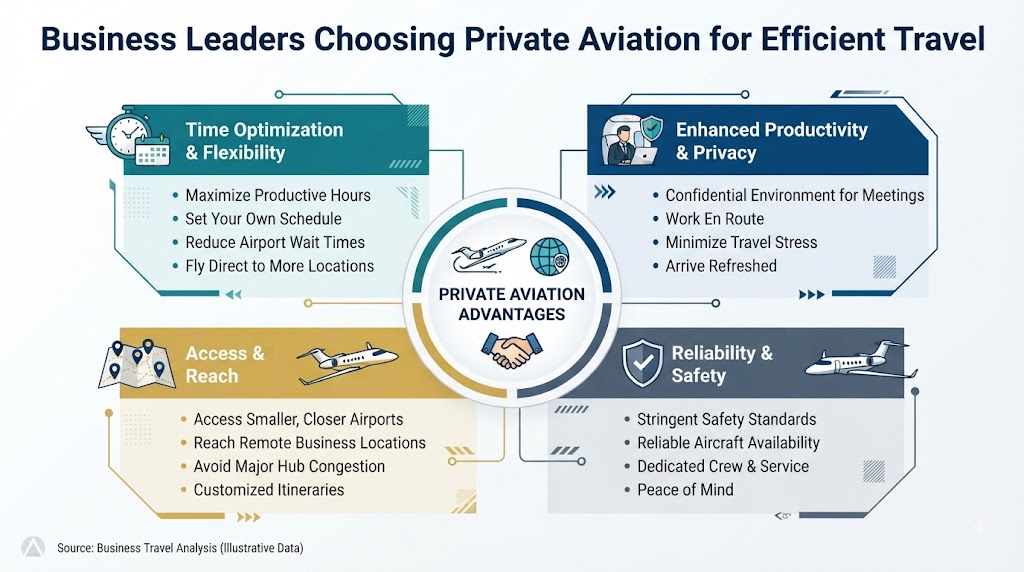
Private aviation can provide several potential advantages in these situations.
1. Better Time Efficiency
Time is one of the most valuable resources for an executive.
Commercial travel can involve scheduled departure times, large terminals, connecting flights, and other processes that may not align with a business leader’s preferred schedule.
Private aviation can offer greater control over departure planning and may allow travelers to use airports closer to their actual destinations.
This can reduce certain types of travel friction and make it easier to organize a demanding itinerary.
However, the actual time benefit depends on the route, airport, aircraft, weather, ground transportation, and other factors.
2. Greater Schedule Flexibility
Business meetings do not always fit neatly into commercial flight schedules.
A negotiation may run longer than expected. A client meeting may be moved. An executive may suddenly need to visit another location.
Private charter travel can provide more flexibility when arranging departure times around these changing requirements.
This can be particularly useful for leaders managing:
- Client meetings
- Board meetings
- Investor discussions
- Facility visits
- Conferences
- Business negotiations
- Regional operations
The ability to build a travel plan around the business schedule can make a significant difference for time-sensitive trips.
3. Access to More Airports
One of the practical advantages of private aviation is access to a broader range of airports, subject to aircraft, airport, and regulatory limitations.
Commercial airlines generally concentrate their services around larger airports and established routes. Private aircraft may be able to use smaller airports closer to a business destination.
This can be valuable when an executive needs to reach:
- Industrial facilities
- Regional offices
- Remote business locations
- Smaller cities
- Manufacturing sites
- Multiple destinations within one region
Choosing an airport closer to the final destination can simplify the overall journey.
4. A More Productive Travel Environment
Travel time does not necessarily have to mean lost work time.
Private aircraft can provide an environment where executives may be able to:
- Review business documents
- Prepare presentations
- Discuss strategy with colleagues
- Make permitted communications
- Conduct private conversations
- Prepare for upcoming meetings
Aircraft amenities vary, so travelers should confirm specific connectivity, workspace, and communication capabilities before booking.
For executives with demanding schedules, the ability to use travel time productively can be an important consideration.
5. Greater Privacy
Confidentiality is important in many business situations.
Executives may need to discuss:
- Corporate strategy
- Financial information
- Acquisitions
- Investments
- Legal matters
- Negotiations
- Personnel decisions
A private cabin can provide a more controlled environment for confidential conversations than a crowded commercial travel setting.
This does not mean every private aircraft is designed as a formal conference room, but the increased privacy can be valuable for business leaders handling sensitive information.
6. More Efficient Multi-City Travel
Some business trips involve several destinations rather than a simple return journey.
For example, an executive might need to travel from a company’s headquarters to a client meeting, then continue to a regional office before attending an evening industry event.
A possible itinerary could look like:
City A → City B → City C → City D
Planning a multi-city trip around commercial schedules can sometimes create unnecessary complexity.
Private aviation may provide greater flexibility when designing a route around the actual business requirements.
7. Reduced Travel Friction
Private aviation can simplify some parts of the travel process.
Depending on the airport and charter arrangement, travelers may benefit from:
- Flexible departure planning
- Smaller airport environments
- Simplified boarding procedures
- Customized ground transportation
- Direct itinerary planning
- Less dependence on commercial airline schedules
These benefits can make the overall travel experience more predictable.
However, private aviation does not eliminate every possible delay. Weather, aircraft availability, airport restrictions, air traffic, and other operational factors can still affect a flight.
Private Aviation vs Commercial Air Travel for Business Leaders
Both commercial and private aviation have advantages. The right option depends on the requirements of each trip.
| Factor | Commercial Travel | Private Aviation |
|---|---|---|
| Schedule flexibility | Usually based on published schedules | More flexible charter planning |
| Airport access | Primarily larger scheduled airports | May include additional suitable airports |
| Privacy | Limited in shared cabins | Greater cabin privacy |
| Multi-city routing | May require connections or schedule adjustments | More customized routing may be possible |
| Productivity | Depends on aircraft and travel environment | More controlled working environment |
| Group travel | Fixed airline seating options | Aircraft can be selected according to group size |
| Travel customization | Generally limited | More itinerary customization |
| Cost structure | Usually lower for individual travelers | Varies according to aircraft and itinerary |
Private aviation should therefore be viewed as a specialized travel solution rather than an automatic replacement for commercial airlines.
When Does Private Aviation Make Business Sense?
Private aviation can make more sense when the business value of flexibility and time control is significant.
Multiple Meetings in Different Cities
Executives who need to visit several cities within a short period may benefit from customized routing.
Tight Business Schedules
When meetings are scheduled close together, greater control over departure times can help make the itinerary easier to manage.
Remote Business Locations
Companies operating facilities away from major commercial airports may find additional airport access useful.
Time-Sensitive Negotiations
Important negotiations, transactions, or business opportunities may require executives to travel on short or changing schedules.
Group Executive Travel
When several executives need to travel together, a charter may provide a more coordinated travel arrangement.
Limited Commercial Connectivity
Some destinations may require multiple commercial connections. Private aviation can potentially simplify the route when a suitable airport is available.
Factors Business Leaders Should Consider Before Booking
Private aviation decisions should be based on the complete travel requirement rather than the aircraft alone.
Before booking, consider:
Number of Passengers
The number of travelers influences aircraft selection and overall charter requirements.
Destination
Consider whether the destination has a suitable airport and whether private aircraft can operate there.
Aircraft Range
Different aircraft have different range capabilities. The aircraft must be appropriate for the planned route.
Baggage Requirements
Business equipment, samples, luggage, and other items can influence aircraft selection.
Departure Time
Confirm whether the desired departure time is operationally feasible.
Number of Flight Legs
A multi-city itinerary may require a different aircraft or planning approach than a simple round trip.
Ground Transportation
Airport selection is only part of the journey. Ground transportation should also be planned around meetings and final destinations.
Budget
Private aviation costs vary considerably, so businesses should establish a clear travel budget before booking.
Understanding the Cost of Private Aviation
Private aviation should not be evaluated solely by comparing the charter price with the price of an airline ticket.
Several factors can affect the total cost of a private charter, including:
- Aircraft type
- Flight distance
- Passenger count
- Airport fees
- Aircraft availability
- Positioning requirements
- Trip duration
- Number of flight legs
- Additional services
A business leader should also consider the potential value of the travel arrangement.
For example, a trip involving several important meetings may create significant business value if the itinerary allows an executive to visit multiple locations efficiently.
The goal is not to assume that private aviation is always cheaper. Instead, businesses should evaluate whether the overall travel arrangement supports the company’s objectives.
How to Choose a Private Aviation Provider
Selecting the right provider is an important part of the process.
Business leaders should consider several factors.
Safety and Operational Standards
Understand who operates the aircraft and review the relevant operator credentials and safety practices.
Aircraft Options
The provider should be able to identify an aircraft suitable for the route, passenger count, baggage requirements, and other trip needs.
Transparent Pricing
Ask for a clear explanation of the estimated charter cost and any additional charges that may apply.
Customer Support
Responsive support is particularly important when itineraries change or when international travel involves multiple arrangements.
Trip Planning
A professional provider should be able to help coordinate flight details, airport requirements, and related travel arrangements.
Reputation
Review the provider’s experience, service reputation, and customer feedback before making a decision.
For business leaders exploring charter options, CHARTERKINGS.COM can serve as a resource for understanding private aviation and evaluating executive travel requirements.
Common Mistakes Business Leaders Should Avoid
Choosing Only on Price
The lowest quoted price may not provide the aircraft, schedule, or services best suited to the business trip.
Ignoring Aircraft Suitability
Aircraft differ in range, passenger capacity, cabin configuration, and baggage capability. The right aircraft should match the itinerary.
Not Checking Airport Accessibility
Not every private aircraft can operate from every airport. Airport suitability should be confirmed before finalizing the itinerary.
Failing to Confirm Passenger Requirements
Passenger numbers, baggage, special equipment, and other requirements should be communicated clearly.
Leaving Planning Too Late
Although private aviation can offer flexibility, aircraft availability is not unlimited. Important trips should be planned as early as practical.
Ignoring the Complete Cost
Businesses should understand the full expected cost rather than focusing on the initial quoted amount.
Not Reviewing Operator Credentials
The aircraft and operator should be properly evaluated before booking.
Forgetting Ground Transportation
An efficient flight can still result in an inefficient business trip if transportation between the airport and meeting locations is poorly planned.
Assuming Every Aircraft Offers the Same Experience
Cabin size, seating, connectivity, baggage capacity, and onboard services vary between aircraft.
Choosing Convenience Without a Business Reason
Private aviation should solve a genuine travel requirement. If a commercial flight is simpler and more appropriate, it may remain the better choice.
A Practical Business Travel Scenario
Consider a business executive who needs to visit three locations during a single business trip.
The first meeting takes place at a company’s headquarters. A second meeting is scheduled several hours away, followed by an evening industry event in another city.
A commercial itinerary may require the executive to work around published schedules and available connections. Depending on the locations, this could make the trip more difficult to coordinate.
A private charter may allow the itinerary to be designed around the business schedule, provided suitable aircraft and airports are available.
The value is not simply the flight itself. The broader benefit may come from coordinating meetings, travel, ground transportation, and return plans into one organized itinerary.
This type of scenario demonstrates why private aviation can be particularly relevant for executives with complex travel requirements.
Benefits of Private Aviation for Business Leaders
Private aviation may provide several advantages when the circumstances justify it.
Better Schedule Control
Executives can plan travel around business commitments rather than relying entirely on published airline schedules.
Flexible Routing
Private charters can potentially support more customized itineraries.
Additional Airport Access
Suitable smaller airports may bring travelers closer to their actual destinations.
Greater Privacy
Private cabins can provide a more controlled environment for business conversations.
Productive Travel Time
Executives may be able to use portions of the journey for work and preparation.
Customized Travel Arrangements
Aircraft and itinerary planning can be tailored to passenger and trip requirements.
Efficient Group Travel
A private aircraft can provide a coordinated travel environment for executive teams when appropriate.
Business Travel Priorities and Private Aviation
| Business Priority | How Private Aviation Can Help |
| Tight schedule | Flexible departure planning |
| Multiple destinations | Customized routing |
| Confidential discussions | Private cabin environment |
| Remote locations | Potential access to additional airports |
| Executive productivity | Controlled working environment |
| Group travel | Aircraft selected according to passenger requirements |
| Travel customization | Itinerary planned around business needs |
Frequently Asked Questions
1. Why do business leaders choose private aviation?
Business leaders may choose private aviation when they value schedule flexibility, privacy, airport access, productivity, or customized multi-city travel.
2. Is private aviation more time-efficient than commercial travel?
It can be for certain itineraries, particularly when airport access, schedule flexibility, and multiple destinations are important. The actual benefit depends on the specific route and circumstances.
3. Can private aircraft fly to smaller airports?
Some private aircraft can operate from smaller airports, subject to aircraft capabilities, airport facilities, regulations, weather, and other operational considerations.
4. Is private aviation suitable for multi-city business trips?
Yes. Customized routing can make private aviation useful for business leaders who need to visit several locations during a limited period.
5. Can executives work during private flights?
Private aircraft can provide a more controlled environment for working, although connectivity and onboard facilities vary by aircraft.
6. How does private aviation provide more privacy?
A private aircraft allows a business group to travel in a dedicated cabin rather than sharing the cabin with unrelated passengers.
7. Is private aviation always more expensive than commercial travel?
Private aviation generally has a different cost structure and is not automatically the most economical choice. Businesses should evaluate the complete itinerary and the value of time, flexibility, and convenience.
8. What should businesses consider before chartering an aircraft?
Important factors include passenger numbers, destination, aircraft range, baggage, departure time, airport availability, number of flight legs, ground transportation, and budget.
9. How should a business choose a private aviation provider?
Businesses should evaluate operator credentials, aircraft suitability, pricing transparency, customer support, trip-planning capabilities, and overall reputation.
10. When does private aviation make the most sense for business travel?
It can be particularly useful for complex itineraries, multiple destinations, time-sensitive meetings, remote business locations, executive group travel, and situations where schedule flexibility is highly valuable.
Final Thoughts
Private aviation can be a practical business travel solution when executives need greater control over schedules, destinations, privacy, and travel arrangements. Its value extends beyond the aircraft itself and can include better coordination of meetings, airport access, ground transportation, and multi-city itineraries.
However, private aviation is not automatically the right choice for every trip. Business leaders should evaluate the actual travel requirements, aircraft suitability, total cost, airport availability, and operational considerations before making a decision.

