
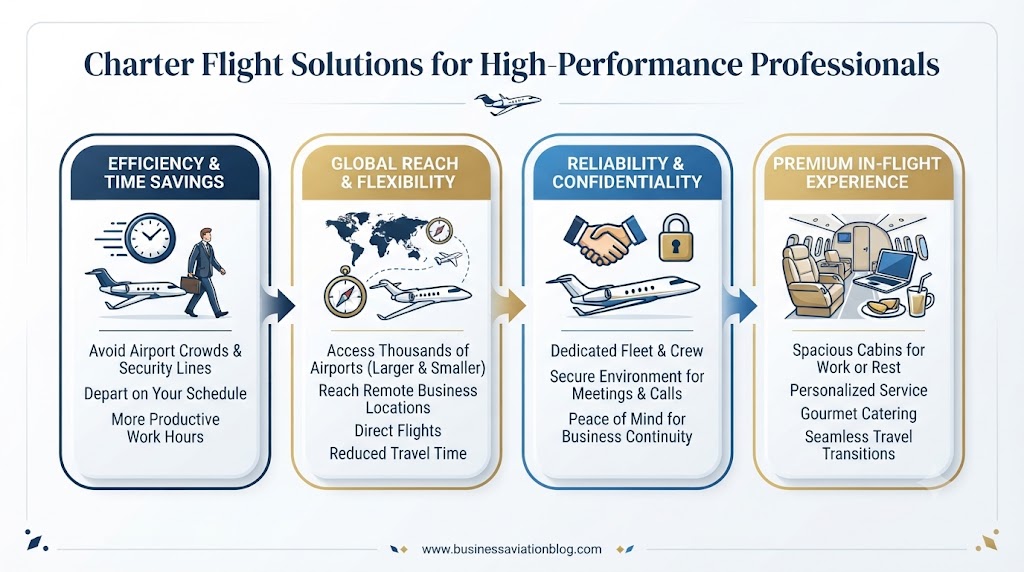
Introduction
High-performance professionals work in environments where time, focus, confidentiality, and rapid decision-making matter every day. CEOs, entrepreneurs, investors, attorneys, consultants, doctors, entertainers, athletes, and senior executives often manage demanding schedules that include meetings, site visits, negotiations, conferences, and urgent travel.
Commercial airline travel can support many journeys, but fixed schedules, long check-in procedures, crowded terminals, connecting flights, and limited route flexibility may reduce productivity. For professionals whose time has direct business value, travel delays can affect opportunities, client relationships, project timelines, and important decisions.
Charter flight solutions provide a more flexible approach to executive transportation. Instead of adjusting an entire business schedule around a published airline timetable, travelers can arrange flights around their route, passenger requirements, meeting commitments, and preferred departure time.
Who Are High-Performance Professionals?
High-performance professionals are individuals whose roles require consistent concentration, rapid decision-making, responsibility, and effective time management.
They may include:
- CEOs and company founders
- Corporate executives
- Entrepreneurs
- Investors
- Legal professionals
- Business consultants
- Healthcare specialists
- Professional athletes
- Entertainers
- Engineers
- Senior government officials
- Corporate travel managers
- Project leaders
Their schedules often include several competing priorities. A single day may involve an investor meeting, a client presentation, a facility visit, and an urgent conference call.
For these professionals, travel is not separate from work. It is part of their working day. The quality and reliability of transportation can directly affect how effectively they perform.
What Are Charter Flight Solutions?
Charter flight solutions are private air travel services arranged according to a client’s specific itinerary.
Instead of purchasing a seat on a scheduled airline, a person or organization arranges the use of an aircraft for a particular journey.
The arrangement may be based on:
- Departure location
- Destination
- Preferred travel time
- Number of passengers
- Flight distance
- Baggage requirements
- Cabin preferences
- Ground transportation
- Catering
- Special travel needs
Charter services can support domestic and international travel, subject to aircraft suitability, airport access, weather, crew availability, and regulatory requirements.
Available aircraft may include:
- Turboprops
- Very light jets
- Light jets
- Midsize jets
- Super-midsize jets
- Heavy jets
- Long-range business aircraft
The right aircraft depends on the journey rather than simply the appearance or size of the cabin.
How Charter Flights Differ from Scheduled Airlines
Scheduled airlines follow fixed routes and published departure times. Passengers travel through major airports and share the aircraft with many other people.
Private charter travel is more customized.
Depending on the route and operator, it may offer:
- Flexible departure scheduling
- Access to additional airports
- Private cabin space
- Faster boarding procedures
- Customized onboard services
- Direct routing where operationally possible
- Easier itinerary changes
- Coordinated ground transportation
This flexibility can be especially valuable when a professional has a time-sensitive schedule or needs to visit a location that is not conveniently served by commercial airlines.
Why High-Performance Professionals Choose Charter Flights
Time Is a Business Resource
Time is often the main reason professionals consider charter aviation.
A commercial journey may involve:
- Early airport arrival
- Security queues
- Boarding delays
- Connecting flights
- Baggage collection
- Ground travel from a distant airport
A charter flight may reduce some of these steps by using dedicated facilities and smaller airports where available.
The time saved can be used for:
- Additional meetings
- Client discussions
- Project planning
- Rest
- Business development
- Family commitments
For busy leaders, saving several hours can be more valuable than simply improving comfort.
Greater Scheduling Flexibility
High-performance professionals rarely work around perfectly predictable schedules.
Meetings may run late. Negotiations may continue. A site visit may reveal an urgent issue. A client may request an immediate discussion.
Charter flight solutions can provide more scheduling flexibility than fixed commercial services.
Possible benefits include:
- Choosing a preferred departure time
- Adjusting the itinerary when conditions allow
- Planning same-day return travel
- Visiting multiple cities
- Responding to urgent business needs
- Coordinating travel with meeting schedules
Operational conditions still apply, but the journey can often be designed around the client’s priorities.
Better Access to Regional Airports
Commercial airlines generally concentrate operations at major airports. These airports may be far from factories, project sites, private offices, resorts, hospitals, or regional business centers.
Business aircraft may use a wider selection of airports, depending on runway length, aircraft type, local rules, weather, and operating hours.
Landing closer to the final destination may reduce:
- Ground transportation time
- Traffic delays
- Overnight hotel requirements
- Missed meetings
- Travel fatigue
For professionals visiting industrial sites or regional offices, airport access can be one of the most important advantages of private aviation.
A Productive Work Environment
A private cabin can function as a mobile workspace.
Passengers may be able to:
- Review financial reports
- Prepare presentations
- Conduct team discussions
- Respond to emails
- Review contracts
- Plan negotiations
- Coordinate projects
- Hold confidential conversations
The exact facilities depend on the aircraft. Some cabins provide worktables, charging points, Wi-Fi, conference seating, and quieter spaces.
Instead of losing productive hours during travel, professionals can continue working throughout much of the journey.
Greater Privacy
High-performance professionals often travel with sensitive information.
This may include:
- Financial reports
- Legal documents
- Business strategies
- Product plans
- Investor information
- Acquisition discussions
- Client records
- Government documents
A private cabin reduces exposure to unrelated passengers and provides a more controlled environment for conversations.
Private aviation does not automatically guarantee confidentiality. Travelers must still use secure devices, manage documents carefully, and follow company information-security policies.
However, the smaller and more controlled travel environment can make confidential business discussions easier to manage.
Reduced Travel Fatigue
Repeated travel can affect concentration, energy, and decision-making.
Long waits, crowded airports, connections, and irregular schedules can leave professionals exhausted before they arrive.
Charter flights may reduce fatigue by offering:
- Quieter cabins
- More personal space
- Comfortable seating
- Direct journeys
- Personalized catering
- Rest opportunities
- Shorter airport procedures
Arriving refreshed can be especially important before an investor presentation, legal negotiation, medical procedure, performance, or major client meeting.
Flexible Departure Scheduling
A major advantage of charter travel is the ability to design the flight around the professional’s working schedule.
For example, an executive may complete a morning meeting, travel to another city in the afternoon, conduct a site inspection, and return home that evening.
This type of itinerary may be difficult with scheduled airlines because available flights may not match the meeting times.
Charter scheduling can support:
- Early morning departures
- Late returns
- Same-day travel
- Weekend business trips
- Time-sensitive journeys
- Multi-location schedules
Clients should still allow for weather, crew requirements, airport limitations, and operational planning.
Multi-City Business Trips
High-performance professionals often need to visit several locations in a limited period.
A commercial multi-city journey may involve:
- Multiple bookings
- Long connections
- Overnight stays
- Repeated security procedures
- Limited departure choices
Charter flight solutions can combine several destinations into one coordinated itinerary.
A business team may visit:
- A regional office
- A manufacturing facility
- An investor meeting
- A customer site
- A conference venue
The aircraft and crew can be planned around the complete trip, helping reduce unnecessary waiting and improve schedule control.
Confidential Business Discussions
A private cabin can support important discussions that would be difficult to conduct in a public environment.
Examples include:
- Merger planning
- Legal consultation
- Financial restructuring
- Product launch preparation
- Investor negotiations
- Government contract discussions
- Crisis management
- Leadership planning
Travelers should still use good confidentiality practices.
Sensitive documents should be secured, screens should be protected, and electronic communication should follow company security policies.
Private aviation creates a more suitable environment, but responsible information handling remains essential.
Team Travel and Collaboration
Charter flights can help business teams travel together.
This may benefit:
- Executive leadership groups
- Legal teams
- Medical specialists
- Consultants
- Project engineers
- Investors
- Production teams
- Sports professionals
Traveling together allows the group to:
- Review objectives
- Prepare for meetings
- Assign responsibilities
- Discuss strategy
- Evaluate risks
- Debrief after an event
The journey becomes part of the working process rather than unproductive time between destinations.
Supporting Business Continuity
Unexpected business events can require immediate attention.
Examples include:
- Equipment failure
- Supply chain disruption
- Client emergencies
- Facility problems
- Legal deadlines
- Project delays
- Executive meetings
- Investment opportunities
Charter flight solutions can help organizations move decision-makers and technical experts quickly when suitable aircraft and airports are available.
This can support faster response times and reduce the business impact of travel limitations.
Charter Flights for Healthcare Professionals
Healthcare specialists may need to travel urgently for:
- Medical consultations
- Surgical procedures
- Hospital support
- Training
- Conferences
- Research meetings
A charter flight may support a more controlled schedule and direct routing.
However, a standard private charter should not be confused with a medically equipped air ambulance. Patients requiring medical monitoring or specialized equipment need an appropriate medical transport service.
Charter Flights for Legal Professionals
Attorneys and legal teams often travel with confidential documents and strict deadlines.
Private charter may help them:
- Reach court locations
- Attend negotiations
- Meet clients
- Conduct team discussions
- Review case material
- Manage urgent filings
A private cabin can offer a more suitable environment for legal preparation, although professional confidentiality procedures must still be followed.
Charter Flights for Investors and Financial Executives
Investors, bankers, and financial professionals may need to visit several businesses, meet management teams, or inspect potential investments.
Charter aviation can support:
- Multi-city due diligence
- Private financial discussions
- Site visits
- Investor meetings
- Time-sensitive transactions
- International travel
The ability to adjust the itinerary can be valuable when meetings change or additional site visits become necessary.
Charter Flights for Athletes and Entertainers
Professional athletes and entertainers often face demanding schedules, specialized baggage needs, privacy concerns, and the need for physical recovery.
Charter solutions may support:
- Event travel
- Competition schedules
- Production tours
- Equipment transport
- Team coordination
- Reduced public exposure
- Rest between engagements
Aircraft selection should consider passenger count, equipment, baggage volume, and route requirements.
Charter Flights for Consultants and Technical Teams
Consultants, engineers, and technical specialists may need to reach remote project sites that are difficult to access through major airports.
Private aviation can help teams travel closer to:
- Construction sites
- Energy facilities
- Manufacturing plants
- Mining operations
- Research locations
- Infrastructure projects
This can reduce total travel time and allow specialists to respond more quickly to project needs.
Choosing the Right Aircraft
Aircraft selection should be based on the complete travel requirement.
Important factors include:
- Flight distance
- Passenger count
- Baggage
- Airport runway
- Cabin space
- Fuel-stop requirements
- Ground access
- Budget
- Weather
- Onboard facilities
A larger aircraft is not always necessary. A smaller aircraft may offer better access to a regional airport, while a larger jet may be more suitable for long-distance team travel.
Ask the charter provider to explain why the proposed aircraft matches the journey.
Understanding Charter Flight Costs
Charter pricing depends on several factors.
These may include:
- Aircraft category
- Flight time
- Aircraft positioning
- Fuel
- Crew
- Airport charges
- Handling
- Parking
- Overnight requirements
- Catering
- Ground transportation
- International permits
- Taxes
- Seasonal demand
Travelers should request a written quotation that explains what is included and which charges may change.
The lowest price may not offer the best overall value if it requires a fuel stop, uses a less suitable airport, or excludes important services.
Choosing the Right Charter Provider
Selecting the right provider is as important as selecting the aircraft.
Consider:
Operator Identity
Confirm who will actually operate the flight. The booking company may be a broker rather than the aircraft operator.
Safety Practices
Ask about maintenance, crew training, operational procedures, and the operator’s experience.
Aircraft Suitability
The provider should recommend an aircraft based on route, passengers, luggage, and airport requirements.
Transparent Pricing
The quotation should explain inclusions, exclusions, and possible additional charges.
Communication
A professional provider should give clear answers and provide timely itinerary updates.
Scheduling Support
Ask how delays, aircraft changes, weather issues, and last-minute adjustments are handled.
Customer Service
Business travelers need reliable support before, during, and after the flight.
Common Mistakes High-Performance Professionals Should Avoid
Choosing Only by Price
A cheaper flight may involve a smaller cabin, additional fuel stops, less baggage space, or excluded costs.
Ignoring Alternative Airports
A regional airport may be closer to the final destination and save significant ground travel time.
Providing Incomplete Information
The provider needs accurate details about passengers, baggage, timing, catering, and special requirements.
Booking the Wrong Aircraft
Selecting an aircraft based only on appearance can result in limited baggage space or unnecessary cost.
Failing to Review Cancellation Terms
Business schedules can change. Understand the cancellation and rescheduling policy before payment.
Assuming Wi-Fi Is Always Available
Connectivity varies by aircraft and route. Confirm availability before booking.
Forgetting Ground Transportation
The benefits of a fast flight can be reduced by poor planning after arrival.
Executive Charter Flight Planning Checklist
Before booking, confirm the following:
- Travel objectives defined
- Departure and arrival airports reviewed
- Passenger list finalized
- Aircraft category confirmed
- Baggage requirements shared
- Ground transportation arranged
- Identification documents checked
- Catering preferences submitted
- Connectivity needs confirmed
- Schedule reviewed
- Weather alternatives discussed
- Charter quotation reviewed
- Cancellation terms understood
- Operator identity confirmed
- Emergency contacts saved
- Final travel briefing received
Frequently Asked Questions
1. What are charter flight solutions?
Charter flight solutions are private flights arranged according to the client’s route, schedule, passenger count, and travel requirements. Rather than purchasing individual seats on a fixed airline service, the client arranges an aircraft for a specific journey. The aircraft category, airport, onboard facilities, and services are selected based on operational needs.
2. Why do executives use private jet charters?
Executives often use charter flights to save time, access additional airports, maintain flexible schedules, travel with teams, and continue working during the journey. Private aviation may also support multi-city travel and reduce time spent in crowded terminals. The value depends on the executive’s schedule, route, business objectives, and cost considerations.
3. Can charter flights improve productivity?
Yes. A private cabin can provide a more suitable environment for reviewing reports, holding discussions, preparing presentations, and coordinating with colleagues. Available facilities depend on the aircraft. Travelers should confirm worktables, charging points, Wi-Fi, cabin space, and communication services before booking.
4. Are charter flights suitable for multi-city travel?
Charter flights can be highly useful for multi-city itineraries. They may allow professionals to visit several destinations without relying on airline connections. The aircraft, crew schedule, airport availability, weather, and route must be carefully planned. A complete itinerary should be provided before booking.
5. Can executive teams travel together?
Yes. Teams can travel together when the aircraft has sufficient seating and baggage capacity. Shared travel allows colleagues to prepare for meetings, discuss projects, and coordinate responsibilities. The number of passengers, luggage, cabin layout, and flight distance should be confirmed when selecting the aircraft.
6. How flexible are charter flight schedules?
Charter flights generally offer greater scheduling flexibility than commercial airlines, but they remain subject to aircraft availability, crew duty limits, airport operating hours, weather, permits, and air traffic conditions. Clients should communicate possible schedule changes early and ask how adjustments may affect the price.
7. Which industries benefit from business aviation?
Business aviation can support professionals in finance, healthcare, technology, construction, manufacturing, legal services, energy, entertainment, sports, consulting, and government. It is particularly valuable when time-sensitive travel, remote destinations, team coordination, or confidentiality are important.
8. What should I consider when choosing a charter provider?
Consider the actual operator, safety practices, crew experience, aircraft suitability, pricing transparency, maintenance standards, customer support, cancellation terms, and communication quality. Ask for written details and avoid choosing solely by price.
9. Are charter flights available for international travel?
Many charter aircraft can support international journeys, depending on range, permits, customs facilities, passenger documents, and airport requirements. International flights require additional planning for passports, visas, immigration, customs, and route approvals. Early coordination is recommended.
10. How should professionals prepare for a charter flight?
Provide accurate passenger names, baggage details, dietary requests, ground transportation needs, and identification documents. Confirm the airport location, reporting time, aircraft type, operator contact, and itinerary. Sensitive business documents and devices should be handled according to company security policies.
Conclusion
High-performance professionals need transportation that supports demanding schedules rather than creating additional limitations. Charter flight solutions can provide greater flexibility, improved airport access, productive cabin environments, and more efficient multi-city travel.
The value of private aviation comes from matching the aircraft and itinerary to the business objective. Careful planning, accurate passenger information, suitable airport selection, transparent pricing, and reliable operational support are essential for a successful journey.

