
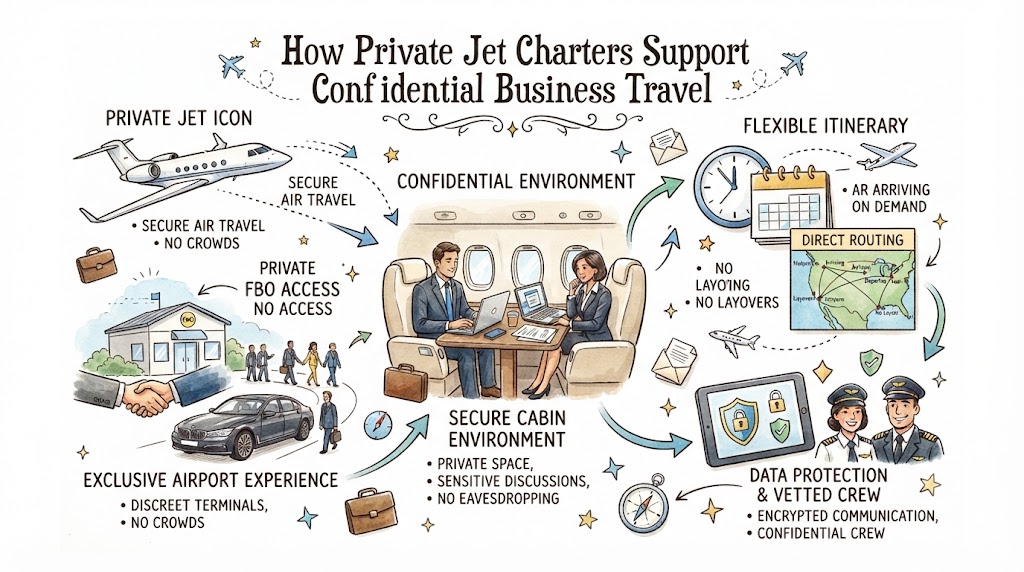
Introduction
In today’s competitive business environment, information is often one of an organization’s most valuable assets. Whether executives are negotiating a merger, meeting investors, discussing intellectual property, or preparing for a major product launch, maintaining confidentiality has become a critical part of corporate travel.
Commercial airlines serve millions of passengers every day, but they are not designed around privacy. Crowded terminals, shared lounges, delayed flights, and public boarding areas create numerous opportunities for confidential conversations to be overheard or sensitive business plans to be exposed.
Private jet charters offer a fundamentally different travel experience. Beyond luxury and convenience, they provide executives, entrepreneurs, legal teams, government officials, and high-profile clients with an environment designed for discretion, flexibility, and productivity.
Understanding Confidential Business Travel
Confidential business travel refers to business trips where privacy, discretion, and information security are essential throughout the journey.
Unlike standard corporate travel, confidential travel often involves sensitive meetings, high-value negotiations, legal discussions, financial transactions, or strategic planning that could be affected if information becomes public prematurely.
Examples include:
- Merger and acquisition meetings
- Executive board meetings
- Investor presentations
- Legal consultations
- Government negotiations
- Product launch planning
- Intellectual property discussions
- Executive recruitment
- Crisis management
- High-profile client meetings
In these situations, protecting conversations, schedules, documents, and passenger identities is just as important as arriving on time.
Why Confidentiality Matters in Corporate Travel
Business decisions often involve millions of dollars, strategic partnerships, or proprietary information. Even minor information leaks can influence markets, affect negotiations, or damage reputations.
Confidential travel helps organizations:
- Protect trade secrets
- Prevent information leaks
- Maintain competitive advantage
- Reduce security risks
- Protect executive privacy
- Ensure uninterrupted business discussions
- Improve client confidence
- Support regulatory compliance where applicable
For many organizations, confidential travel is not simply a convenience—it is an operational necessity.
Challenges of Commercial Airline Travel
Commercial aviation offers affordability and extensive route networks, but it presents several challenges for organizations handling sensitive information.
Public Airports
Passengers move through crowded terminals where business conversations may easily be overheard.
Shared Waiting Areas
Airport lounges often contain competitors, journalists, clients, or industry professionals.
Flight Delays
Unexpected delays can disrupt important meetings and confidential schedules.
Limited Privacy
Executives frequently sit near strangers, making private discussions difficult.
Media Exposure
Well-known executives, celebrities, or public officials may attract unwanted attention at busy airports.
Reduced Productivity
Commercial flights rarely provide an environment suitable for confidential meetings or strategic planning.
How Private Jet Charters Protect Business Confidentiality
Exclusive Private Terminals
Private jet travelers typically use Fixed Base Operators (FBOs), which are separate from crowded commercial terminals.
These facilities provide:
- Private entrances
- Dedicated security
- Comfortable lounges
- Faster boarding
- Controlled passenger access
This significantly reduces unnecessary public exposure.
Controlled Passenger Access
Unlike commercial airlines, only authorized passengers and approved crew members have access to the aircraft.
There are no crowded boarding gates or large passenger groups, allowing businesses to maintain greater control over who is present throughout the journey.
Flexible Flight Scheduling
Private charter flights operate according to the client’s schedule.
Organizations can:
- Depart earlier
- Delay departures if meetings run long
- Choose convenient airports
- Adjust travel plans quickly
This flexibility helps keep business itineraries confidential while reducing unnecessary exposure.
Access to Smaller Airports
Private aircraft can often operate from airports that are unavailable or less frequently used by commercial airlines.
Benefits include:
- Shorter travel times
- Reduced public visibility
- Faster arrivals
- Convenient access to business destinations
Confidential Onboard Environment
The aircraft cabin effectively becomes a private office in the sky.
Executives can comfortably:
- Review contracts
- Discuss acquisitions
- Conduct strategy sessions
- Prepare presentations
- Analyze financial reports
- Hold executive meetings
This level of privacy is difficult to achieve on commercial flights.
Reduced Public Visibility
Private aviation minimizes exposure to crowded check-in areas, boarding gates, baggage claim, and public transportation hubs.
For executives, public figures, and high-profile clients, this added discretion is often invaluable.
Supporting Productive Executive Travel
Time is one of the most valuable resources for senior executives.
Private jet charters allow passengers to transform travel time into productive working hours.
Business teams frequently use flights to:
- Conduct leadership meetings
- Review legal documents
- Finalize contracts
- Discuss investment opportunities
- Prepare investor presentations
- Plan international expansion
- Coordinate crisis response
Rather than losing valuable hours, organizations continue making decisions throughout the journey.
Industries That Benefit from Confidential Business Travel
Financial Services
Investment firms, private equity companies, and banks regularly manage confidential financial information.
Private aviation helps protect sensitive transactions and investor communications.
Legal Firms
Law firms often travel with confidential case files and privileged information.
Private aircraft provide a secure environment for legal discussions.
Healthcare
Healthcare organizations frequently discuss acquisitions, research projects, executive appointments, and regulatory matters.
Maintaining confidentiality helps protect organizational integrity.
Technology Companies
Technology firms often manage intellectual property, product development, and software innovations.
Private travel reduces the likelihood of exposing sensitive information.
Manufacturing
Executives visiting production facilities or negotiating supplier agreements benefit from flexible and discreet travel.
Government Organizations
Government officials often require enhanced privacy for diplomatic meetings and strategic discussions.
Entertainment Industry
Actors, musicians, athletes, and production companies frequently choose private aviation to avoid unwanted media attention while maintaining demanding schedules.
Common Business Situations for Private Jet Charters
Organizations frequently rely on private aviation for:
- Emergency executive meetings
- Merger negotiations
- Acquisition due diligence
- Investor roadshows
- Crisis response
- Executive relocation
- Multi-city business tours
- Site inspections
- International client meetings
- Board member transportation
Privacy Features That Matter Most
Professional charter providers typically emphasize:
- Passenger discretion
- Personalized itineraries
- Flexible scheduling
- Dedicated flight coordination
- Professional flight crews
- Efficient boarding procedures
- Customized catering
- Confidential handling of travel arrangements
These services help deliver a smoother and more private travel experience.
Operational Flexibility
Business priorities can change quickly.
Private charter flights allow organizations to:
- Modify departure times
- Change destinations
- Add additional stops
- Visit multiple cities in one day
- Respond rapidly to unexpected developments
This flexibility supports both operational efficiency and confidentiality.
Safety and Security Considerations
Professional charter operators prioritize safety through:
- Regular aircraft maintenance
- Qualified flight crews
- Operational compliance
- Weather monitoring
- Flight planning
- Secure baggage handling
- Passenger screening where required
- Ongoing safety procedures
Strong operational standards complement the privacy benefits of private aviation.
Commercial Airlines vs Private Jet Charters
| Feature | Commercial Airlines | Private Jet Charters |
|---|---|---|
| Privacy | Limited | High |
| Scheduling | Fixed | Flexible |
| Airport Access | Major airports | Major and many regional airports |
| Boarding | Public | Private |
| Passenger Control | Shared with public | Authorized passengers only |
| Business Meetings | Difficult | Comfortable and private |
| Flight Changes | Limited | Often more flexible |
| Productivity | Limited | High |
| Travel Time | Longer overall | Often reduced door-to-door time |
| Confidential Discussions | Challenging | More suitable |
| Waiting Time | Often significant | Typically reduced |
| Media Exposure | Higher | Lower |
| Multi-City Trips | Less efficient | More efficient |
| Ground Transfers | Standard | Can be customized |
| Overall Executive Experience | Standardized | Personalized |
Signs Your Business Should Consider Private Jet Charters
Your organization may benefit if you regularly:
- Handle confidential negotiations
- Meet investors frequently
- Travel with executive leadership
- Visit multiple locations in one trip
- Operate on tight schedules
- Require greater travel privacy
- Manage sensitive legal or financial information
- Need rapid response to business opportunities
Best Practices for Maintaining Confidentiality During Travel
To maximize privacy during executive travel:
- Use encrypted devices whenever possible.
- Limit unnecessary sharing of travel itineraries.
- Keep sensitive documents secure.
- Discuss confidential matters only in appropriate settings.
- Coordinate travel through trusted charter providers.
- Confirm secure ground transportation arrangements.
- Use strong authentication for business systems accessed during travel.
- Brief traveling teams on confidentiality expectations before departure.
Frequently Asked Questions
1. Why do executives choose private jet charters for business travel?
Private jet charters provide greater privacy, scheduling flexibility, and the ability to work in a more controlled environment, making them well suited for sensitive business travel.
2. Can confidential meetings take place during a private flight?
Yes. The private cabin allows executives to hold discussions, review documents, and prepare for meetings with far fewer distractions than on commercial flights.
3. Are private terminals different from commercial airports?
Private travelers often use dedicated terminals with streamlined procedures, separate lounges, and more controlled access.
4. Which industries benefit the most?
Finance, legal, healthcare, technology, manufacturing, government, entertainment, and other sectors that regularly handle confidential information often benefit from private charter services.
5. Can private jets reach airports that commercial airlines cannot?
Many private aircraft can operate from smaller regional airports, allowing travelers to get closer to their final destinations and reduce overall travel time.
6. Is private jet travel only for large corporations?
No. Entrepreneurs, growing businesses, investors, family offices, and project teams also use private charters when privacy, flexibility, or time savings justify the investment.
7. How does private aviation improve productivity?
Passengers can work, hold meetings, review documents, and collaborate throughout the flight without many of the interruptions common on commercial travel.
8. Can travel plans be changed quickly?
One advantage of charter flights is greater operational flexibility, although changes depend on aircraft availability, regulations, and other operational considerations.
9. Does private aviation help reduce public exposure?
Using dedicated terminals and private boarding procedures can significantly reduce visibility compared with commercial airport travel.
10. How should businesses choose a private charter provider?
Look for an operator with a strong safety culture, experienced crews, transparent communication, operational reliability, and a reputation for professional, discreet service.
Conclusion
Confidential business travel is about much more than luxury—it is about protecting sensitive information, enabling productive decision-making, and giving organizations the flexibility to operate efficiently. For executives managing high-value negotiations, legal matters, strategic planning, or investor relations, private jet charters provide a travel environment that better supports privacy and operational continuity than traditional commercial travel.
By combining flexible scheduling, dedicated terminals, controlled passenger access, and a private onboard workspace, charter aviation helps businesses reduce unnecessary exposure while making better use of valuable executive time. For organizations seeking secure, efficient, and discreet transportation, CHARTERKINGS.COM can be a trusted partner in delivering professional private jet charter solutions tailored to modern business travel needs.

