
Introduction
Modern software engineering is no longer measured only by the speed of releasing new features. Organizations must also ensure software quality, security, reliability, compliance, operational efficiency, and customer satisfaction. As engineering teams scale across multiple products, cloud environments, and distributed development models, maintaining consistency becomes increasingly challenging. Manual processes, disconnected tools, and inconsistent engineering practices often create delivery bottlenecks that slow innovation and increase operational risk.
Organizations aiming to build high-performing engineering teams need a structured way to evaluate how software is planned, developed, tested, secured, deployed, monitored, and continuously improved. A Software Delivery Maturity Assessment provides this structured evaluation by identifying strengths, uncovering process gaps, and creating a roadmap for continuous engineering excellence. Rather than focusing solely on deployment speed, maturity assessments evaluate the entire software delivery lifecycle to ensure engineering organizations can consistently deliver reliable, secure, and high-quality software at scale.
What Is a Software Delivery Maturity Assessment?
A Software Delivery Maturity Assessment is a comprehensive evaluation of an organization’s software engineering capabilities, delivery processes, governance practices, automation maturity, and operational performance. Instead of reviewing isolated development activities, the assessment examines how every stage of the software lifecycle contributes to business outcomes.
The assessment typically evaluates planning, architecture, source control, code quality, testing, security integration, deployment automation, infrastructure management, observability, incident response, compliance, and continuous improvement practices. Each domain is measured against defined maturity levels, enabling organizations to understand their current state and prioritize improvements that deliver measurable engineering value.
Why High-Performing Engineering Teams Need Maturity Assessments
Engineering organizations often invest heavily in modern development tools, cloud platforms, and automation technologies. However, technology investments alone do not guarantee better software delivery. Teams may still struggle with inconsistent workflows, technical debt, delayed releases, production incidents, fragmented collaboration, or governance challenges.
A maturity assessment helps engineering leaders move beyond assumptions by providing objective insights into how software is actually delivered. It highlights operational bottlenecks, identifies areas lacking standardization, and measures how effectively engineering practices support business objectives. This structured visibility allows organizations to make informed improvement decisions rather than relying on intuition or isolated metrics.
Common Challenges in Software Delivery
Many engineering organizations encounter similar delivery obstacles as they scale development operations. These challenges often reduce productivity, increase operational costs, and negatively affect software quality.
Common challenges include:
- Inconsistent development workflows
- Manual deployment activities
- Limited automation
- Slow release cycles
- Poor cross-team collaboration
- Inadequate testing coverage
- Security implemented late in development
- Weak governance and compliance
- Fragmented engineering metrics
- High production incident rates
- Limited operational visibility
- Technical debt accumulation
Without a structured maturity assessment, these issues frequently remain hidden until they significantly impact software delivery performance.
Core Objectives of a Software Delivery Maturity Assessment
The primary goal of a maturity assessment is not simply identifying problems but establishing a practical improvement roadmap. Organizations gain a clearer understanding of where engineering practices align with business goals and where investments will provide the greatest return.
Key objectives include:
- Standardizing engineering practices
- Increasing delivery predictability
- Improving software quality
- Strengthening security integration
- Enhancing release reliability
- Expanding automation
- Improving governance
- Increasing deployment frequency
- Reducing operational risks
- Supporting continuous improvement
- Aligning engineering with business strategy
These objectives help organizations evolve from reactive software delivery toward proactive engineering excellence.
Key Assessment Domains
A comprehensive Software Delivery Maturity Assessment evaluates multiple engineering capabilities rather than focusing on a single development activity.
Important assessment domains include:
| Assessment Domain | Evaluation Focus |
|---|---|
| Strategy & Governance | Engineering alignment and decision-making |
| Requirements Management | Planning and prioritization |
| Architecture | Scalability and maintainability |
| Source Code Management | Version control and collaboration |
| CI/CD | Build and deployment automation |
| Quality Engineering | Testing and validation |
| Security | DevSecOps integration |
| Infrastructure | Infrastructure automation |
| Observability | Monitoring and telemetry |
| Incident Management | Operational resilience |
| Compliance | Regulatory governance |
| Continuous Improvement | Learning and optimization |
Together, these domains provide a holistic view of engineering maturity.
Understanding Software Delivery Maturity Levels
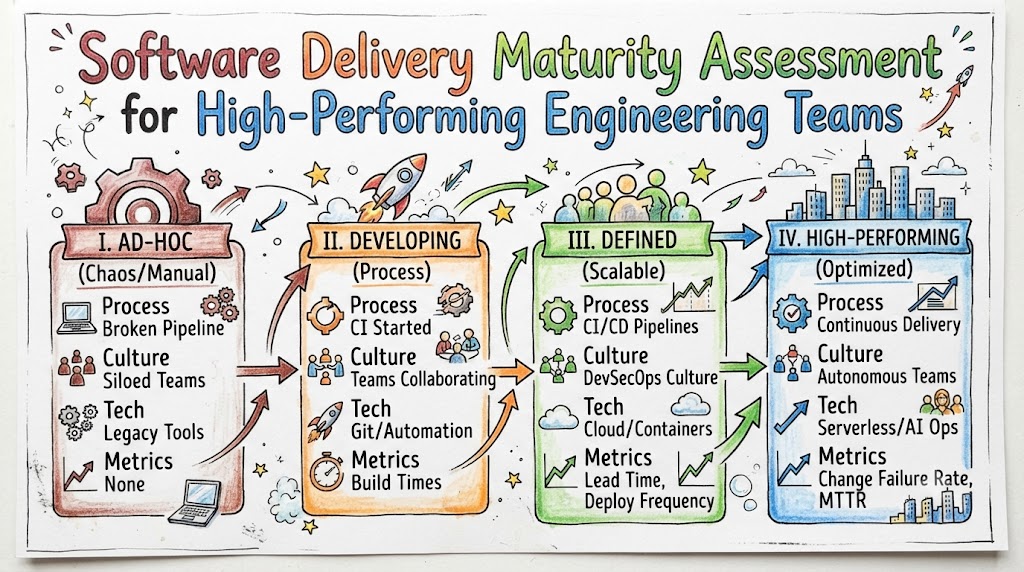
Engineering maturity typically progresses through several stages. Each stage reflects increasing levels of process standardization, automation, governance, and operational excellence.
| Maturity Level | Characteristics |
|---|---|
| Initial | Processes are informal and inconsistent |
| Managed | Basic workflows are documented |
| Defined | Standard engineering practices exist across teams |
| Automated | Extensive automation supports delivery |
| Optimized | Continuous improvement is data-driven and proactive |
Organizations rarely achieve maximum maturity across every domain simultaneously. The assessment identifies where each capability currently resides and where future improvements should be prioritized.
Evaluating Development Workflow Maturity
Development workflows form the foundation of software delivery. Poor planning, inconsistent branching strategies, unclear ownership, and limited collaboration often create delays throughout the development lifecycle.
A maturity assessment examines how engineering teams manage work planning, backlog refinement, sprint execution, code reviews, branching strategies, release planning, documentation, and knowledge sharing. Standardized workflows improve collaboration while reducing development inefficiencies and increasing engineering consistency.
Measuring Automation Across the Delivery Pipeline
Automation is one of the strongest indicators of engineering maturity. Manual processes introduce delays, increase human error, and reduce deployment consistency.
Assessment areas include:
- Automated builds
- Continuous integration
- Automated testing
- Security scanning
- Infrastructure provisioning
- Deployment automation
- Release approvals
- Configuration management
- Environment consistency
- Rollback automation
Higher automation maturity enables engineering teams to deliver software more frequently while maintaining reliability and reducing operational risks.
Assessing DevSecOps Integration
Security should be integrated throughout software delivery rather than treated as a final approval stage. Mature organizations embed security into every phase of development.
A maturity assessment evaluates secure coding practices, automated vulnerability scanning, dependency management, secrets management, compliance automation, infrastructure security, identity management, and security monitoring. Early security integration reduces vulnerabilities while improving release confidence and regulatory compliance.
Evaluating Engineering Governance
Governance ensures engineering teams follow consistent standards while maintaining operational flexibility. Strong governance balances innovation with accountability.
Assessment criteria include:
- Development standards
- Change management
- Architecture reviews
- Compliance controls
- Policy enforcement
- Risk management
- Documentation quality
- Audit readiness
- Release governance
- Operational accountability
Effective governance supports predictable software delivery without slowing innovation.
Measuring Operational Excellence
Software delivery extends beyond deployment. Mature engineering organizations continuously monitor software performance after release to ensure reliability and customer satisfaction.
Operational excellence assessment covers:
- System monitoring
- Observability
- Incident response
- Root cause analysis
- Service reliability
- Performance monitoring
- Capacity planning
- Disaster recovery
- Operational dashboards
- Continuous feedback
Organizations with strong operational maturity recover faster from incidents while continuously improving service quality.
Benefits of Conducting a Software Delivery Maturity Assessment
Engineering leaders gain significant advantages by periodically evaluating delivery maturity across the organization.
Major benefits include:
- Better engineering visibility
- Improved delivery predictability
- Faster release cycles
- Reduced technical debt
- Higher software quality
- Stronger governance
- Increased automation
- Better developer experience
- Improved collaboration
- Enhanced customer satisfaction
- Reduced operational costs
- Long-term engineering scalability
These benefits support sustainable software delivery rather than short-term process improvements.
Who Should Participate in the Assessment?
A maturity assessment delivers the greatest value when multiple engineering stakeholders contribute their perspectives.
Typical participants include:
- Chief Technology Officers
- Engineering Directors
- DevOps Leaders
- Platform Engineering Teams
- Software Architects
- Development Managers
- QA Leaders
- Security Engineers
- Site Reliability Engineers
- Infrastructure Teams
- Compliance Teams
- Product Managers
Cross-functional participation ensures the assessment reflects actual engineering practices rather than isolated viewpoints.
Best Practices for Improving Software Delivery Maturity
Organizations should treat maturity improvement as an ongoing journey rather than a one-time initiative.
Recommended best practices include:
- Standardize engineering workflows.
- Automate repetitive manual tasks.
- Embed security into development.
- Continuously measure engineering metrics.
- Encourage cross-functional collaboration.
- Reduce technical debt systematically.
- Improve deployment automation.
- Invest in developer enablement.
- Establish governance without excessive bureaucracy.
- Review maturity progress regularly.
Consistent improvement efforts create sustainable engineering excellence over time.
Frequently Asked Questions About Software Delivery Maturity Assessment
1. What is the primary purpose of a Software Delivery Maturity Assessment?
A Software Delivery Maturity Assessment helps organizations evaluate their engineering capabilities across planning, development, testing, security, deployment, operations, and governance. It identifies improvement opportunities and provides a roadmap for building more reliable, scalable, and efficient software delivery processes.
2. How often should organizations perform a maturity assessment?
Many organizations perform comprehensive maturity assessments periodically or after significant organizational, technological, or operational changes. Regular evaluations help measure progress, validate improvement initiatives, and ensure engineering practices continue evolving alongside business needs.
3. Does a maturity assessment focus only on DevOps?
No. While DevOps is an important component, the assessment covers the entire software delivery lifecycle, including governance, architecture, development workflows, quality engineering, security, infrastructure, operations, compliance, and continuous improvement.
4. Can smaller engineering teams benefit from maturity assessments?
Yes. Smaller teams often benefit by establishing standardized engineering practices early in their growth. A maturity assessment helps identify scalable processes that reduce future complexity while improving delivery consistency.
5. What outcomes should organizations expect after completing an assessment?
Organizations typically gain greater visibility into engineering strengths and weaknesses, prioritized improvement recommendations, better governance, increased automation opportunities, stronger collaboration, improved delivery performance, and a structured roadmap for continuous engineering excellence.
Final Thoughts
High-performing engineering organizations do not achieve excellence through automation alone. Sustainable software delivery requires consistent governance, standardized workflows, integrated security, operational visibility, continuous measurement, and a culture of ongoing improvement. A Software Delivery Maturity Assessment provides the structured framework needed to evaluate these capabilities objectively and prioritize improvements that align engineering performance with business goals.
Rather than viewing maturity as a fixed destination, organizations should treat it as a continuous evolution. By regularly assessing software delivery capabilities, strengthening engineering governance, expanding automation, and fostering collaboration across development, operations, security, and business teams, organizations can build resilient software delivery systems that support innovation, reliability, and long-term competitive advantage.

