
Introduction
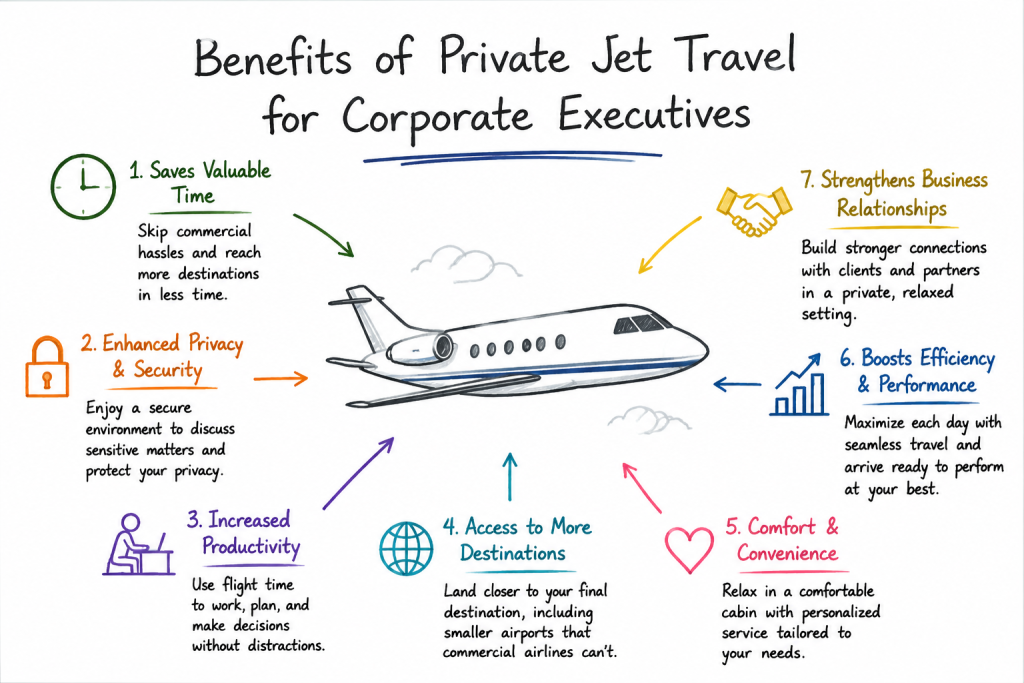
Private jet travel has become a strategic tool for corporate executives who need to maximize productivity, efficiency, and comfort while traveling for business. Unlike commercial flights, private jets allow executives to travel on-demand, maintain confidentiality, and reduce transit time significantly. These benefits translate into better decision-making, improved client relationships, and a stronger competitive advantage. For corporate leaders, private air travel is not just a luxury—it is an operational strategy that optimizes time and resources.
Real-world Use Cases
Executives often need to attend multiple meetings across different cities or countries within a single day. A CEO managing international projects can use a private jet to attend meetings in New York, Chicago, and Toronto without the delays associated with commercial flights. Similarly, sensitive negotiations, board meetings, or mergers benefit from the privacy and security offered by private aviation. By providing direct access to airports closer to clients or project sites, private jets allow executives to operate more efficiently and focus on strategic priorities.
Evaluation Criteria for Executives
When considering private jet travel, executives evaluate factors such as scheduling flexibility, flight range, cabin amenities, safety standards, and cost efficiency relative to time saved. Choosing the right private jet service involves balancing operational needs with travel goals, ensuring maximum productivity while minimizing stress and delays.
Key Benefits of Private Jet Travel
1- Time Savings
Private jets allow executives to depart on their own schedule, avoid long security lines, and fly direct routes, significantly reducing travel time compared to commercial airlines.
2- Flexibility
Flight plans can be adjusted at short notice, enabling executives to accommodate last-minute meetings, schedule changes, or multi-city itineraries with ease.
3- Increased Productivity
Cabins are equipped for work, allowing executives to conduct meetings, review documents, and make critical decisions during the flight. Travel time becomes productive work time rather than downtime.
4- Privacy and Security
Private jets provide a secure environment for confidential conversations, strategic planning, and sensitive business dealings, reducing the risk of information leaks.
5- Comfort and Well-being
Spacious seating, personalized services, and controlled cabin environments reduce fatigue, helping executives arrive refreshed and ready to perform at their best.
6- Networking Opportunities
Private travel often brings executives together in exclusive environments, facilitating collaboration, relationship-building, and informal networking.
7- Access to More Airports
Private jets can operate from smaller airports, closer to business centers or remote project sites, reducing ground transportation time and increasing operational efficiency.
8- Operational Reliability
With dedicated crews and on-demand scheduling, private jets minimize cancellations, delays, and missed connections, allowing executives to maintain continuity and meet tight deadlines.
Comparison with Commercial Travel
Commercial flights are often cost-effective for general travel but rarely meet the unique scheduling, privacy, and productivity needs of executives. Private jets provide direct access, flexible timing, and a controlled environment that enables leaders to make critical decisions without interruption.
Practical Tips for Executives
- Partner with reputable private jet operators for reliable service.
- Plan itineraries in advance but allow flexibility for changes.
- Factor in total travel costs, including ground transportation, to assess ROI.
- Use flight time efficiently for work, meetings, or rest to optimize productivity.
FAQs
1- Is private jet travel only for top executives?
Not necessarily. Companies of all sizes can use private charters for strategic travel when efficiency or confidentiality is critical.
2- How safe is private jet travel compared to commercial flights?
Private jets adhere to strict safety standards and regulations, often exceeding commercial aviation requirements.
3- Can executives work effectively on a private jet?
Yes. Cabins are equipped with Wi-Fi, workstations, and private spaces for calls, meetings, and document review.
4- Are last-minute flights possible?
Yes. One of the main advantages of private aviation is on-demand scheduling to accommodate urgent business needs.
5- Does private jet travel save time overall?
Absolutely. Direct flights, flexible schedules, and minimal check-in or security delays can save several hours per trip.
6- How does cost compare with commercial travel?
While upfront costs are higher, the time saved and productivity gained often outweigh commercial flight expenses.
7- Is privacy guaranteed on a private jet?
Yes. The controlled cabin environment ensures confidential conversations and secure travel.
8- Can private jets access smaller airports?
Yes. They can operate from airports inaccessible to commercial airlines, closer to clients or business sites.
9- Are there health benefits to private travel?
Reduced exposure to crowded terminals and the ability to control the cabin environment minimizes stress and fatigue.
10- Does private jet travel improve networking opportunities?
Yes. Exclusive environments allow executives to meet, collaborate, and build relationships in a professional yet informal setting.
Conclusion
Private jet travel offers corporate executives unmatched benefits in terms of time savings, flexibility, productivity, and operational reliability. By providing a secure, comfortable, and efficient travel solution, private aviation allows executives to focus on strategic decision-making and business growth. For leaders who value time, confidentiality, and seamless travel, private jets provide an essential tool for maintaining a competitive edge in today’s fast-paced business environment.

