Flying airplanes and exploring space are two of the most exciting career paths in the world. Every year, thousands of students search for clear answers on how to become an airline pilot or prepare for a future in space exploration. Understanding the exact steps, rules, and training options can feel confusing at first.
That is why educational platforms like AstroPilot – Astronaut & Pilot exist. AstroPilot provides clear career guides, aviation licensing explanations, and space science resources for students and beginners. In this guide, you will learn how pilot licences work, how astronaut preparation begins, and how flight simulators can support your early learning journey.
How to Become an Airline Pilot
Learning how to become an airline pilot starts with careful planning and steady training. Airlines look for safe, skilled, and disciplined pilots who can manage complex aircraft.
Basic Education and Medical Fitness
Most airlines require a high school diploma or equivalent qualification. Studying mathematics and physics helps you understand navigation, weather, and aircraft performance.
Before spending money on flight lessons, you must pass an aviation medical exam. Aviation authorities require a Class 1 medical certificate for airline pilots. A certified aviation doctor checks your vision, hearing, heart health, and overall fitness.
Step-by-Step Pilot Training Pathway
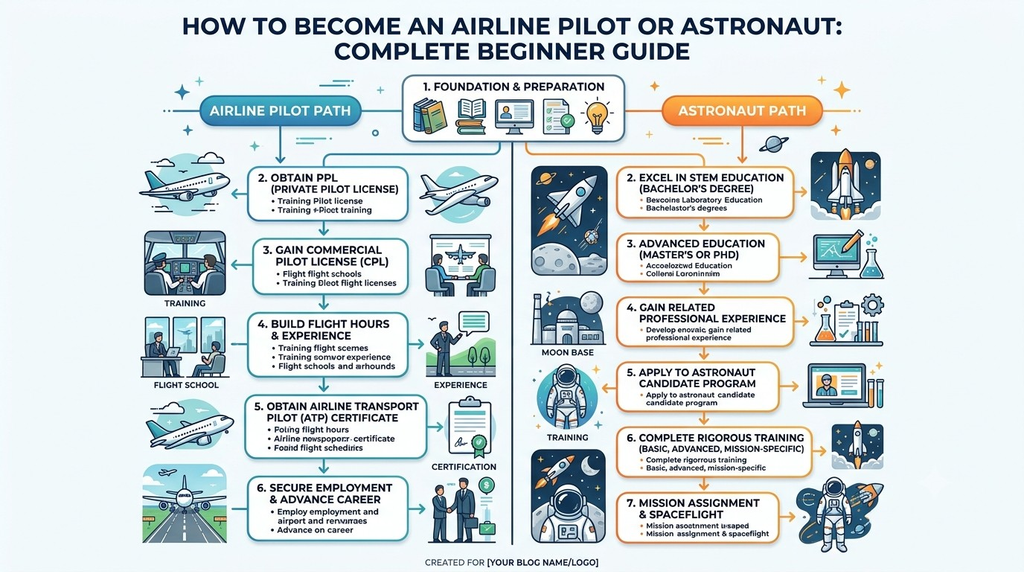
Becoming a professional pilot happens in clear stages:
- Earn a Private Pilot Licence (PPL): Learn basic flying skills and fly small single-engine planes.
- Build Flight Hours: Practice solo flying, cross-country navigation, and night flying.
- Add an Instrument Rating (IR): Learn to fly safely inside clouds using only cockpit instruments.
- Earn a Commercial Pilot Licence (CPL): Gain advanced skills required to get paid for flying.
- Earn a Multi-Engine Rating (ME): Learn to fly planes with more than one engine.
- Complete Airline Transport Pilot Licence (ATPL) Requirements: Reach the highest pilot certification level.
Airline Selection and Career Growth
Once you hold the right licences and flight hours, you can apply to regional or commercial airlines. Airlines test candidates using simulator checks, technical interviews, and teamwork exercises.
After getting hired, new pilots complete type-rating training for a specific airliner, such as a Boeing 737 or Airbus A320. You start as a First Officer (co-pilot) and later upgrade to Captain after gaining experience.
Important Note: Exact age limits, exam rules, and flight-hour requirements differ by country. Always check your local aviation authority, such as the FAA in the USA, DGCA in India, CAA in the UK, Transport Canada, or CASA in Australia.
Private Pilot License Requirements
A Private Pilot Licence (PPL) is the first major step for almost every pilot. It allows you to fly light aircraft for personal travel, fun, and skill building. However, a PPL does not allow you to fly passengers or cargo for pay.
Basic Eligibility and Medical Rules
Understanding private pilot license requirements helps you start without delays. In the United States, the Federal Aviation Administration (FAA) sets these core rules:
- Minimum Age: You can fly solo at age 16 and earn your PPL at age 17.
- Language: You must read, speak, write, and understand English.
- Medical Certificate: You need at least an FAA Third-Class medical certificate.
In countries like India (DGCA), the UK (CAA), and Australia (CASA), the minimum age for a PPL is also typically 17, though medical classes and exam formats differ.
Ground School, Flight Hours, and Exams
During ground school, you study aerodynamics, weather, air traffic rules, and navigation. You must pass a written knowledge exam before taking your final flight test.
Under FAA rules in the USA, you need at least 40 hours of total flight time (or 35 hours at an approved Part 141 school). Most students take 55 to 70 hours to feel fully ready. Your training ends with a practical flight test, called a checkride, with an examiner.
Commercial Pilot License Requirements
A Commercial Pilot Licence (CPL) allows you to work as a paid pilot. With a CPL, you can fly for charter companies, cargo operators, aerial survey teams, or become a flight instructor.
Key Qualifications and Flight Experience
Meeting commercial pilot license requirements demands higher precision and deeper knowledge than a PPL. Under FAA commercial pilot rules in the USA, applicants must meet several standards:
- Minimum Age: At least 18 years old.
- Prior Licence: Must already hold a Private Pilot Licence.
- Medical Fitness: Must hold a Second-Class medical certificate (First-Class is needed for airline jobs).
- Flight Hours: At least 250 total flight hours under FAA Part 61 rules, including specific cross-country and instrument time.
In other countries, minimum flight hours vary. For example, India (DGCA) and Australia (CASA) require 200 total flight hours for a CPL.
Exams, Ratings, and CPL vs. PPL
To earn a CPL, you must pass advanced written knowledge exams and demonstrate tight flight maneuvers during a checkride. Most commercial pilots also add an Instrument Rating and a Multi-Engine Rating to qualify for better jobs.
The biggest difference between a PPL and a CPL is legal privilege. A PPL is strictly for personal flying, while a CPL allows you to earn a living in the cockpit.
Pilot Training Programs in the USA
Many domestic and international students research pilot training programs in the USA because of good flying weather, busy airspace, and modern training fleets.
Types of Flight Training Routes
Students in the USA generally choose between three main training structures:
- Part 61 Flight Schools: Flexible training schedules. Great for students studying part-time or working while training.
- Part 141 Flight Schools: Structured, FAA-approved programs with strict syllabi. Often chosen by full-time students and international applicants.
- University Aviation Programs: Combine a college degree in aviation with flight training. Graduates may qualify for restricted airline minimums earlier.
Integrated vs. Modular Training
In an integrated program, you train full-time from zero experience to a Commercial Pilot Licence in about 12 to 18 months. In a modular program, you complete each licence step-by-step at your own pace and budget.
Planning Factors and International Students
Training costs vary widely based on aircraft rental rates, fuel prices, instructor fees, and how fast you learn. Never trust schools that promise guaranteed airline jobs.
International students planning to train in the USA must choose a SEVP-certified school to apply for an M-1 or F-1 student visa. You will also need security clearance through the TSA Flight Training Security Program before starting flight lessons.
Airline Transport Pilot License Requirements
The Airline Transport Pilot Licence (ATPL) is the highest level of aircraft pilot certification. Airlines require Captains—and in many countries, First Officers—to hold this qualification.
Experience and Multi-Crew Operations
Meeting airline transport pilot license requirements proves you can safely command large, complex passenger jets. In the United States, the FAA ATP guidelines require:
- Minimum Age: 23 years old for a full unrestricted ATP certificate.
- Medical Certificate: Valid First-Class medical certificate.
- Flight Experience: At least 1,500 total flight hours, including cross-country, night, and instrument hours.
- ATP CTP Course: Completion of an Airline Transport Pilot Certification Training Program, including full-motion simulator sessions.
Full ATPL vs. Restricted and Frozen Pathways
In the USA, graduates of approved aviation universities may qualify for a Restricted ATP (R-ATP) at 1,000 or 1,250 flight hours, or at age 21.
In Europe (EASA), the UK (CAA), and India (DGCA), students often earn a “Frozen ATPL.” This means you pass all ATPL theory exams and hold a CPL with Instrument and Multi-Engine ratings. Once you reach 1,500 flight hours in airline operations, the licence becomes “unfrozen.”
Pilot Licence Comparison
| Licence | Main Purpose | Typical Training Focus | Important Considerations |
| Private Pilot Licence (PPL) | Personal and recreational flying | Basic aircraft handling, navigation, and air safety | Does not allow paid commercial flying |
| Commercial Pilot Licence (CPL) | Entry-level professional flying | Advanced maneuvers, commercial rules, and precision | Requires higher medical class and more flight hours |
| Airline Transport Pilot Licence (ATPL) | Commanding commercial airliners | Multi-crew coordination, jet systems, and airline operations | Highest flight-hour and age requirements; rules vary by country |
How to Become an Astronaut
Exploring how to become an astronaut is a dream for many science and aviation fans. Space agencies look for adaptable experts who can live and work safely in extreme environments.
Education and Professional Background
Unlike airline pilots, astronauts come from many technical backgrounds. Agencies like NASA, the European Space Agency (ESA), and ISRO typically require:
- Master’s Degree in STEM: Engineering, biological science, physical science, computer science, or mathematics.
- Work Experience: At least two to three years of related professional experience after graduation, or 1,000 hours of pilot-in-command time in jet aircraft.
- Medical and Psychological Fitness: Astronauts must pass strict physical exams, vision tests, and mental resilience evaluations.
Selection Process and Competition
Astronaut selection is highly competitive. Thousands of qualified people apply for only a handful of spots every few years. Agencies test candidates on teamwork, leadership, communication under stress, and problem-solving skills.
Once selected, astronaut candidates spend about two years in basic training. They learn spacecraft systems, spacewalk skills, robotics, and survival training before getting assigned to a mission.
Astronaut Training for Students
You do not need to wait until adulthood to start preparing for space careers. Early astronaut training for students focuses on building strong academic habits, curiosity, and teamwork.
Building Strong STEM Skills
School and college students can build a solid foundation through focused study:
- Math and Physics: Focus on algebra, calculus, mechanics, and electricity.
- Computer Programming: Learn coding languages like Python or C++ to understand spacecraft software and data.
- Engineering Projects: Join robotics clubs, build model rockets, or design simple electronics.
Leadership, Fitness, and Space Programs
Space agencies value well-rounded people. Stay active through swimming, running, or team sports to build physical endurance. Learning how to scuba dive is also great practice for moving in a weightless environment.
Look for local science fairs, astronomy clubs, or NASA STEM student programs. While no single school course guarantees astronaut selection, these steps prepare you for engineering, science, or aviation careers.
Pilot Training vs Astronaut Training
Many beginners wonder about pilot training vs astronaut training. Both careers demand intense discipline, technical skill, and a strong focus on safety, yet their daily goals are very different.
Key Differences and Overlap
Pilots focus on flying aircraft safely through Earth’s atmosphere from one airport to another. Astronauts train to conduct scientific research, operate spacecraft, and survive in outer space for months at a time.
Having a military or test pilot background helps candidates who want to become spacecraft pilots or mission commanders. However, a pilot licence is not required for all astronauts. Scientists, doctors, and engineers regularly fly to space as mission specialists.
Pilot Training vs Astronaut Training
| Comparison Area | Pilot Training | Astronaut Training |
| Main Focus | Safe aircraft operation in Earth’s atmosphere | Space mission operations, research, and survival |
| Education | High school diploma minimum; aviation degrees optional | Master’s degree in STEM or extensive jet pilot experience |
| Practical Training | Light aircraft, multi-engine planes, and flight simulators | Spacecraft mockups, neutral buoyancy pools, and survival camps |
| Safety | Managing weather, air traffic, and aircraft systems | Managing life support, radiation, microgravity, and emergencies |
| Career Goal | Commercial airlines, cargo, charter, or flight instruction | National space agencies or commercial spaceflight missions |
Spaceflight Basics for Beginners
Understanding spaceflight basics for beginners makes rocket launches and space missions easy to follow. Spaceflight relies on simple laws of physics working at massive scales.
Thrust, Gravity, and Orbits
To reach space, a rocket must overcome Earth’s gravity. Rockets burn fuel and push hot gas downward at high speed. This creates an upward push called thrust.
Once a spacecraft reaches space, it must move sideways very fast—around 17,500 miles per hour (28,000 kilometers per hour)—to stay in orbit. At this speed, the spacecraft falls toward Earth at the exact same rate that Earth curves away beneath it. This creates continuous free fall, which astronauts experience as microgravity (weightlessness).
Spacecraft Systems, Stations, and Mission Control
Every spacecraft needs key systems to keep crews alive:
- Life Support Systems: Provide clean oxygen, remove carbon dioxide, and control cabin temperature.
- Heat Shields: Protect the capsule from extreme heat during re-entry into Earth’s atmosphere.
- Mission Control: A team of engineers on the ground who monitor spacecraft health and guide astronauts 24 hours a day.
Orbiting laboratories like the International Space Station (ISS) allow astronauts to live in space and test technologies for future trips to the Moon and Mars.
Best Flight Simulator Software for Student Pilots
Using the best flight simulator software for student pilots at home is a smart way to practice procedures and save money before real flight lessons.
Popular Simulator Options
Three main platforms stand out for home aviation learning:
- Microsoft Flight Simulator: Offers realistic global scenery and live weather. Great for practicing visual navigation and cross-country route planning.
- X-Plane: Known for accurate flight physics and realistic aircraft handling. Many flight schools use FAA-approved versions of X-Plane for instrument training.
- Prepar3D: Widely used for procedural training, commercial jet systems, and complex cockpit practice.
How Simulators Support Learning
Home simulators help students master cockpit layouts, radio navigation, checklists, and instrument scanning. Adding a basic joystick, throttle, and rudder pedals makes the practice much more realistic.
Flight Simulator Learning Features
| Feature | Learning Purpose | Student Benefit |
| Flight Controls | Practicing pitch, roll, and yaw coordination | Builds muscle memory before flying real planes |
| Navigation Tools | Using GPS, VOR beacons, and flight plans | Improves map reading and route awareness |
| Weather Settings | Testing crosswinds, clouds, and low visibility | Helps students understand weather impacts safely |
| Instrument Displays | Reading altimeters, airspeed, and attitude indicators | Builds confidence for future Instrument Ratings |
| Aircraft Systems | Practicing engine start, fuel checks, and checklists | Reduces cockpit stress during real lessons |
Important Limitation: Home flight simulator software is a great study aid, but it never replaces certified flight instruction. Flight hours logged on a home computer do not count toward official PPL, CPL, or ATPL requirements.
Common Mistakes and Their Solutions
Avoiding early mistakes saves students time, stress, and money when planning aviation or space careers.
- Ignoring Medical Eligibility Early
- Mistake: Paying for flight lessons before checking medical fitness.
- Solution: Pass your aviation medical exam before starting flight training.
- Choosing a Flight School Without Research
- Mistake: Picking the first school you see online without visiting.
- Solution: Tour multiple schools, inspect aircraft maintenance, and talk to current students.
- Underestimating Total Training Costs
- Mistake: Budgeting only for minimum legal flight hours.
- Solution: Add a 20% to 30% buffer for extra flight hours, exam fees, and study gear.
- Confusing PPL and CPL Privileges
- Mistake: Thinking a Private Pilot Licence lets you earn money flying.
- Solution: Remember that paid flying always requires at least a Commercial Pilot Licence.
- Ignoring Country-Specific Aviation Rules
- Mistake: Assuming a licence from one country automatically works everywhere.
- Solution: Check licence conversion rules if you plan to train abroad and work at home.
- Relying Only on Home Flight Simulators
- Mistake: Developing bad flying habits on a computer without an instructor.
- Solution: Use simulators to practice checklists and navigation, not to teach yourself basic flying.
- Assuming a Pilot Licence Guarantees an Airline Job
- Mistake: Expecting an immediate airline offer right after earning a CPL.
- Solution: Plan how you will build flight hours, such as working as a flight instructor.
- Believing One Degree Guarantees Astronaut Selection
- Mistake: Studying a subject you dislike just because you think space agencies require it.
- Solution: Choose a STEM field you genuinely love and aim to excel in your career.
Benefits of Learning About Aviation and Space Careers
Researching aerospace careers early gives students a major advantage. When you understand licensing steps, academic goals, and medical rules ahead of time, you avoid costly detours.
Early learning builds strong STEM foundations in math, physics, and problem-solving. It also teaches safety awareness, discipline, and clear communication—skills valued in every technical industry.
Educational publications like AstroPilot help students explore these complex subjects in plain English. By reading structured career guides and technical explainers, beginners can compare aviation pathways, explore spacecraft systems, and plan their education with confidence.
Practical Career Scenarios
Note: The following examples are fictional scenarios created for educational illustration.
Fictional Scenario 1: Planning an Airline Pilot Pathway
Maya is a 17-year-old high school student who dreams of flying commercial airliners. Before graduating, she takes a discovery flight at a local airport and passes her Class 1 aviation medical exam. She focuses on physics and math in school while reading beginner aviation guides on AstroPilot to understand the steps from PPL to ATPL.
Fictional Scenario 2: Comparing Flight Schools in the USA
Liam is a 20-year-old student researching flight training in the USA. Instead of enrolling immediately, he visits three Part 141 and Part 61 flight schools. He compares fleet size, instructor availability, weather delays, and transparent hourly rates before choosing a structured program that fits his budget.
Fictional Scenario 3: Preparing for an Astronaut Career
Arjun is a college freshman studying mechanical engineering. Interested in human spaceflight, he joins his university robotics team, learns Python programming, and earns his scuba diving certification. He knows astronaut selection is competitive, so he builds a strong engineering career while staying physically fit.
Fictional Scenario 4: Using a Simulator Before Real Lessons
Sofia wants to earn her Private Pilot Licence next year, so she sets up X-Plane on her home computer. Instead of doing stunts, she practices reading cockpit instruments, following pre-flight checklists, and flying basic traffic patterns. When she starts real lessons, she already understands basic cockpit terminology.
Frequently Asked Questions
1. What is the first step in how to become an airline pilot?
Start by researching your local aviation authority’s rules and passing a Class 1 aviation medical exam. This ensures you meet health, vision, and hearing standards before investing money in flight training. Afterward, enroll in a ground school and begin training for your Private Pilot Licence.
2. What are the basic private pilot license requirements in the USA?
Under FAA rules in the United States, you must be at least 17 years old, read and speak English, and hold a Third-Class medical certificate. You must also complete ground school, pass a written knowledge exam, log at least 40 flight hours, and pass a practical flight test.
3. How do commercial pilot license requirements differ from a PPL?
A Commercial Pilot Licence lets you get paid to fly, whereas a PPL only allows personal flying. In the USA, a CPL requires you to be at least 18 years old, hold a PPL, pass a Second-Class medical exam, log 250 total flight hours, and pass advanced flight tests.
4. How should students compare pilot training programs in the USA?
Compare FAA Part 61 and Part 141 schools based on aircraft maintenance, instructor-to-student ratios, local weather, and total program costs. International students must also verify that the school is authorized to issue M-1 or F-1 student visas and check TSA security clearance steps.
5. What are the main airline transport pilot license requirements?
In the USA, a full Airline Transport Pilot Licence requires you to be at least 23 years old, hold a First-Class medical certificate, and log 1,500 total flight hours. You must also complete an approved ATP Certification Training Program, pass written exams, and pass a multi-crew simulator check.
6. Do you have to be a pilot to learn how to become an astronaut?
No, a pilot licence is not mandatory for every astronaut. Space agencies like NASA and ESA select engineers, scientists, and medical doctors alongside test pilots. However, having jet pilot experience can help candidates who apply for spacecraft pilot or mission commander roles.
7. What is the best astronaut training for students in school or college?
Focus on STEM subjects like mathematics, physics, computer science, and engineering. Join robotics clubs, build science projects, and develop strong teamwork and leadership skills. Staying physically active and learning skills like scuba diving or coding also builds helpful habits for future aerospace careers.
8. What is the biggest difference in pilot training vs astronaut training?
Pilot training focuses on safely flying aircraft through Earth’s atmosphere, managing air traffic, and handling weather. Astronaut training prepares crews to live and work in outer space, operate spacecraft life-support systems, conduct scientific experiments, and handle emergencies in microgravity environments.
9. What are the most important spaceflight basics for beginners to learn?
Beginners should start by learning how rockets generate thrust to overcome gravity, how orbital speed keeps spacecraft in continuous free fall around Earth, and how life-support systems keep crews alive. Understanding spacecraft re-entry heat shields and Mission Control operations also helps explain how missions succeed.
10. What is the best flight simulator software for student pilots?
Microsoft Flight Simulator and X-Plane are two top choices for student pilots. X-Plane offers very realistic flight physics and instrument behavior, while Microsoft Flight Simulator provides detailed global scenery and live weather. Both help students practice checklists, navigation, and cockpit layouts at home.
11. Can home flight simulator hours count toward a real pilot licence?
No, flight hours logged on a standard home computer simulator do not count toward FAA or international pilot licences. Only certified aviation training devices approved by an aviation authority and supervised by a certified flight instructor can count toward official flight-hour requirements.
12. Does AstroPilot offer official pilot licences or flight training?
No, AstroPilot – Astronaut & Pilot is an educational publication, not a flight school or licensing authority. The platform provides beginner-friendly guides, career explanations, and technical articles to help students understand aviation pathways, astronaut preparation, and aerospace concepts before choosing official training providers.
Conclusion
Exploring how to become an airline pilot or prepare for a career in space starts with clear, accurate information. Whether you are comparing pilot licences, researching flight schools in the USA, practicing with flight simulator software, or building STEM skills for astronaut selection, every stage requires patience, discipline, and continuous learning. Because aviation rules and space agency standards differ across countries, always verify official requirements before making major training decisions. Educational resources like AstroPilot make this journey easier by breaking down complex aviation and spaceflight topics into simple steps, helping aspiring pilots and future space explorers plan their careers with confidence.