Introduction
Private charter travel offers flexibility, privacy, and convenient travel options. Passengers can choose suitable departure times and airports. They can also select aircraft based on their journey and travel needs.
However, convenience should never replace safety. Every charter flight involves an aircraft, a flight crew, an operator, and careful planning. Clients should understand these factors before confirming a booking.
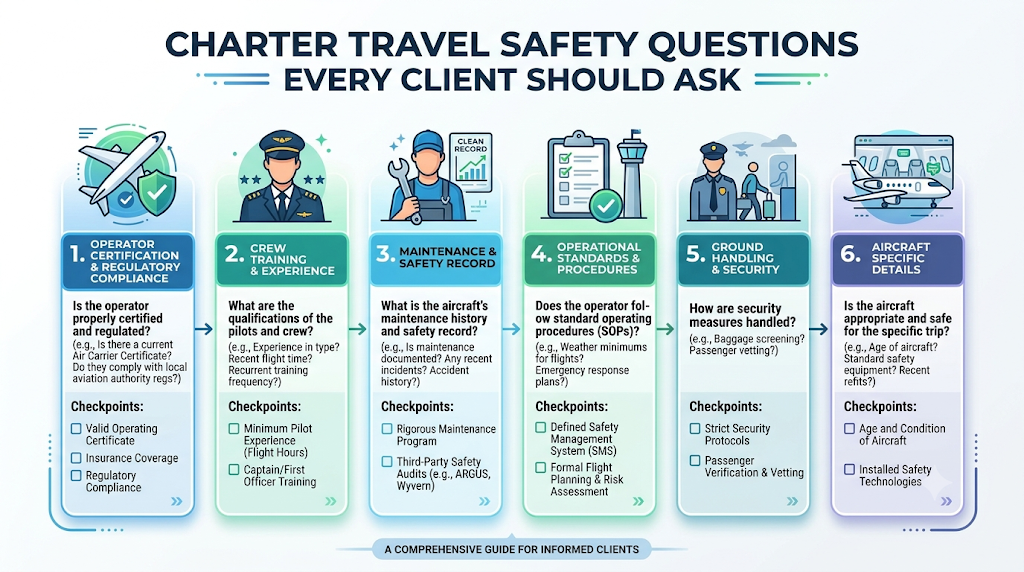
Asking the right questions can help passengers make informed decisions. It can also help them identify unclear information before paying for a flight.
Why Charter Travel Safety Questions Matter
Private charter flights operate under aviation rules that depend on the country and type of operation. These rules cover areas such as aircraft airworthiness, pilot qualifications, maintenance, and operational responsibilities.
Passengers should not assume that every company selling a charter flight operates the aircraft itself. A broker may arrange the journey through a separate aircraft operator.
This distinction matters because the actual operator is responsible for conducting the flight under its applicable approvals and procedures.
Before booking, clients should understand:
- Who will operate the flight.
- Whether the operator has the required authorization.
- Which aircraft is planned for the journey.
- Whether the flight crew holds suitable qualifications.
- How the aircraft is maintained.
- What passenger safety arrangements are provided.
- What happens if weather or technical conditions affect the flight.
The Federal Aviation Administration (FAA) provides passenger guidance through its Safe Air Charter program. It encourages passengers to research charter providers and confirm that flights are properly authorized.
1. Is the Charter Operator Properly Authorized?
This should be one of the first questions a client asks.
A company may advertise private jet services without directly operating aircraft. It may act as a broker or booking intermediary. Therefore, passengers should identify the company responsible for the actual flight.
Ask these questions:
- Are you the aircraft operator or a charter broker?
- Which company will operate my flight?
- Does the operator hold the required aviation authorization?
- Which aviation authority regulates the operation?
- Can you provide the operator’s certificate details?
- Can I independently verify those details?
A relevant operating certificate may have different names in different countries. For example, the United States uses specific FAA operating certificates for certain commercial charter operations. Other countries use their own approval systems.
The UK Civil Aviation Authority also advises passengers to identify the actual operator and check its authorization.
Why this matters: Booking through a familiar company does not automatically confirm that the flight operator has the required approval. Clients should verify the actual operating company.
Reference: FAA Safe Air Charter and UK Civil Aviation Authority Charter Guidance.
2. What Aircraft Will Operate the Flight?
Aircraft selection affects passenger capacity, baggage space, range, airport access, and travel comfort. It also determines which operating limitations and maintenance requirements apply.
Clients should request the planned aircraft type and relevant details.
Useful questions include:
- What aircraft type is assigned to my journey?
- Is it suitable for the planned route?
- How many passengers can it carry within approved limits?
- Is there enough baggage capacity?
- Does the aircraft meet the required airworthiness standards?
- Can the aircraft be changed after booking?
- How will I be informed about an aircraft substitution?
A light jet may suit a short journey with fewer passengers. A larger aircraft may be more suitable for longer routes or additional baggage.
However, aircraft size alone does not establish safety. The aircraft must be suitable for the route, weather, airport conditions, passenger load, and applicable performance requirements.
Why this matters: Clients should understand what aircraft they are booking and whether it matches their travel requirements.
3. How Is the Aircraft Maintained?
Aircraft maintenance supports safe and reliable operations. It includes inspections, scheduled servicing, repairs, and checks of important aircraft systems.
Maintenance requirements depend on the aircraft, its use, and the applicable aviation regulations.
Ask the operator:
- What maintenance program applies to the aircraft?
- Are required inspections and maintenance checks current?
- Who performs the maintenance?
- Are maintenance activities completed by appropriately authorized personnel?
- How are technical defects recorded and reviewed?
- What happens if a technical issue is identified before departure?
- What arrangements are available if the aircraft cannot operate?
Clients do not need to inspect maintenance records themselves. However, they can ask the operator to explain its maintenance arrangements.
A responsible operator should be able to describe its maintenance responsibilities clearly.
Why this matters: Aircraft airworthiness depends on proper maintenance and compliance with applicable requirements. A professional appearance cannot replace technical inspections.
The FAA provides information about aircraft and maintenance requirements for certain charter operations in its
4. Are the Pilots Properly Qualified?
Pilots are responsible for operating the aircraft safely. Their qualifications must match the aircraft and type of operation.
A pilot’s experience involves more than total flight hours. Relevant factors include licensing, aircraft type qualifications, training, proficiency checks, and recent operational experience.
Ask these questions:
- Are the pilots appropriately licensed?
- Do they hold the required aircraft ratings?
- Are their qualifications valid for this operation?
- Have they completed the required training and proficiency checks?
- Does the operator follow applicable crew duty and rest requirements?
- How does the company maintain pilot training?
For some aircraft, pilots need a specific type rating. This confirms that they have completed the required training and assessment for that aircraft type.
Clients should also understand that pilot qualification requirements differ across jurisdictions and operations.
Why this matters: A pilot must be qualified for the aircraft and operation being conducted. Clients should not rely on general experience claims alone.
5. Does the Operator Have a Safety Management Process?
A Safety Management System (SMS) is an organized approach to identifying and managing safety risks.
It helps an aviation organization understand possible hazards and improve its safety practices. Depending on the applicable rules, an operator may have specific SMS requirements.
Ask:
- Does the operator have a formal safety management process?
- How does the company identify operational risks?
- How are safety concerns reported?
- How are incidents and operational problems reviewed?
- How does the operator communicate safety improvements?
- Are employees trained in relevant safety procedures?
A well-organized safety process supports consistent decision-making. It also helps an operator identify problems before they become more serious.
Clients should avoid treating a safety policy or certificate as proof that an operation has no risk. No aviation operation can guarantee zero risk.
Why this matters: Safety management shows how an operator approaches risk, reporting, and continuous improvement.
6. How Does the Operator Handle Weather Conditions?
Weather can affect every stage of a charter journey. Conditions may change between departure and arrival.
Thunderstorms, strong winds, turbulence, icing, poor visibility, and airport conditions may affect flight planning.
Ask the charter provider:
- How is weather assessed before departure?
- Who reviews the weather information?
- What happens if conditions become unsuitable?
- Are alternate airports considered?
- Can the flight be delayed or cancelled for safety reasons?
- How will passengers receive updates?
- What happens if weather changes during the journey?
A responsible operator should not promise that every flight will depart at the planned time.
The pilot in command has important safety responsibilities. This includes making decisions about whether to continue, delay, or divert a flight under the applicable rules and procedures.
Why this matters: Weather decisions should be based on safety and operational conditions, not passenger schedule pressure.
7. What Passenger Safety Information Is Provided?
Passengers should understand the basic safety arrangements before departure.
A safety briefing explains important information about the aircraft and the procedures passengers should follow.
Ask:
- Will passengers receive a safety briefing?
- Where are the emergency exits?
- How should seat belts be used?
- What safety equipment is available?
- Are life jackets provided where required?
- Is oxygen equipment available where applicable?
- Are special passenger needs discussed before departure?
- Can the crew explain any relevant restrictions?
Different aircraft have different layouts and safety equipment. The briefing should match the aircraft assigned to the flight.
Passengers should listen carefully to the crew. They should also follow instructions during boarding, taxiing, takeoff, flight, and landing.
Why this matters: Knowing basic safety information helps passengers understand their responsibilities during the journey.
8. What Insurance Coverage Does the Operator Maintain?
Insurance is another important topic to discuss before booking.
Aviation insurance can cover different risks. These may include aircraft damage, passenger liability, and third-party liability.
However, coverage depends on the policy, applicable law, and contractual terms.
Ask:
- Does the operator maintain the required aviation insurance?
- Is passenger liability coverage included?
- Does the coverage apply to the planned operation?
- Can the operator provide relevant insurance confirmation?
- Are there any important exclusions or conditions?
- Should passengers arrange separate travel insurance?
Clients should distinguish between an operator’s aviation insurance and personal travel insurance.
Personal travel insurance may cover certain travel-related events. Its terms may not provide the same protection as an aircraft operator’s liability insurance.
Read the policy documents carefully. Ask the insurance provider or a qualified adviser about unclear terms.
Why this matters: Understanding insurance arrangements helps clients know what protection may apply and where additional cover may be needed.
9. Is the Aircraft Suitable for My Journey?
An aircraft may look suitable but still be unsuitable for a particular route or passenger requirement.
The operator must consider aircraft performance, passenger load, baggage, airport conditions, and weather.
Ask:
- Is the aircraft suitable for the planned route?
- Can it carry all passengers and baggage within approved limits?
- Are the departure and arrival airports suitable?
- Are there runway or airport restrictions?
- Are technical stops required?
- Can accessibility needs be accommodated?
- Are there any restrictions on special equipment or baggage?
Aircraft range is not simply a distance figure. It can change with passenger weight, baggage, weather, wind, routing, and other operating conditions.
The operator should assess the journey using appropriate aircraft performance information.
Why this matters: A suitable aircraft must meet the operational requirements of the complete journey, not just the passenger’s preferred travel distance.
10. Who Is Responsible for the Flight: Broker or Operator?
Charter bookings can involve more than one company. A broker may arrange the booking, while another company supplies and operates the aircraft.
Clients should understand these roles before making a payment.
Ask:
- Are you the direct aircraft operator?
- If you are a broker, which operator will conduct the flight?
- Can I receive the operator’s legal name and details?
- Who is responsible for operational decisions?
- Can the aircraft or operator change after confirmation?
- Will I receive written notice of important changes?
- Who should I contact if an operational issue occurs?
A booking confirmation should clearly explain the relevant parties and responsibilities.
If an aircraft substitution occurs, clients should request updated information about the aircraft and operating company.
Why this matters: Clear information reduces confusion and helps passengers know whom to contact.
The UK Civil Aviation Authority specifically advises passengers to check the actual operator rather than relying only on the company selling the flight.
11. What Happens During Delays, Diversions, or Cancellations?
Charter flights can change because of weather, technical issues, airport restrictions, or other operational reasons.
A responsible provider should explain how it communicates these changes.
Ask:
- How will I receive delay updates?
- What happens if the aircraft develops a technical issue?
- Can another suitable aircraft be arranged?
- What happens if the flight must divert?
- Who assists passengers during an unexpected delay?
- What are the cancellation and rebooking terms?
- How are refunds handled under the booking agreement?
Safety-related decisions must remain separate from commercial promises.
For example, a passenger may prefer to depart at a particular time. However, the operator and flight crew must consider the actual operating conditions.
Clients should review cancellation and refund terms before payment. These terms may differ between providers and contracts.
Why this matters: Understanding possible changes helps passengers prepare for unexpected travel arrangements.
12. What Are the Warning Signs of an Unclear Charter Arrangement?
Not every unanswered question indicates an unsafe operation. Sometimes a provider needs time to obtain information from the actual operator.
However, certain situations deserve further investigation.
Pay attention if:
- The company refuses to identify the actual aircraft operator.
- Required authorization details remain unclear.
- The provider cannot explain who controls the flight.
- Aircraft information changes without proper communication.
- Pilot qualification questions receive vague answers.
- Maintenance arrangements cannot be explained.
- Insurance information is unavailable.
- Safety concerns are dismissed.
- You are pressured to accept an arrangement without clear documentation.
Do not make a booking based only on attractive aircraft photographs or low prices.
Take time to verify important details through the relevant aviation authority. If a provider cannot answer basic questions, consider seeking independent advice before proceeding.
13. Complete Charter Travel Safety Checklist
Use this checklist when discussing a charter booking with a provider.
| Safety area | Questions to confirm |
|---|---|
| Operator authorization | Who operates the flight, and what approval applies? |
| Aircraft details | What aircraft type is assigned? |
| Aircraft maintenance | Are required inspections and maintenance current? |
| Pilot qualifications | Are the pilots qualified for the aircraft and operation? |
| Safety management | How are operational risks identified and reviewed? |
| Weather planning | How are weather changes and alternate airports handled? |
| Passenger safety | Will passengers receive an aircraft-specific safety briefing? |
| Insurance | What aviation insurance does the operator maintain? |
| Aircraft suitability | Can the aircraft meet route, passenger, and baggage requirements? |
| Broker transparency | Is the booking company the operator or an intermediary? |
| Delays and cancellations | What happens when operational conditions change? |
Keep written answers and booking documents together. This makes it easier to review the information before confirming the journey.
14. How to Compare Charter Providers Responsibly
Price and convenience are useful comparison factors. However, they should not be the only factors.
Clients can compare providers using a few practical criteria.
| Comparison factor | What to look for |
|---|---|
| Transparency | Clear operator and aircraft information |
| Authorization | Verifiable regulatory approvals |
| Maintenance | Clear maintenance responsibilities |
| Crew qualifications | Relevant licensing and training |
| Safety communication | Clear explanations of operational procedures |
| Weather planning | Responsible decisions about unsuitable conditions |
| Passenger support | Clear safety briefings and assistance |
| Insurance | Appropriate coverage information |
| Booking terms | Written details about changes and cancellations |
Do not assume that the most expensive provider is automatically the safest. Similarly, a low price does not prove that an operator is unsuitable.
Focus on verifiable information, clear responsibilities, and the operator’s ability to explain its safety arrangements.
Frequently Asked Questions
1. What should I check before booking a private charter flight?
Check the actual aircraft operator, relevant authorization, aircraft details, maintenance arrangements, pilot qualifications, insurance information, and passenger safety procedures. Ask for clear written information before confirming the booking.
2. How can I verify whether a charter operator is authorized?
Identify the company operating the flight. Then check its details through the relevant national aviation authority. Verification methods differ between countries.
3. Should I ask about pilot experience before booking?
Yes. Ask whether pilots hold the required licenses, aircraft ratings, and training. You can also ask how the operator manages proficiency checks and crew duty requirements.
4. How do charter companies maintain aircraft safety?
Operators follow applicable maintenance programs, inspections, airworthiness requirements, and technical procedures. Authorized maintenance personnel perform work according to the relevant rules and approved documentation.
5. What insurance should a charter operator have?
The operator should maintain insurance required for its operation and jurisdiction. Ask about aircraft and passenger liability coverage. Review the relevant policy information rather than assuming every policy offers identical protection.
6. Can a charter flight be delayed because of weather?
Yes. Weather may affect departure, arrival, routing, or the availability of suitable airports. The flight crew must make decisions based on safety and applicable operating procedures.
7. What is the difference between a charter broker and an aircraft operator?
A charter broker arranges a flight for a client. An aircraft operator is responsible for conducting the flight. Sometimes one company performs both roles, but clients should confirm this before booking.
8. What safety information should passengers receive before departure?
Passengers should receive an appropriate safety briefing. It normally covers seat belts, exits, safety equipment, and relevant passenger instructions for the aircraft.
9. Can I request details about the aircraft assigned to my trip?
Yes. Ask for the planned aircraft type and relevant booking details. Also ask how the company will communicate any aircraft substitution.
10. What should I do if an operator cannot answer my safety questions?
Request clarification and supporting information. Verify important details with the relevant aviation authority. Avoid confirming the booking until you understand who will operate the flight and what arrangements apply.
Conclusion
Charter travel offers flexibility, but informed decisions remain essential. Clients should ask clear questions about the operator, aircraft, pilots, maintenance, insurance, and passenger safety. They should also understand how weather, technical issues, and other operational changes may affect a journey. A transparent provider should explain its responsibilities and answer reasonable safety questions. Before confirming any charter booking, take time to verify the details and review the agreement. A well-informed passenger is better prepared to make a responsible travel decision.